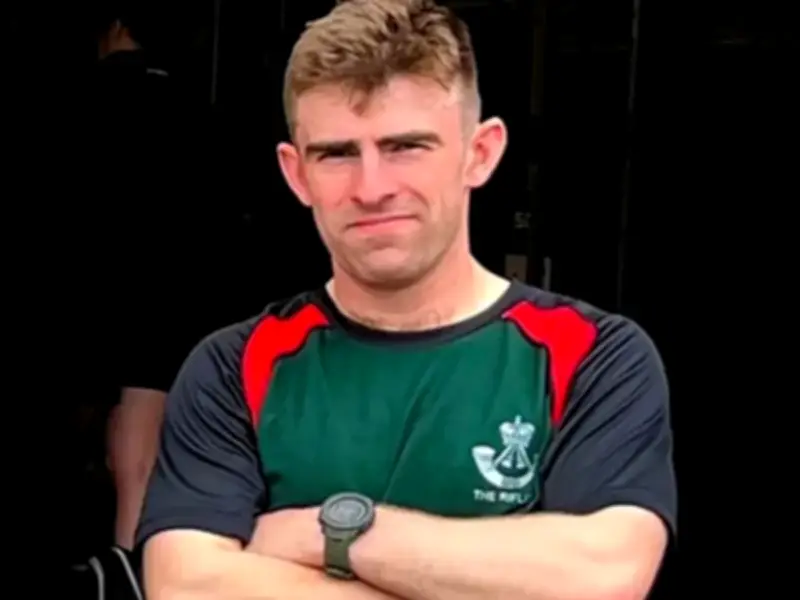
A 26-year-old Army officer was killed instantly when a reversing Warrior armoured vehicle struck him during a training exercise on Salisbury Plain, an inquest has heard. Second Lieutenant Max George, from County Durham, died after exiting the vehicle in June 2022.
Wiltshire and Swindon Coroner’s Court was told that the vehicle’s rear door safety alarm, designed to alert the driver when the doors were open, had been faulty since 2018. Lt George was fatally injured after the Warrior’s commander ordered a reverse at speed without realising he was still exiting.
Faults Known Since 2018
Members of 5 Rifles were taking part in Exercise Combat Spirit when the incident occurred. Lieutenant Colonel Graham Watson, who led a service inquiry, said alarms were installed after two fatal incidents in the 1990s.
Col Watson said several faults with the Warrior were known, but none meant the vehicle should have been taken out of service. “One was the rear door alarm cable had snapped, which was first identified on June 20 2018,” he said. “The second one was the rear door locking plunger would not release and is stuck, which meant that the rear doors could not be locked in position. The third fault was the repetition of the first fault that the rear door alarm cable was snapped and required renewing or repairing.”
Order to Reverse
The inquest heard two groups of soldiers were converging on a target and Lt George was ordered to take command on the ground. As the Warrior halted, the gunner threw a smoke grenade and Lt George was ordered to exit.
“Lt George exited the vehicle and was seen momentarily struggling either with a day sack or trying to free a radio antenna which may have snagged,” Col Watson said. “He then went to grab his weapon which was still inside the vehicle and simultaneously the student commander commanded the gunner to reverse the turret to the right in the direction of the enemy.”
Col Watson added: “The student commander checked through the periscopes and could no longer see the open doors, or Lt George at the rear of the vehicle. Believing Lt George was clear the student commander commanded the driver to reverse. Lt George was still at the rear reaching for his weapon. He was knocked to the ground.”
Warning Attempts
Col Watson said between 38 and 43 seconds elapsed between the Warrior stopping and the collision. “There were several attempts by those who witnessed the accident to warn of the impending danger, people shouted, waved their hands, sounded their horn, unfortunately to no avail,” he said.
Lt George’s exit created a “clunking noise”, which may have led the commander to assume he was clear and had shut the doors. “The built in alarm would have alarmed because the rear doors were open, and had that gone off the driver would have almost certainly stopped,” Col Watson said. “In addition on the driver’s instrument panel, because the rear doors were open there should have been a light, but again because the wiring loop was damaged that didn’t light up.”
Flawed Safety Case
The exercise used two types of Warrior – the FV-510 and FV-511 models – and Lt George’s vehicle was not ordinarily used for disembarking troops and close combat. Col Watson said the student commander had done most of his training on the FV-510, and crew and service personnel in 5 Rifles were not familiar with the FV-511.
The service inquiry found two causal factors, 22 contributory factors, and 22 other factors in Lt George’s death. Col Watson said: “The fact a rear door safety alarm had been fitted to rectify issues discovered in 1998 and 1999 was right and proper, but the fact there was not a maintenance regime that ensured that alarm worked was a flaw and a safety case. It was not a high priority. It was not a conscious decision to make it a ‘fully fit’ fault. I personally believe it was an oversight not to make it a limited role or a not task worthy role. It was a flawed safety case.”
The inquest continues.