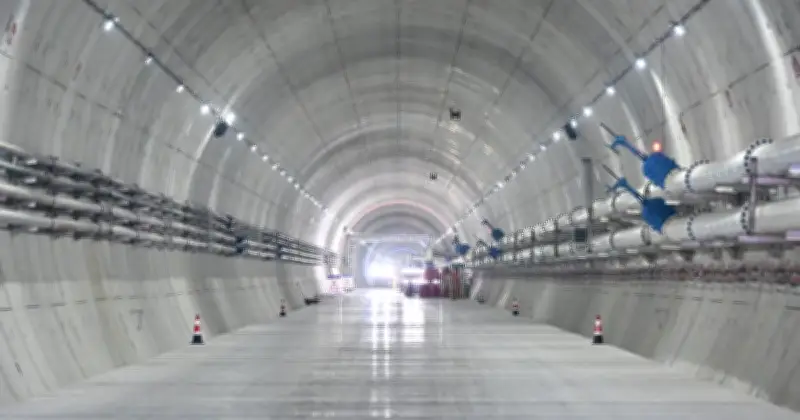
China's ambitious Yongzhou Railway project, costing an estimated £3.2bn, will feature the world's longest underwater railway tunnel, reducing a two-hour commute to just 26 minutes. The line is expected to be operational by 2028.
Project Overview and Route
The project was first proposed in 2005, with Beijing approving the plans in 2018. Construction began in November 2022. The railway will connect Ningbo, a city south of Shanghai, to the islands at Zhoushan, an archipelago on China's east coast. One aim is to create a two-hour commute zone within Zhejiang Province.
The 47.8-mile railway route includes a 10-mile undersea section, making it the longest underwater railway tunnel in the world. The Yong-Zhou Railway will connect Ningbo East Station and Zhoushan (Baiquan) Station, with high-speed trains reaching 250 kilometres per hour.
Journey Time Reductions
The new route will take passengers from Hangzhou, the capital of Zhejiang Province, to Zhoushan in 77 minutes. Currently, the same journey takes four-and-a-half hours by bus or two-and-a-half hours by car. The trip between Ningbo and Zhoushan will take just 26 minutes, compared to two hours by bus and up to 90 minutes by car.
The project will involve seven stations along the path between Ningbo and Zhoushan, including four new ones and three being redeveloped. A bridge will also be built to link parts of the archipelago.
Engineering and Technology
Dong Bing, chief mechanical engineer of the Yongzhou Railway project, provided an update this month. He spoke about the 135-meter-long tunnel-boring machine currently operating some 93 metres below the seabed. The large-diameter machine, called Yongzhou, helps drill through mountainous regions and subterranean landscapes. Its developers say it is "more sensitive than humans" in detecting anomalies during the digging process.
Mr Bing said: "Some problems are impossible to detect through human inspection. You might walk by and everything seems fine, but a second later, a problem arises. The system can also collect data, identify related conditions, and analyze potential causes. This is a huge help for safety."
Hao Weiqi, deputy director of the High-End Equipment Industry Technology Research Institute at China Railway Construction Corp, told Global Times: "We can tailor the machines to specific underground environments, while simultaneously providing integrated solutions that combine equipment, intelligent systems, and technical services throughout the entire construction process."
Completion and Investment
Once the tunnel boring machine has completed 83% of the excavation, it will meet the second tunnel boring machine called Dinghai, resulting in the tunnel, located 93 metres below the Ningbo seabed, being close to completion. The project, backed by an investment of 27bn yuan (approximately £3.2bn), is expected to be finished in 2028.