
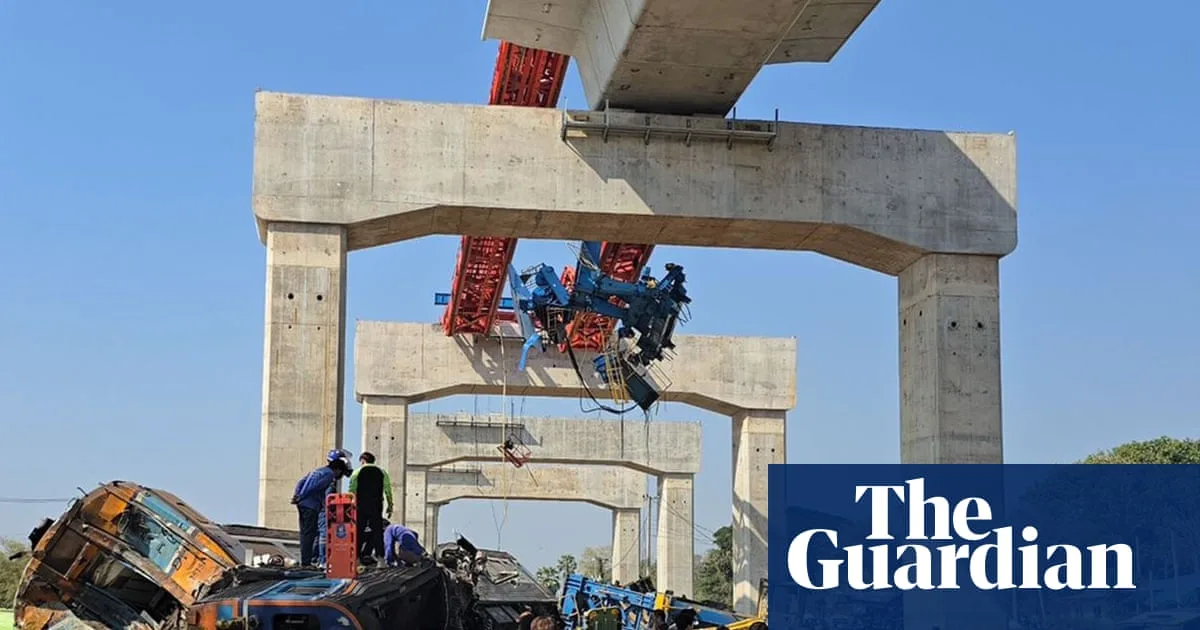
At least 32 people have been killed and scores injured after a crane collapsed on to a passenger train in Thailand, causing it to derail, officials have said. The incident occurred in Nakhon Ratchasima province, north-east of Bangkok, as the train was travelling from the capital to Ubon Ratchathani province.
Footage from the scene verified by Agence France-Presse showed the crane’s broken structure resting on giant concrete pillars, with smoke rising from the wreckage below. Rescuers worked to extract passengers from the tilted carriages. Mitr Intrpanya, a 54-year-old local resident, said: “At around 9am I heard a loud noise, like something sliding down from above, followed by two explosions. The metal from the crane appeared to strike the middle of the second carriage, slicing it in half.”
The health ministry reported 64 people were hospitalised, seven in a serious condition. The transport minister, Phiphat Ratchakitprakarn, said 195 people had been on board and authorities were working to identify the dead. The district police chief, Thatchapon Chinnawong, said the rescue operation was temporarily paused because of a “chemical leakage” at the scene.
Work on the $5.4bn (£4.4bn) high-speed rail project, backed by Beijing, aims to connect Bangkok to Kunming in China via Laos by 2028 as part of China’s belt and road infrastructure initiative. The train was passing a construction site when the crane collapsed.
The prime minister, Anutin Charnvirakul, said authorities must determine the cause of the crane collapse and hold anyone responsible to account. “These kind of incidents happen very regularly. I have heard that it is the same company [involved as in previous accidents]. It is time to change the law to blacklist construction companies that are repeatedly responsible for accidents,” he told reporters in Bangkok.
Industrial and construction site accidents are common in Thailand, and lax enforcement of safety regulations can lead to deaths. The country has about 3,100 miles of railway, but the run-down state of the network has long driven people to favour travel by road.




