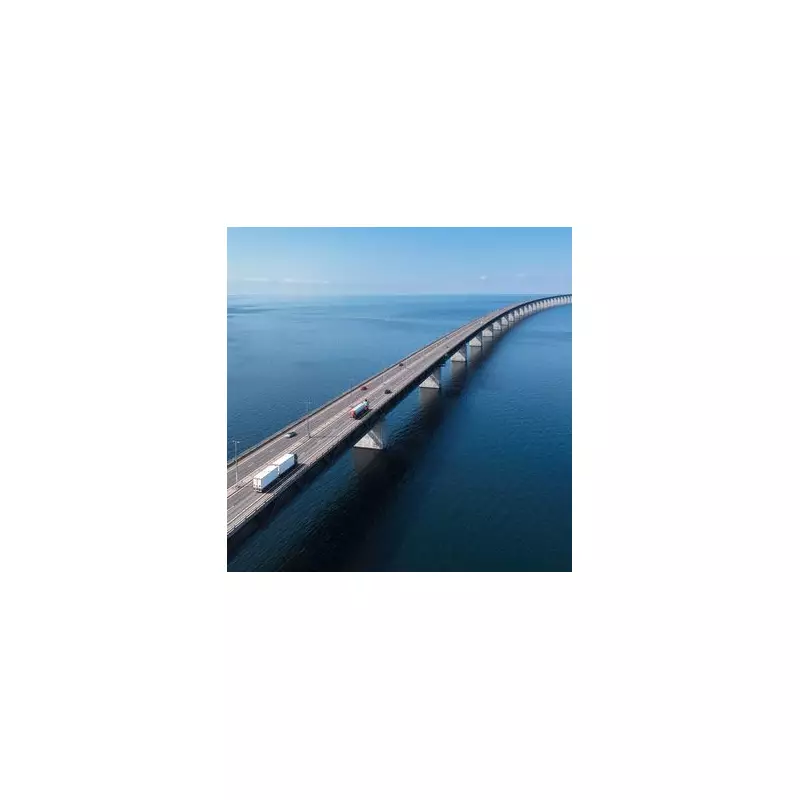
For more than two decades, a monumental feat of engineering has silently reshaped the geography and economy of Scandinavia. The Øresund Bridge, a combined railway and motorway link, has been connecting Sweden and Denmark since July 2000, serving as a vital artery for trade, tourism, and daily commuters.
A Colossal Engineering and Financial Undertaking
Construction on this ambitious project began in 1995, a collaboration between the Swedish company Svedab and the Danish firm A/S Øresundsforbindelsen. The final structure came with a staggering price tag of approximately £3.4 billion. This immense investment is projected to be fully recouped by the year 2037, financed through the tolls paid by the thousands who use it every day.
The bridge itself stretches for 8 kilometres from a point near the Swedish city of Malmö, reaching the artificial Danish island of Peberholm in the middle of the Øresund Strait. The journey does not end there. From Peberholm, which acts as a crucial junction, a tunnel completes the link to the island of Amager, home to Copenhagen Airport. The total travel distance from Sweden to Denmark via this route is around 16 km.

Daily Life and the Cost of Crossing
The bridge is far from a white elephant; it is a bustling thoroughfare integral to regional life. On an average day, around 70,000 people make the crossing. However, using this direct link comes at a significant cost. Toll fees are tiered based on vehicle type:
- Motorcyclists pay £25.68.
- Standard passenger cars are charged £50.77.
- Vans, motorhomes, or cars with a trailer face a fee of £178.55.
Peberholm island is equipped with essential infrastructure, including a motorway exit for authorised vehicles only and a helicopter landing pad to facilitate emergency responses in case of road accidents.
Recognition and Place in European History
The bridge's engineering excellence was formally recognised just two years after its opening when it received the prestigious IABSE Outstanding Structure Award. In terms of scale, it holds the title of the second-longest bridge in Europe. It is surpassed only by the 18.1-kilometre Kerch Bridge, which connects the Taman Peninsula of Krasnodar Krai in Russia with the Kerch Peninsula of Crimea.
Now in its 25th year of operation, the Øresund Bridge stands as a powerful symbol of cross-border cooperation. It has effectively shrunk the distance between two nations, fostering economic integration and cultural exchange, proving that even the most challenging natural barriers can be overcome with vision and investment.