Project Revived After Funding Issues
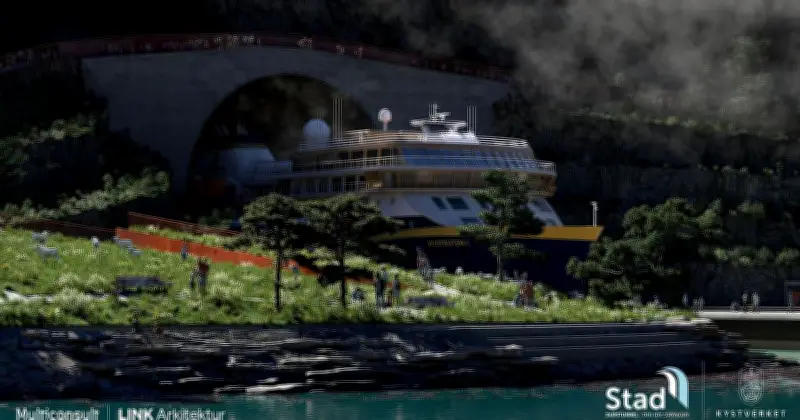
Norway has given the green light for the world's first full-size ship tunnel, the Stad Ship Tunnel, with a staggering budget of £671 million for a distance of just over one mile. The project, which connects the Moldefjord and Kjødepollen fjords on the Stadlandet Peninsula, spans 1.7 kilometers (1.06 miles) internally, extending to 2.2 kilometers (1.4 miles) including entrance structures. Construction is scheduled to begin in 2027 and is expected to be completed by 2032, pending final parliamentary approval of the budget.
Why Build a Ship Tunnel?
The Norwegian Coastal Administration, which leads the project, aims to create a safe alternative route to bypass the Stadhavet Sea, classified as one of the most dangerous maritime areas in the world. This body of water is the most windswept part of Norway's coastline, experiencing storms around 100 days each year. These treacherous conditions cause severe delays, logistical issues, and pose risks to passenger ferries, fishing fleets, and cargo ships. The tunnel will provide a sheltered passage large enough for regular traffic, including fishing boats, ferries, and cruise ships.
Technical Specifications and Cost
The tunnel will measure 50 meters from ceiling to floor and 36 meters wide, engineered to accommodate ships of up to 16,000 gross tonnes. Sailing through the tunnel at a speed limit of five to eight knots (approximately 5.75 to 9.21 miles per hour) will take about 10 minutes. Unlike the Rogfast road tunnel—Norway's deepest and longest subsea road tunnel—the ship tunnel will be toll-free, offering free passage to all vessels.
Economic and Practical Benefits
Norwegian authorities anticipate the tunnel will boost the nation's shipping industry by eliminating weather-related delays. Tore O. Sandvik, county mayor in the Trøndelag region, highlighted the practical impact: "If we are to export salmon from Trøndelag to the continent, we cannot risk the salmon getting stuck at Stad in bad weather. Then it is served as rakfisk [Norwegian Fermented Fish], and not as sushi when it arrives on the continent." The project was initially approved by the Norwegian parliament in 2021 but was shelved last year due to skyrocketing costs. It has now been revived after the government approved a revised budget, and the Norwegian Coastal Administration is assessing bids from contractors, with heavy excavation and blasting expected to begin early next year.