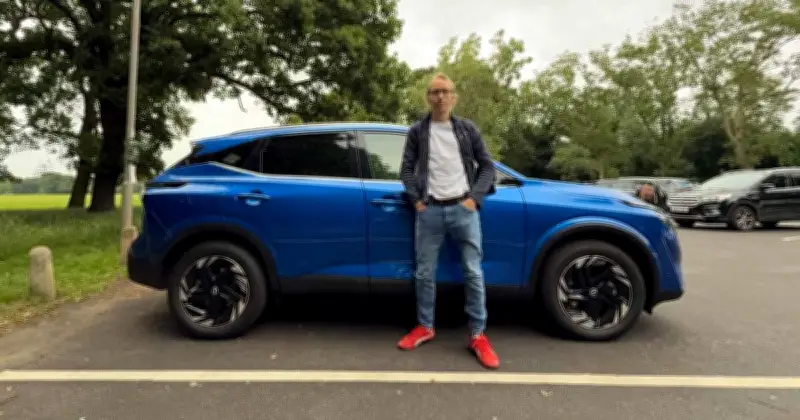
Christopher Sharp got behind the wheel of the Nissan Qashqai to mark the popular SUV's 20th birthday. The car, which debuted in 2006, has become a staple of British roads and is currently the fourth most popular car in the UK with 23,102 models sold in 2026 so far, according to the Society of Motor Manufacturers and Traders (SMMT). Only the Ford Puma, Kia Sportage and Jaecoo 7 have sold more.
The Numbers
The test car was the N-Connecta e-Power 205 PS Automatic 2WD version of the Qashqai SUV. This means the car is two-wheel drive and has a hybrid system. It has five seats, a 1.5-litre three-cylinder engine, an automatic gearbox, and a big boot.
The car, which weighs around two tonnes, has a boot capacity of around 500 litres with the seats up and just under 1,500 litres with the seats folded down. It is two metres wide and nearly four and a half metres in length. The magnetic blue colour, as specced, cost £38,825.
Why It's Important
The Nissan Qashqai is important because it really started off the SUV revolution in the UK. Yes, Porsche and BMW had been out and about with the Cayenne and X5 for a few years, but this was one of the first times someone without a massive wallet could afford a good quality SUV.
The British public, and much of the world where Nissan sold the car, fell in love with the Qashqai. Today, SUVs dominate Britain’s roads with brands of all price levels developing SUVs of all shapes and sizes. There are even awards for best small SUV, best medium-sized SUV, and best large SUV. The Nissan was part of that, and it started in 2006.
What It's Like on the Inside
The Nissan’s interior is, like those of many manufacturers, at a bit of a crossroads. They are starting to realise that not everyone wants to do everything via a touchscreen. So there is an array of physical controls across the steering wheel – no haptic touch pads here – and it is rare that you have to reach across and use the touchscreen.
As you would expect from a family SUV, there are plenty of cubby holes and a few USB-C charging points for your various phones and devices. There is a wireless charging pad, but I would avoid using that because, like pretty much every one I have used in the past, it really rather warms up your phone too much. Plug it into the USB-C instead.
Once you are used to the controls and how to get it set up to your liking, it is pretty easy to use and get on. It is not as good as others, but definitely in the top half of the cars I have driven this year when it comes to getting up and running.
What It's Like to Drive
Like many hybrids, it has regenerative braking. This is where you lift off the throttle, the car brakes, and generates electricity that gets sent back into the battery. Just like the Toyota Prius, but to a lesser extent than the Prius, you can adjust this somewhat.
It can be quite sensitive, but this means you as the driver have to improve yourself, be more sensitive when coming off throttle into a corner, feel when the regen is coming in, then react as you come out of it onto the brakes. This will benefit not just the car’s balance, but make the ride smoother for any passengers in the car.
The car, as an SUV, will never be sportscar slick, but if you take that into account it is neutral. Compared to other cars in the SMMT’s top five best-selling cars, it is fairly decent. It rolls a lot less than the Ford Puma, gives you more feel than the Jaecoo 7, and its hybrid system feels more refined than the Kia Sportage.
It is no Audi in the steering department, but you get enough communication for you to guide the car through a B road corner. You are never going to push this, but the engine is responsive, and the suspension is comfortable; you never feel the need to put it in sport mode.
Verdict
It is a sensible car with a big boot, plenty of headroom in the back for children or adults, and it is efficient too. You can see why Nissan has kept building it for 20 years and will keep building it until the SUV bubble bursts.
Christopher’s Verdict: 7.5/10