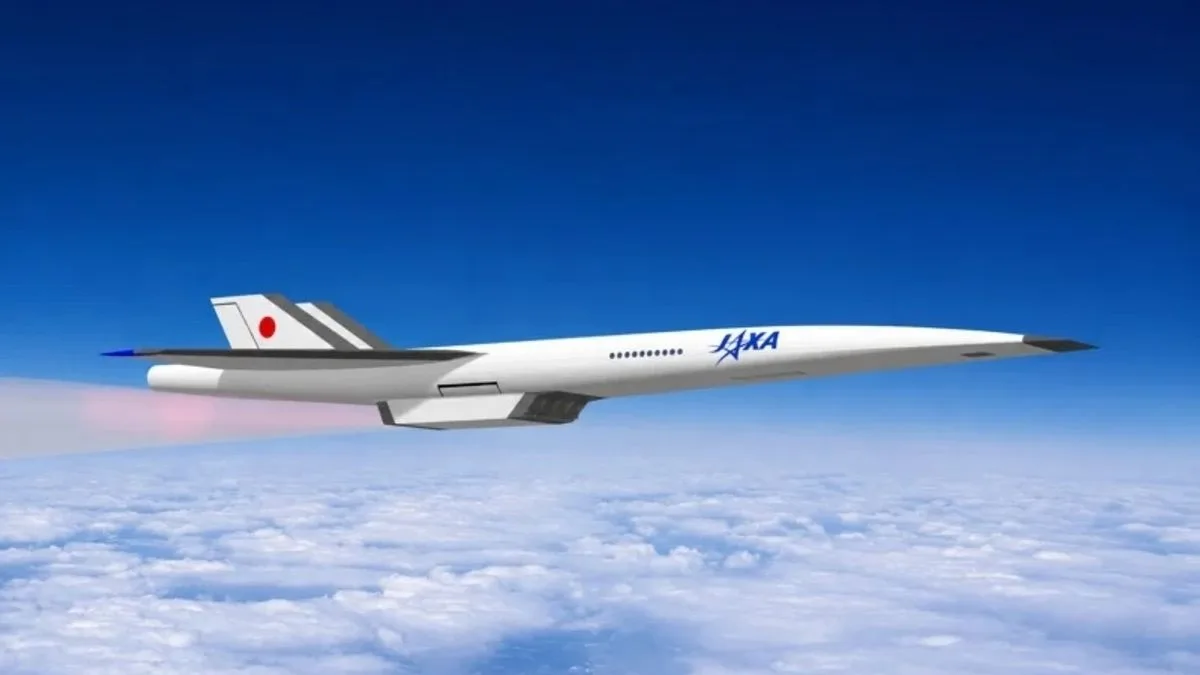
Japan Unveils Hypersonic Jet 2.5x Faster Than Concorde
Japan's Hypersonic Jet 2.5x Faster Than Concorde

Japan has unveiled a hypersonic passenger jet concept that could travel two and a half times faster than the iconic Concorde. The Japan Aerospace Exploration Agency (JAXA) recently conducted a successful test of an experimental aircraft inside a ramjet engine testing facility at its Kakuda Space Center in Miyagi Prefecture.

Breakthrough Hypersonic Test

Researchers simulated flight conditions at Mach 5, approximately five times the speed of sound. This far exceeds the Concorde's top speed of Mach 2 (around 1,400 mph). The trial validated the aircraft's thermal protection system, control surfaces, and ramjet combustion performance under extreme hypersonic conditions.

Such tests are critical, as temperatures around the aircraft can soar close to 1,000 degrees Celsius at that speed. The next phase may involve mounting the experimental aircraft onto a sounding rocket for a real-world Mach 5 flight demonstration.

Wide Pickt banner — collaborative shopping lists app for Telegram, phone mockup with grocery list

Global Race for Ultra-Fast Travel

Japan's hypersonic research is part of a broader global race to develop ultra-high-speed transportation. If realized, the JAXA plane could cut the flight time from Tokyo to the US to just two hours, compared to the current half-day journey on conventional aircraft. The aircraft would achieve this by rising to altitudes of around 17 miles, more than double that of a typical commercial plane.

A Mach 5 hypersonic passenger plane would fly at about 3,300 mph, roughly six times faster than a normal aircraft. The Concorde, which operated until 2003, reached a maximum speed of about Mach 2.

Long Road Ahead

Despite the excitement, commercial service remains decades away. Hideyuki Taguchi, a professor at the Tokyo University of Science, noted that developing a conventional aircraft typically takes about 10 years. For hypersonic passenger aircraft, two stages of demonstration—experimental then passenger aircraft—mean development could take around 20 years.

Tetsuya Sato, a professor at Waseda University, emphasized that this result is only a first step, with the dream being to connect it to a flight demonstration.

Other Players in Supersonic Race

JAXA is not alone. Recent milestones include NASA's X-59 experimental aircraft and Boom Supersonic's XB-1, both of which completed test flights addressing noise and efficiency challenges. The race to bring back supersonic and hypersonic travel is heating up, promising to transform global transportation in the coming decades.

Pickt after-article banner — collaborative shopping lists app with family illustration




