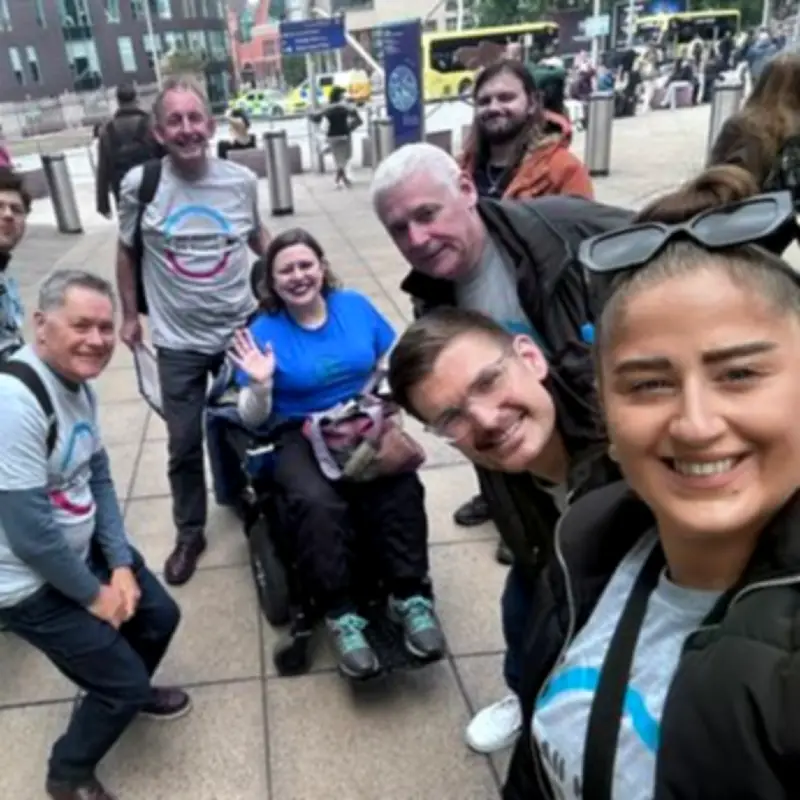
Campaigners are calling for 'plus-one' travel passes to be introduced for disabled people across Greater Manchester to get one step closer to 'transport justice' in the region. The All Hours All Voices group are campaigning for people with a disabled person's travel pass to be given a 'truly inclusive companion pass' that allows a carer to travel with them for free and is not linked to receipt of disability benefits such as PIP.
It comes after the campaign group successfully called for time restrictions to be lifted on concessionary bus passes in the region, meaning that those affected are able to travel for free before 9.30am, after the restriction was lifted by TfGM.
The group is now calling for companion passes to be brought to Greater Manchester to help with the 'significant barrier' of additional fare that can 'limit access to work, healthcare, social activities and community life' for disabled people. Over the weekend, the group campaigned for the change at Piccadilly station and has so far got 1,235 letters of support sent to their 13 targets of the action, including Andy Burnham, Kate Green and the disability advocate for The Bee Network.

The group is hoping that Greater Manchester can create a type of 'gold standard' of companion pass that will set the standard of removing barriers and empowering disabled people across the country.
Gold standard for inclusivity
Joe Troop, from the All Hours All Voices group, said: 'We believe Greater Manchester has an opportunity to set a gold standard for what a companion pass can look like. We are calling for a pass that operates as a simple plus-one arrangement, allowing the holder to choose their own companion. Crucially, we are calling for eligibility to be based on self-identification of need, not on receipt of benefits such as PIP, which involves a complex and often distressing application process. Greater Manchester has already shown what is possible. Now it has the chance to set an example for the rest of the country on what a truly inclusive companion pass can look like.'
As part of the pass, campaigners want disabled people to be able to use it at their own discretion and not rely on PIP eligibility or having the pass appointed to one specific person.
Empowering disabled people
Rick Burgess, from Greater Manchester Coalition of Disabled People, said: 'The next step is to get companion passes added to the disabled person's bus pass. So that means that the disabled person using the bus can at their discretion say I need a companion with me - either a personal assistant, carer, family member or friend - and they travel for free with the disabled person to help them navigate the world. The existing application puts a significant amount of emphasis on being qualified for PIP, but the fundamental point of it is that it's a bad assessment of disability and of how your impairments or conditions affect you. The best way to do it is to have it integrated into the disabled person's pass. The reason for that is so that the disabled person has the power to decide who is their assistant or carer. Because if it's a separate pass that is held by a carer they might just use it for general travel and they shouldn't be doing that.'
He added that it's important that the pass is transferable between carers as some people have multiple support staff to help them, and so different people might be travelling with them on different days. He said: 'And in fact, if you go to cinemas and a lot of theatres they usually operate a free plus one entry for disabled people to see the movie. So it's not uncommon in that respect. It's all about keeping the power with the disabled person and not giving it to care agencies or family or friends who, sometimes, can abuse those things. Disabled people can sometimes find themselves in neglectful, abusive situations, so everything we do in that respect, we always want to make sure to empower the disabled person.'

He added that the system would also need to be subject to reasonable adjustment and that implementing the proposed changes would put the region one step closer to 'transport justice' following on from the time restriction changes. He said: 'It just gets us closer to what I would call transport justice and disability justice. What disables us is actually society and how it's organised. The really obvious example is places that have steps. That means people with wheelchairs can't use those places but if you take away those steps, that person can then use that place. It doesn't stop whatever their impairment condition is, that doesn't change, but it means they're involved in the world. It means they're welcome somewhere. This is making an adjustment to the system to remove barriers for disabled people and that is really all that we want to do. We just want to remove barriers for people.'
Fran Wilkinson, Customer and Growth Director at Transport for Greater Manchester, said: 'We are committed to delivering a public transport network that is inclusive and accessible for all. Carers play a vital and valued role and we continue to explore options around introducing companion passes on the Bee Network.'