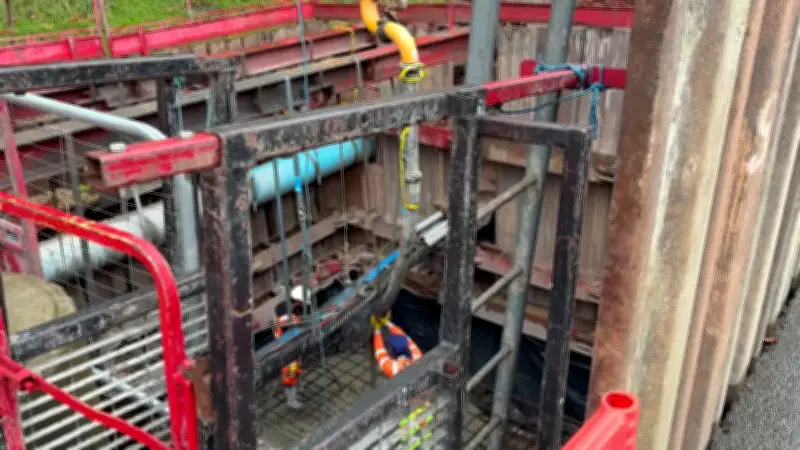
The repair of the giant hole on Alan Turing Way in Manchester, caused by a 50m deep mineshaft, is expected to be completed by mid-December. The northbound section of the road between Ashton Old Road and Grey Mare Lane has been closed since March, when a 3m wide crater appeared.
Engineers discovered in September that the collapse was triggered by an unmapped mineshaft beneath the road. The shaft, which was not recorded on historic maps, took workers by surprise despite the area's long history of mining.
Stabilisation and Filling Works
The council has stabilised the mine shaft and filled it with 120 tonnes of concrete grout, ensuring no risk to surrounding roads and buildings. The next step involves placing a reinforced concrete slab over the filled-in shaft.
On October 21, contractors were seen flattening concrete around 10m below the road surface. The following phases will see the concrete lid reinforced, the void between the road and lid filled, and finally the road resurfaced and reopened to vehicles.
Impact on Residents and Events
The closure has caused significant frustration among local residents. Newton Heath resident David Carey previously reported that 20-minute journeys were taking an hour or more. The hole's proximity to the stadiums of both Manchester City teams and the Co-op Live Arena has also led to increased traffic congestion on event days.
Workers noted the need for caution to avoid impacting main lines and utility feeds for the Etihad Stadium and Co-op Live. The council explained that much of the investigation work was taking place below the surface, which may have appeared as a lack of visible progress.
Council Apology and Timeline
Councillor Mandie Shilton Godwin, Manchester council's executive member for Clean Air, Environment and Transport, apologised to residents affected by the closure. She said: "The depression in the road was first noticed in March. But it actually took until September before the team were really sure what the problem was.
"There were all kinds of things that had to be investigated such as water, utilities, or a clay mine. It wasn't until September that we were absolutely certain it was a coal mine and we identified how deep the shaft was. Once that was done then the full solution could be identified.
"The important thing was to establish exactly what happened. Because until you do that you can't be sure that your solution is going to solve it.
"It has been hugely difficult for local residents because people have been diverted through their estate. I want to say sorry to all those people it happened to. Hopefully the end is now in sight with the end of mid-December.
"Manchester is the world's first industrial city so there has been human activity on this site for well over 1,000 years, so of course it isn't all mapped. A lot of it is mapped now but unfortunately these things can still happen."
Coun Shilton Godwin added that she would have wanted to go down into the hole, but health and safety prevented that.
Works are expected to take until mid-December to complete, but the council has stressed that this is an estimate and could be delayed by adverse weather conditions or issues that arise during the course of the work. The cost of the works has not been published by the council, but a final price can be expected following completion of the project.