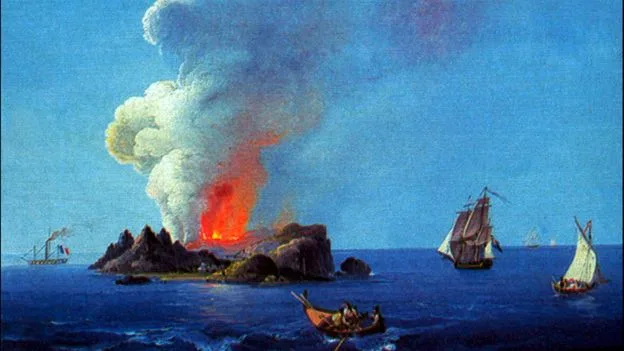
In July 1831, Sicilian fishermen noticed dead fish rising to the surface off the south-western coast of Sicily, accompanied by a strong smell of sulphur. Some fishermen even lost consciousness from the fumes. Days later, on the night of 10 July, sailors observed a volcanic vent emerging from the sea, spewing smoke, ash, and lava. By August, a new island had formed, roughly half a mile in diameter and 200 feet above sea level.
The island, little more than a barren rock, sparked an international dispute as France, the UK, and Sicily vied for ownership. However, within five months, the island sank back beneath the waves, earning nicknames such as 'the island that isn't there' and 'the island that went away'. This month marks the 190th anniversary of its brief emergence.
Volcanologists have since mapped the sea floor in detail, revealing the submerged volcanic cones that caused the island's rise and fall. The region sits on the boundary between the Eurasian and African tectonic plates, where ongoing movement leads to earthquakes and volcanic eruptions. Submarine volcanoes, like the one that created the island, are common in the area.
Sicily's history is marked by seismic activity, including devastating eruptions of Mount Etna and earthquakes such as the 1693 Val di Noto quake and the 1908 Messina earthquake. Local folklore, such as the legend of Colapesce, a fisherman who supports Sicily on his shoulder, reflects the ancestral fear of these natural phenomena.
Scientists continue to study the area to understand whether a new island might emerge in the future. While the short-lived 'Atlantis' of 1831 is gone, the geological forces that created it remain active beneath the Mediterranean.