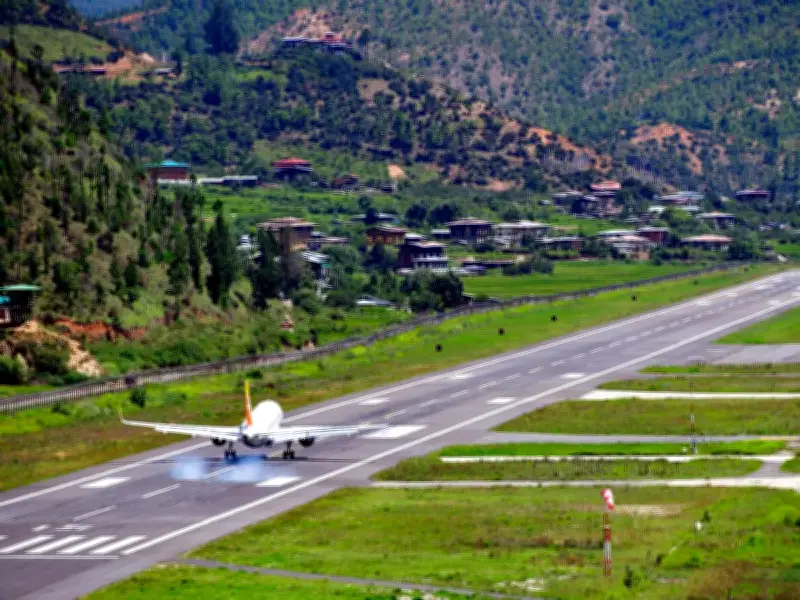
Paro Airport in Bhutan, often dubbed one of the world's 'most extreme' airports, has a runway so challenging that only around 50 pilots are certified to land there. The airport, the country's only international gateway, sits in a deep Himalayan valley surrounded by peaks reaching up to 18,000ft, with no radar guidance, forcing pilots to perform landings entirely manually.
A Runway Shorter Than Most
The runway at Paro is just 7,431ft long, notably shorter than the average commercial runway, which typically ranges between 8,000ft and 13,000ft. To approach, pilots must navigate a steep, winding flight path through the mountains, following specific turning points that lead to the runway. Often, there are only seconds between the moment the runway becomes visible and the landing itself.
Because of these challenges, flights at Paro are restricted to daylight hours, and the airport has earned its nickname among aviation enthusiasts as one of the world's most extreme travel hubs.
Stringent Training for Pilots
Pilots seeking to fly to Paro must undergo rigorous preparation. Requirements include a minimum of 1,500 flight hours, over 500 hours of mountain flying, additional qualifications and certificates, and intensive simulator training conducted by the Bhutanese government. Even after meeting these criteria, pilots must complete a number of supervised takeoffs and landings before being deemed certified to fly to Paro.
Other Extreme Runways
Paro is not the only airport with such demanding conditions. Lukla Airport in Nepal is also considered one of the toughest landings in the world. Located in a mountainous landscape, its short runway presents significant technical challenges, and there have been several crashes on the runway over the years, with a handful resulting in deaths. Like at Paro, pilots flying to Lukla must undergo a stringent vetting process, including extra flight hours and supervised takeoffs and landings.