On a freezing day late last year, I took a scenic three-hour train ride from Geneva to Lauterbrunnen, an Alpine village nestled between Interlaken and the Jungfrau massif in central Switzerland. I was now at the gateway to the car-free mountain hamlet of Mürren.
For most of Mürren's history, residents would lead their mules three hours down to gather essential supplies in the valley before trekking back up. Then in 1891, a narrow-gauge railway opened, connecting Mürren to the nearby mountain village of Grütschalp and a funicular that reached Lauterbrunnen. In 1965, a single-track cableway opened that could ferry residents down to another traffic-free village, Gimmelwald, above the valley.
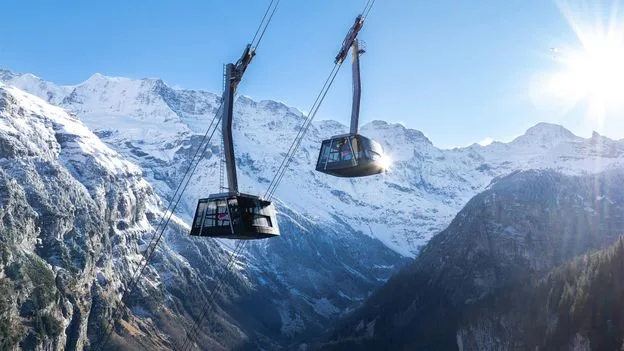
But the day I arrived, this formerly secluded 430-person hamlet perched 1638m in the Bernese Oberland became directly connected with the outside world and valley below through the opening of the world's steepest cable car: the Schilthornbahn, which whisks travellers 775m up through some of the Swiss Alps' most jaw-dropping scenery in just four minutes.
After arriving at the Stechelberg car park, I was soon being hoisted from the valley floor up in a glass-enclosed cabin, staring down towards the storybook cottages below and surrounded by craggy mountains and snow-covered pines. The trip up the vertical Mürrenfluh rockface was so smooth that I barely noticed the 159.4% gradient (the world's previous steepest cable car, the Loen Skylift in Norway, rises 133%), until my ears started to pop.
Perched on a natural terrace at the foot of the Schilthorn summit (2970m) overlooking the Lauterbrunnen valley, Mürren is a 13th-Century village with traditional stone and timber cottages that looks like it's clinging to the edge of a cliff. Because of its unique position, engineers have never been able to connect it to the outside world by road.
Despite its diminutive size, Mürren is a major winter sports hub. This former sleepy Walser settlement transformed in the late 1800s when British skiers discovered the village and fell in love with its scenery (and slopes).