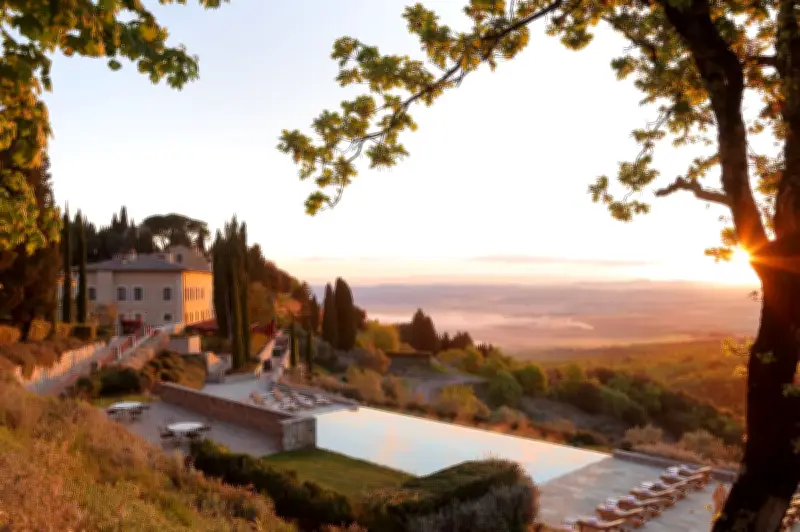
Castiglion del Bosco, a Rosewood Hotel in Tuscany, epitomises quiet luxury, offering a five-star experience that feels timeless and deeply connected to its surroundings. Located in the hills of Val d'Orcia, the estate comprises dozens of converted farmhouses and stables that once formed a mediaeval hamlet, or borgo, home to Tuscan nobility. When Massimo Ferragamo, youngest son of designer Salvatore Ferragamo, purchased the 5,000-acre estate in 2003, it had been abandoned for decades. Ferragamo and his wife Chiara undertook a dedicated renovation, transforming the borgo into an Elysian retreat for friends and family. In 2015, the estate joined the Rosewood Hotel group, now featuring 42 suites and 11 unique villas.
A Cocoon of Calm with Sweeping Views
The hotel commands sweeping views from its hillside perch. A cobbled walkway runs through the main stretch of the borgo, with ivy climbing the converted stables, evoking a Tuscan Daylesford Organic. At the end of the walkway, cypress-lined steps lead to the ruins of the 12th-century fortress that gives Castiglion del Bosco, or 'castle of the woods', its name. Once strategically important in the mediaeval Republic of Siena, it is now home to deer, pheasants, and wild boar roaming the estate.
Upon check-in, guests are whisked to La Canonica, the hotel's laidback osteria, for classic Tuscan fare: pappardelle with wild boar ragù, white beans with sage, delicately fried artichokes, and seabass with organic kitchen garden greens. Tables are set before a vast window overlooking the valley, where spring weather can be capricious. When rain falls, staff shake their heads, insisting it's never usually like this.
Home-Like Atmosphere and Cosy Nooks
Massimo and Chiara aimed to make the estate feel more like a home than a hotel, resulting in plenty of cosy nooks. Guests can decamp to the cigar room, sinking into deep leather chairs to play backgammon by a crackling fire. The room feels like an English stately home, save for oil paintings of Italian poets like Dante and a plasma screen.
Guests can enjoy the deserted grounds, heading to one of the hotel's outdoor infinity pools. The water is deliciously warm, and floating on one's back with cool raindrops on the face is a unique experience. When mist lifts, the landscape becomes more vivid, with air redolent of rosemary, fig, and iris, and the valley humming with birdsong.
Sustainability and Tradition
Unlike many high-end hotels that are lavish to the point of wastefulness, Castiglion del Bosco emphasises preserving tradition and living sustainably. Vegetables from the garden appear in multiple guises at the Michelin-starred Ristorante Campo del Drago and are used in excellent cocktails at the bar. Villas and suites are filled with antique furniture and textiles from local artisans, while exteriors are beautifully preserved, maintaining the site's history as a mediaeval hamlet. The Via Francigena, a pilgrimage route from Canterbury to Rome, passes alongside the estate, with several pathways through unspoilt woodland for rambling.
Hyperlocal Activities and a Private Golf Course
Hyperlocal activities include truffle hunting with a tartufaio and wine tasting at the hotel's vineyard, which produces an award-winning Brunello di Montalcino, one of Italy's most coveted reds known for its earthy hue. The property's crown jewel is its 18-hole private golf course, designed to blend seamlessly into the landscape. It is Italy's only private golf club and has welcomed high-profile guests including former President Barack Obama.
Guests can round off their stay with a hypnotically good massage at the spa, where a cricked neck from gazing at frescoed ceilings in Florence becomes a distant memory. The feeling is of having stayed at an incredibly generous friend's house. Castiglion del Bosco achieves a rare feat: steeped in history yet delightfully modern, luxurious but unfussy, the kind of place one wants to return to again and again.