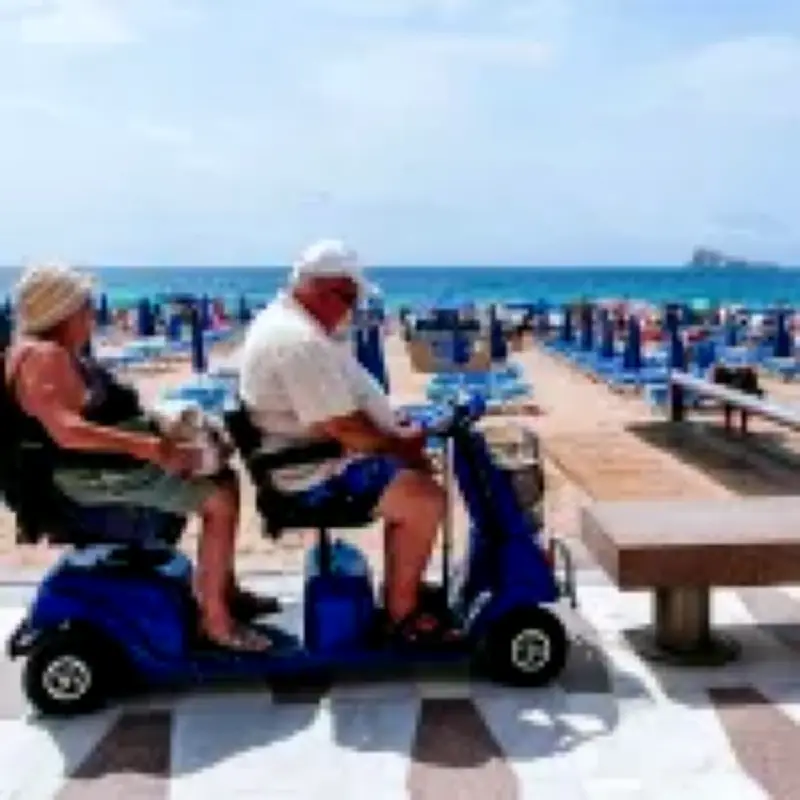
Benidorm City Council is set to ban multi-occupant mobility scooters, including two-seater models often available for rent, following a concerning spike in accidents involving personal mobility vehicles. The council has yet to reveal a definitive blacklist of banned models or confirm what fines law-breakers will face.
Current Rules and Fines
At present, scooters are strictly banned from pavements and pedestrian zones unless you are actively accessing a building. Local police regularly check popular tourist areas. Breaking the rules, such as riding on the pavement or renting without a valid medical reason, carries fines up to €500, and the vehicle can be immediately impounded.
Under current regulations, mobility scooters are restricted to individuals over 65 (55 until 2024) or those with a documented disability.
Why the Ban Is Being Introduced
Personal mobility vehicles, including e-scooters, self-propelled chairs, and mobility scooters, account for an alarming 25% of all urban road accidents in Benidorm, report Olive Press.
Mobility councillor Francis Muñoz emphasised that the 'constant evolution of urban mobility' makes keeping regulations up-to-date essential, adding that such a ban will help 'ensure road safety on pavements and in pedestrian areas.'
'Our intention is to prevent certain vehicles designed to carry several people from being used as a leisure activity or tourist transport alternative, creating dangerous situations in areas intended for pedestrians,' Muñoz stated.
The crackdown follows a wider clampdown on mobility scooters and chairs, with more than 1,100 fines handed out so far this year.
Consultation and Public Reaction
The ban is not yet officially in force. The draft text is entering a mandatory 30-day public consultation period. As such, there is no set date for when the ban will start. Because an earlier 15-day consultation period drew zero objections, local officials widely expect the proposal to receive final approval.
Metro spoke to Nick Birko-Dolder, a volunteer Equality, Diversity and Inclusion champion for the disability charity KEEN London and a former policy advisor at Disability Rights UK, for his thoughts.
'I believe Benidorm should assess this proposal against people's actual mobility needs, the evidence of risk and the availability of practical alternatives,' he notes. 'A mobility scooter can be the difference between participating in a holiday and spending it confined to a hotel,' he adds, warning that 'we should be very careful about turning concerns over misuse into suspicion of everyone who needs assistance'.
'There will be people who misuse rental equipment, and dangerous behaviour should have consequences. But the council needs to demonstrate why a blanket restriction on multi-seat models is necessary, rather than relying on general concerns about scooters.'
On TikTok, @montserrat.lopez861 praised the change, noting that when 'you're walking along, if you don't watch out, you'll get run over.' While @evilways72 added: 'They are a hazard on the sidewalks; there are problems every day, and some tourists use them while under the influence of alcohol.'
But not everyone supported this, with @maria12oc noting: 'It seems absurd to me — the two-seater ones are actually rented by older couples; the danger comes from all of them, and the speeds at which they travel.' On Instagram, @larivigil called them 'necessary' for the elderly and those with disabilities, but agreed that the ban was necessary for those who do not need it.
While @benidorm.now asked: 'What happens to couples who rely on them to get around together?' adding, 'People with limited mobility want freedom and independence. Couples want to enjoy their holidays together.'
Others raised concerns about this potentially resulting in an increased price of single-seat scooters, especially if two people need them.