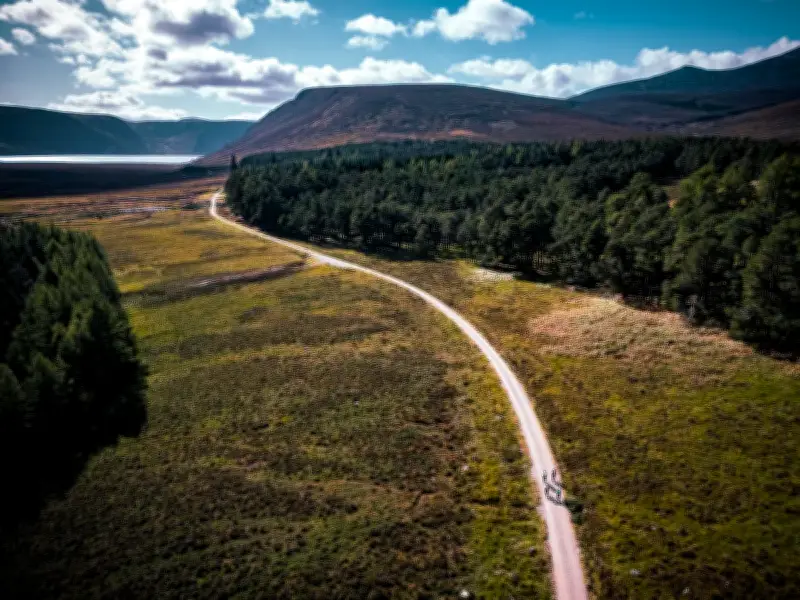
A gravel bike ride through the Cairngorms national park this autumn shows much of the landscape untouched by the wildfires that raged in July, with local businesses welcoming visitors back to the area.
The wildfire that began near Glenmore and Abernethy on 15 July burned more than 33 sq km (13 sq miles) of moorland and forest. More than 500 firefighters were involved; homes and businesses were evacuated; and the emergency response lasted over a month. Much of the burned area is high on the hill and far from the roads, making it surprisingly easy to miss in a national park stretching 4,528 sq km (1,748 sq miles).
Riding new routes through the park
The ride was undertaken with a gravel bike to retest new bikepacking routes with Kees Wouters and Yannick Ferbeek from Legendary Rides, which offers self-guided tours, and Bikepacking Scotland founder Markus Stitz, who helped develop the routes. The journey began in Aviemore, reached from Edinburgh on an electric Ember bus that allows bikes to be booked on board.
The original route would have gone through Glenmore, past Loch Morlich and Ryvoan bothy, but path closures remain. Instead, a new line towards Nethy Bridge was taken, passing through birch and rowan with tracks soft with pine needles. At Loch Garten, where ospreys nest in spring and summer, it is hard to imagine the smoke and helicopters of July.
Local impact of the wildfire
Graham Niven, who lives in Nethy Bridge with his wife, Amy, and runs the self-catering business Arbor Nethy beside the forest, joined the local volunteer firefighting effort coordinated by the RSPB. “We see the forest as an extension of our home,” he says. The Abernethy forest is ecologically rich, filled with ancient Caledonian pine trees that are hundreds of years old. “It’s a unique and special habitat, and it’s very fragile. We were all just grieving for the forest,” he adds.
While business has largely returned to usual, Graham has noticed a dip in bookings for photography workshops and holiday lets. “What is less measurable is people’s confidence in booking or coming back. The buzzwords were ‘apocalyptic fire’ and Abernethy and Nethy Bridge, Cairngorms, and that does stick in people’s minds. People think of Abernethy and say: ‘Oh, it’s been burned down.’ I think it’s less than 10% of the old forest affected.” Nearby, Polly Cameron at The Dell of Abernethy has seen the same effect: “Bookings wise, we certainly experienced a dip, and October has still been much slower to fill.”
Exploring the eastern Cairngorms
The route continued along the Speyside Way, following the river through woods and farmland before the landscape opened into sheep, grouse moors, abandoned crofts and long gravel roads. This is whisky country, and the ride passed through the grounds of Glenlivet Distillery. By late afternoon the hills had turned heather-purple, and darkness settled by the time Tomintoul was reached.
The next day was shorter but steeper, taking in sections of old military roads built in the 18th century after the Jacobite risings, with a stop at Corgarff, a white fortress on a hill built in the 16th century and later converted into a barracks. The second night was spent at Cairngorm Bothies, off-grid cabins surrounded by Scots pines, where nature journals contained children’s handwriting with tales of red squirrels and deer.
With a flexible route, stops were frequent, including a walk to Burn O’Vat, a huge glacial pothole in the Muir of Dinnet national nature reserve, and a coffee stop at The Bothy in Ballater. The route is deliberately forgiving, with Legendary Rides providing shorter alternatives for challenging weather or tired legs, prebooked accommodation, a personalised plan, GPX routes and WhatsApp support. “It allows you to relax and just enjoy the ride,” says Yannick.
From Ballater the ride wound towards Loch Muick through the Balmoral estate, with a long, winding ascent over Capel Mounth leading to a rocky descent, followed by gentle undulating roads to Glen Clova and on to Alyth.
Autumn as ideal time to visit
The trip broadened awareness of the diversity of landscapes the Cairngorms hold, from mountain peaks and forest trails to river valleys, whisky country, high moorland and farmland. The area is not untouched wilderness, crossing private estates managed for deer stalking and grouse shooting as well as national nature reserves, with wildfire prevention now a key part of the management conversation. Scotland’s right to responsible access allows passage through the landscape, provided visitors leave no trace, close gates and avoid disturbing livestock and wildlife.
Autumn is an ideal time for such a journey: the midges have retreated, the roads are emptier and there is still plenty of golden light. Cycling through the area helps support local cafes, shops and accommodation providers. “We want people to know we’re still here, we’re still awesome,” says Graham. The trip ended with a final Pitlochry cafe stop before the Ember bus back to Edinburgh.