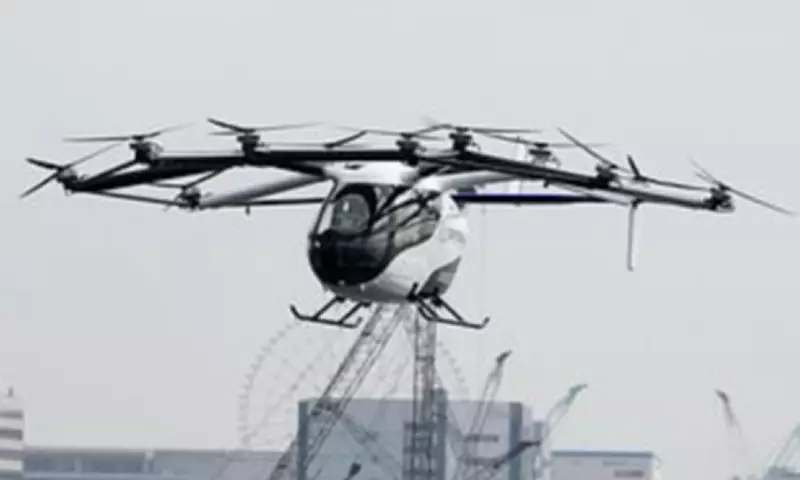
In a remarkable display of futuristic technology, a Japanese 'flying car' has taken to the skies for a demonstration flight over the country's capital. The vehicle, developed by SkyDrive, a company specialising in eVTOL (electrical vertical take-off and landing) aircraft, showcased its capabilities in a public test.
SkyDrive's SD-05 Takes Flight Over Tokyo Bay
On February 24, SkyDrive's SD-05 model flew over Tokyo Bay, bringing a sci-fi-like vision into reality for onlookers. The flight lasted approximately three minutes and 30 seconds, with the vehicle ascending to a height of 150 metres. This demonstration was part of a collaborative project involving the Tokyo Metropolitan Government, Mitsubishi Estate, and Kanematsu Corporation, highlighting significant institutional support for the technology.
Technical Specifications and Safety Features
The SD-05 is propelled by 12 electric rotors and is entirely battery-powered, capable of seating three people. It is controlled remotely by a computer, ensuring precision in flight operations. According to reports, its propeller system is designed to maintain safe flight even if one motor fails, enhancing reliability. The vehicle can carry up to 1,400kg and achieve speeds of up to 100km/h, potentially transporting passengers five times faster than conventional ground taxis.

Plans for Commercial Launch and Regulatory Hurdles
SkyDrive aims to launch a passenger service with this impressive vehicle by 2028. However, the company must first secure approval from Japan's Civil Aviation Bureau and the Federal Aviation Administration (FAA) before commencing operations. The projected fares after 2030 are expected to be twice that of regular taxis, which might make it a costly option for early adopters. The vehicle's range is currently limited to five- to ten-minute flight times, covering distances of 15 to 40 kilometres.
Expansion and Infrastructure Developments
SkyDrive has also tested the flying car in Osaka last year, as indicated by social media posts. The SD-05's compact size allows it to land in a wider variety of locations compared to helicopters, increasing its versatility. Additionally, the company has unveiled a special terminal for flying cars, featuring advanced technology such as a facial recognition check-in system, to facilitate take-offs, landings, and operator control.
Global Context and Competitors
This development aligns with global trends in urban air mobility. For instance, Virgin Atlantic announced a partnership with Joby Aviation last year to launch a similar flying taxi service in London. These electric air taxis are designed to carry a pilot and up to four passengers, reaching speeds of up to 200mph. Such technology could drastically reduce travel times, such as cutting the journey between Heathrow and Canary Wharf from 80 minutes to just eight minutes.
Shai Weiss, CEO of Virgin Atlantic, emphasised the partnership's focus on sustainability and innovation, aiming to provide seamless, zero-emission short-range journeys across the UK. This highlights the growing competition and investment in the flying car sector, as companies worldwide race to commercialise this transformative mode of transport.