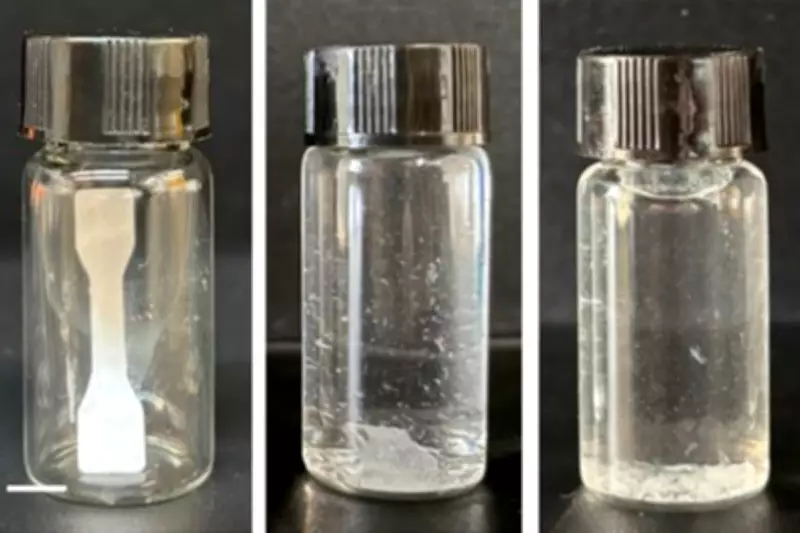
Chinese scientists have developed a 'living plastic' that self-destructs on command without creating microplastics, an advance that could help reduce the increasing burden of non-biodegradable waste.
Many plastic products today are designed for single use and the material can persist in the environment for years. The 'living plastic' contains microbes that release plastic-degrading enzymes and can be activated on command. Two strains of the common bacterium Bacillus subtilis, working together, completely break down the material within six days without creating microplastics, scientists show in a study published in the journal ACS Applied Polymer Materials.
How the Living Plastic Works
'The realisation that traditional plastics persist for centuries, while many applications like packaging are short-lived, led us to ask: could we build degradation directly into the material's life cycle?' study author Zhuojun Dai from the Shenzhen Institute of Synthetic Biology said. 'By embedding these microbes, plastics could effectively 'come alive' and self-destruct on command, turning durability from a problem into a programmable feature.'

Many microbes are known to break down polymeric chains, the building blocks of plastic, into smaller pieces using their enzymes. Previous attempts to design 'living plastic' relied mainly on a single enzyme. The Chinese researchers added a second one to improve the efficiency of destruction.
They engineered two strains of Bacillus subtilis, each producing a different polymer-degrading enzyme. One enzyme acts as a random chopper, snipping the long polymer chains into smaller pieces, while the other slowly chews the pieces into their smallest building blocks from each end.
Dormant Spores and Activation
Scientists protected the microbes until they were needed for destroying the plastic by using them in their dormant spore form. They incorporated the spores into polycaprolactone, a polymer commonly used in 3D printing and some surgical sutures, with stable mechanical properties. Once the plastic was added to a nutrient broth and the temperature raised to 50 degrees Celsius, the spores activated and the bacteria degraded the material all the way down to its building blocks in only six days.
'The cooperative enzymatic activity within the microbial consortia outperforms that of a single-strain system, enabling near-complete degradation of the polycaprolactone matrix within 6 days,' scientists noted.
Future Plans
In further studies, researchers plan to develop a trigger for the bacterial spores in water, where a large part of plastic waste ends up. They also aim to use a similar strategy for other types of plastic like those commonly found in single-use plastics.