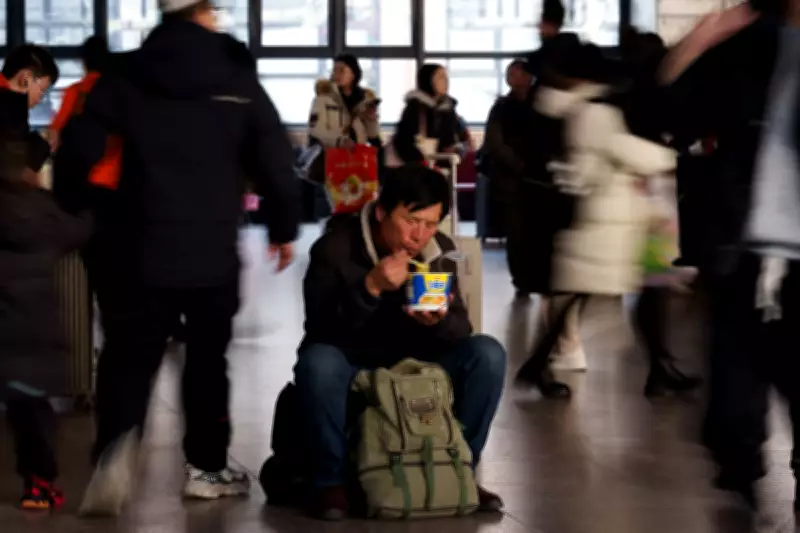
China's annual Lunar New Year travel rush has officially begun, with the government forecasting a record-breaking 9.5 billion trips during the 40-day period surrounding the festival. This massive movement, known locally as "chunyun," represents the world's largest human migration, as hundreds of millions of people travel to their hometowns to celebrate with family.
Economic Pressures Shape Travel Choices
Despite the festive atmosphere, many travelers are feeling the strain of economic difficulties. Liu Zhiquan, a construction worker in Beijing, exemplifies this trend. He is embarking on a 30-plus hour train journey to Chengdu, Sichuan province, covering approximately 1,242 miles (2,000 kilometers).
"Things feel worse this year than last. The economy is bad and it's getting harder to make money," Liu remarked. To save costs, he opted for a slower train instead of a high-speed alternative that would take just nine hours but costs more than double. His decision underscores the financial challenges faced by many workers, yet he remains committed to making the long trip home for the festival.

Official Travel Estimates and Modes of Transport
According to data from the National Development and Reform Commission, the 9.5 billion trips expected this year set a new record. Of these, an estimated 540 million will be made by train, and 95 million by air, with the remainder occurring on roads. This surge in travel highlights the festival's importance in a country where workers typically have limited annual leave and long working hours, including weekends.
Personal Stories from Beijing's Train Stations
At Beijing's train stations, scenes of crowded waiting areas are common, with passengers carrying large bags and suitcases. Many rely on instant noodles for sustenance, taking advantage of free hot water provided at stations. Among them is Tian Duofu, a young woman who recently started full-time work in Beijing.
"It has become more difficult for a big family to get together. After I started working, I realized such a long holiday is rare and we see each other less and less in person, which makes the Spring Festival significant," she said, looking forward to the nine-day holiday beginning February 15.
The Cultural Significance of Homecoming
For many, the Lunar New Year is a non-negotiable time for family reunions. Tian Yunxia, a breakfast stall owner from Henan province working in Beijing, expressed this sentiment strongly. "The new year is the festival of the year, and if we don't go back home, we won't be able to enjoy the festival atmosphere," she stated.
Her primary motivation is to reunite with her children, grandchildren, and husband, emphasizing the deep emotional and cultural ties that drive this annual exodus. As workers across China take their breaks during this period, the travel rush not only reflects logistical challenges but also the enduring value placed on family and tradition in Chinese society.