

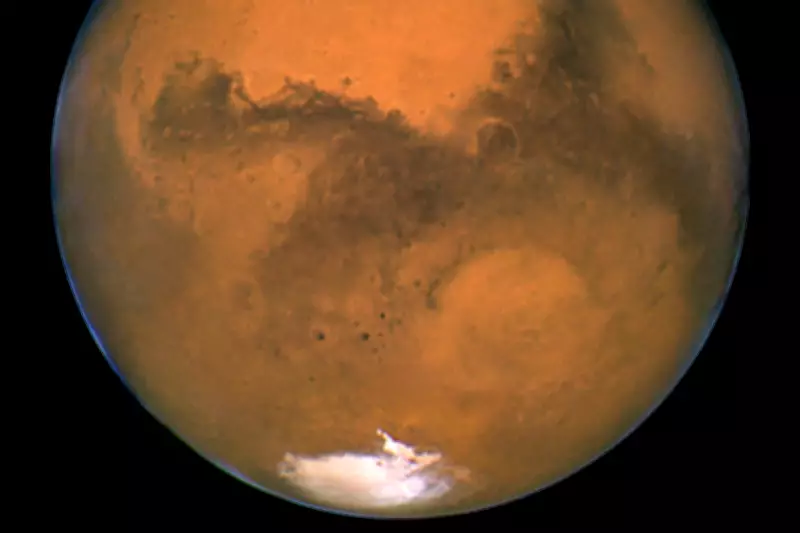
Astronomers have identified a potential shortcut to Mars that could reduce travel time by nearly half, leveraging the orbital path of an asteroid. The discovery, based on analysis of asteroid 2001 CA21, reveals two rapid round-trip trajectories between Earth and the red planet, with the fastest taking just 153 days.
New Corridor to the Red Planet
The distance between Earth and Mars fluctuates as both planets orbit the Sun. The closest approach, known as Mars opposition, occurs roughly every 26 months. Even with the fastest spacecraft, a journey during opposition typically takes between seven and ten months. However, the newly identified corridor, which opens during a close approach, could slash mission time to 153 days—less than half the current estimate.
Asteroid Data Reveals Hidden Paths
Space agencies usually plan interplanetary missions by analyzing planetary trajectories and calculating optimal routes and fuel requirements. In this study, researchers instead turned to asteroid orbital data. They focused on 2001 CA21, a near-Earth asteroid whose predicted path crosses the orbits of both Earth and Mars. By examining the asteroid's close approach to Mars, they identified a more direct route for spacecraft.

The team assessed Mars oppositions in 2027, 2029, and 2031 to determine which offered the best conditions for a shorter trip. They found that only in 2031 did the Earth-Mars geometry align favorably with the asteroid's orbital plane.
Two Round-Trip Missions Identified
The analysis yielded two complete sub-year round-trip paths: a 153-day rapid transfer corridor and a 226-day feasible path. The researchers published their findings in the journal Acta Astronautica, stating: "The 2031 Mars opposition supports two complete sub-year round-trip missions consistent with the CA21-anchored plane, illustrating how early small-body orbital data may contribute to the early identification of rapid interplanetary transfer opportunities."
Implications for Future Missions
According to the scientists, this novel geometric screening methodology could uncover faster flight paths to other planets that traditional methods might miss. They hope that further studies of near-Earth asteroid paths will aid in the rapid design of interplanetary missions, potentially revolutionizing space travel.






