60 Years of British Traffic Lights: A Design Classic Saving Lives
60 Years of British Traffic Lights: A Design Classic

If you didn't crash your car this weekend, traffic light protocol is probably the reason why. But while they are looked at every day, few notice a British design classic that has served the country, unchanged, for six decades. And how many people realise these stalwarts of the roadscape are connected to dining tables in restaurants, embassies – even prisons and hospitals?

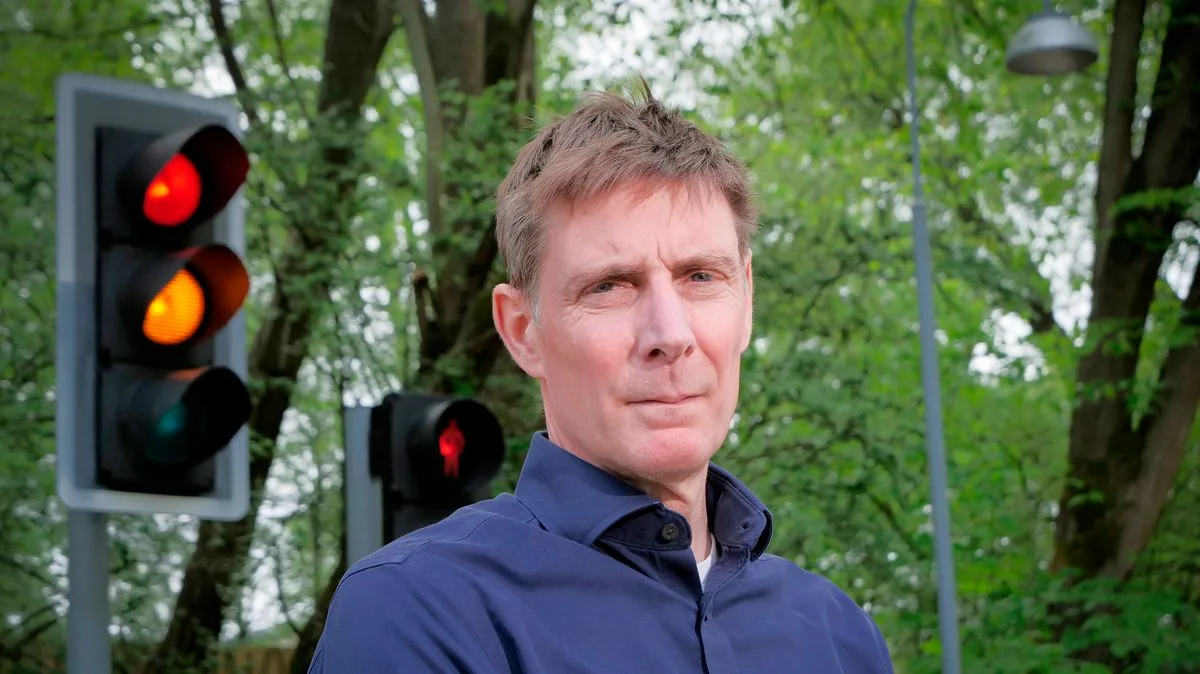
As the British traffic light celebrates its 60th anniversary in operation this year, we met Corin Mellor and were given exclusive access to the original plans for it, drawn by his father, David Mellor. Corin says: “I wasn’t even born when the traffic light came out, but I grew up in the building where my father designed it. Our home was at one end, his workshop was at the other.”

From Cutlery to Street Furniture

David Mellor, born in 1920, had a humble upbringing in Sheffield, where his father was a toolmaker. Corin says: “He had a working-class, non-artistic background. He came from a family of ‘makers’ on one side, but they weren’t creatives. He somehow got his own creative spirit at the junior art department at Sheffield School of Art. They had this idea that young people could better themselves through art, and that got him to the Royal College of Art in London to study silversmithing.”

Wide Pickt banner — collaborative shopping lists app for Telegram, phone mockup with grocery list

To honour his home city, David designed an elegant set of knives, forks and spoons as his final degree project and called it Pride. Immediately recognised for its functional beauty, it was soon being produced in a Sheffield factory. The government then commissioned him to create a utility range for use in hospitals, schools, prisons and other public organisations. Another set went to British embassies worldwide.

Then, during a sabbatical in Rome, David was enamoured with the city’s lampposts – returning to Britain feeling inspired. Corin says: “That’s where he had this vision that he could single-handedly change the British street scene. He came back to Sheffield, set up his own studio, and designed his lamppost. Then he literally went round the country with his rolled-up drawings, knocking on doors to find a manufacturer. Finally, a firm in Derby put it into production.”

David was then asked to design a bus shelter that popped up at every bus stop in England. A litter bin followed, with bright yellow paintwork and a conical shape becoming familiar at parks, playgrounds and promenades. Other Mellor designs included everything from hacksaws to coffee pots.

The Traffic Light Challenge

But it was the increasingly dangerous roads in the 1960s that soon occupied his thoughts. The government’s Worboys Committee had been launched to tackle Britain’s worsening road safety record. Road signs were so old-fashioned that drivers couldn’t react to them fast enough, especially on motorways and dual-carriageways, where modern cars could reach 100mph. Civil servants turned to the nation’s jumbled traffic lights, some dating back to their introduction in 1926.

David Mellor – regarded by many as the king of posh tableware – was tasked with a rethink in 1965. The brief was that the lights had to be easier to see; they had to incorporate more green filter arrows at complicated road junctions; and they had to help pedestrians cross the road safely.

Showing the original plans, Corin explains: “His concept was a modular system. It’s a series of boxes, and each box has a hinged door, so you could change one light bulb. An extra box could go on the side for a filter arrow, say, or no left-turn.” David’s treatment also included a 2cm-wide white border around the traffic light fascia, to make it stand out, and flexible mountings on the pole, so the lights wouldn’t be knocked out if a car or lorry slammed into it.

Corin adds: “It did the job really well, and that would have been my father’s goal. I can detect a subtle designer’s ‘fingerprint’. There are certain radiuses on the light hoods I know he would have chosen.”

Pickt after-article banner — collaborative shopping lists app with family illustration

Just as important were the materials. While older traffic lights were made of cast or welded metal and needed painting, these new ones had to be zero-maintenance. They were made from durable and rust-free blow-moulded plastics, with a matt, non-dazzle finish. Corin continues: “My father would have been involved in making the early pieces. He was very much about ‘truth to materials’ – no applied decoration, nothing that isn’t needed – and form following function.”

Trials and Adoption

Prototypes began to be trialled 60 years ago in London’s Chelsea. They were complete with the distinctive pedestrian button box, featuring the red/green man crossing signals that three generations of children have grown up to respect. Mass production got under way at several UK sites, and, by 1968, the signals were being installed nationwide. There were about 4,500 signal junctions in the UK then. Today, there are 33,000 with drivers typically spending eight minutes a day sitting at them – or two whole days a year.

Remarkably, the lights are still in use everywhere exactly as David designed them. The only change has been a softening of the angular 1960s lines of the button box. Even the new high-intensity LED bulbs were incorporated without altering the exterior. Praising their merits as an example of industrial design, Corin says: “Perhaps they should be listed.”

Next, David tackled the red Royal Mail pillar box, before he returned to cutlery manufacturing, opening his own factory in 1973. Soon, the David Mellor brand was a byword for dining table sophistication. He opened smart shops in London and added many new designs to his range until his death in 2007.

And Corin, also a talented designer, continues to run the family business, which still manufactures cutlery near Sheffield. David Mellor Ltd is housed in a former gasworks in the Derbyshire village of Hathersage, where the HQ, design shop, factory, a design museum and Corin’s house are all situated. Corin says: “My father was always very keen on his work enduring time, like his Pride cutlery has. He was a perfectionist who wouldn’t let go of anything until it was ‘absolutely bang on’. And if we stopped at Watford Gap services and the teapot dripped all over the table, he’d be furious about the bad design.”