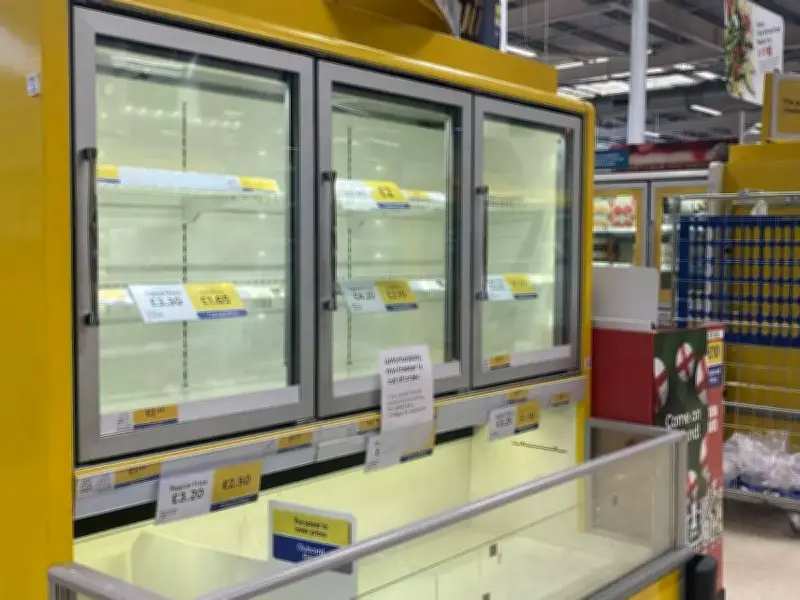
Supermarket shoppers have been greeted with empty shelves and broken fridges this week as the UK heatwave exposes a critical infrastructure weakness, with experts warning that households will ultimately bear the financial burden of adapting to a hotter climate.
Heatwave Exposes Fridge Failures
The June heatwave has seen temperatures reach highs of 36.9C, triggering health alerts across large parts of England, thousands of school closures, and train disruptions. Away from the immediate discomfort, experts warn the impact of rising temperatures will soon be felt in wallets through hiked supermarket food prices, higher household bills, and costly upgrades to homes and public buildings.
Sustainability expert Andrew Hulbert says the UK's recent extreme weather should be a wake-up call. "People think climate change is something that's coming in 50 years' time, but it's not - it's today," he said. "We've had record-breaking hot days this June, and fundamentally the UK's cooling infrastructure simply wasn't designed to work in temperatures above 30C."

Refrigeration Systems Overwhelmed
Empty chilled shelves and refrigeration units switched off during recent hot spells have become common in supermarkets. "When temperatures get too high, cooling systems can't operate properly," Andrew explained. "It's the same for supermarket fridge freezers. They're designed for the climate we've had over the last 20 or 30 years - not the one we're moving into."
Many commercial refrigeration systems rely on outdoor condensers, which become significantly less efficient during extreme heat. If temperatures above 35C become more common, businesses across the country could be forced to replace entire cooling systems with equipment capable of coping with hotter conditions. Those upgrades won't come cheap.
Consumers Will Foot the Bill
"The reality is, if we're consistently going to have temperatures above 35C, we'll have to upgrade cooling systems across the country," Andrew said. "That comes with a cost." He believes consumers will shoulder much of the financial burden. "It's not as if supermarkets are making huge profits. As infrastructure and energy costs continue to rise, some of those costs have to be passed on to the consumer. That's just business."
The challenge extends far beyond retailers. Schools, care homes, and hospitals are increasingly vulnerable to rising temperatures. Andrew pointed to his own children's school, where pupils have been allowed to wear PE kits during hot weather but classrooms still lack air conditioning. "I share a great concern about the longevity of schools, care homes and hospitals," he said. "In places like blood donation centres, rooms have to stay at around 19C. Some hospitals are thinking ahead, but they'll all be affected."
UK Playing Catch-Up on Infrastructure
Unlike countries such as the UAE, where buildings and infrastructure have long been designed to withstand extreme heat, Britain is playing catch-up. "We'll have to move closer to the kinds of systems used in places like Dubai," Andrew explained. "They've invested because they've always known they'd be dealing with those temperatures. We haven't."
Replicating that level of resilience across the UK would require enormous investment. "There are around 220 million dwellings across Europe," he said. "There's simply not enough money on Earth to fix that overnight." Despite the scale of the challenge, delaying action will only make the eventual costs even higher. "If you've got an air conditioning system that's 20 years old and we have a 35C day, it could fail completely. Then you've got the immediate cost of replacing it."
Call for Government Support
For businesses considering whether to invest in more resilient equipment now, Andrew's advice is simple: "Invest. The weather is only going to become more extreme - both hotter summers and colder winters." Yet despite mounting evidence that Britain's climate is changing faster than many expected, there remains little financial support to help organisations or households prepare. "I'd love to see a Government support scheme," he said. "But I'm sceptical."

Much of the political conversation remains centred on long-term net zero targets rather than adapting infrastructure for today's climate. "Everyone keeps talking about Net Zero 2050, but Net Zero isn't going to stop 35C days in June," Andrew argued. "We need to start talking seriously about adapting the country for the climate we're already living in."
Tips to Keep Your Fridge Freezer Summer Ready
- Check the temperature settings and make sure it's set between 3C and 5C and your freezer at -18C.
- Don't overload it with food that could restrict airflow.
- Keep the door closed.
- Clean the condenser coils.
- Defrost if necessary.
- Keep it away from heat sources.