

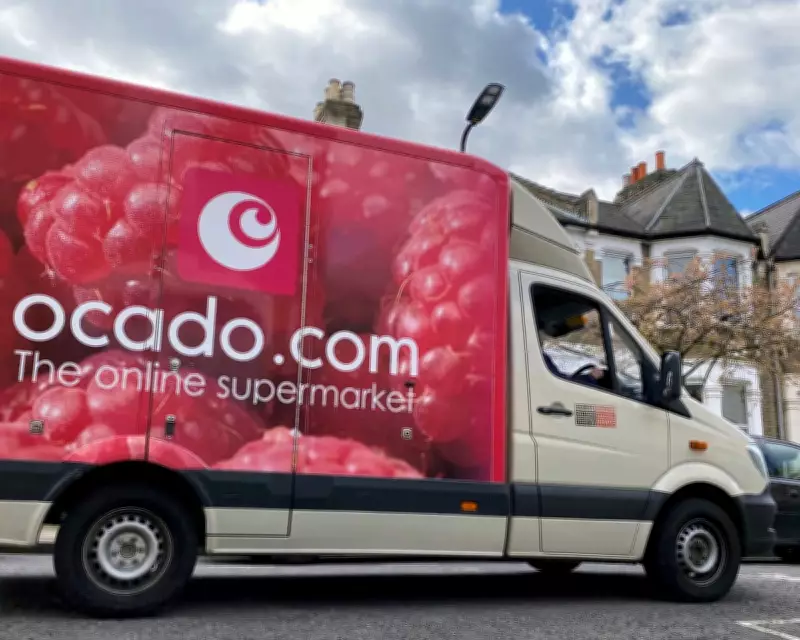
Ocado's Automated Ambitions Falter Amid UK's Online Grocery Reality
Ocado's retail joint venture with Marks & Spencer may hold the title of the UK's fastest-growing grocer, but stark figures reveal a broader market challenge: only about 13% of groceries are purchased online in the UK. This statistic underscores the struggles faced by Ocado Group, once hailed as one of Britain's great technology hopes, as it grapples with heavy losses and significant job reductions.
Pandemic Predictions Fall Short as Shares Slump
Just six years ago, Ocado's CEO, Tim Steiner, confidently predicted a dramatic shift towards online grocery shopping during the Covid-19 pandemic, suggesting it would bring forward a hi-tech future for supermarkets. However, today's reality paints a different picture. The company's shares plummeted more than 6% to 220p recently, following worse-than-expected annual losses and the announcement of 1,000 job cuts, half of which are in research and development. At this price, shares are a mere 22% above Ocado's 2010 stock market float price of 180p and a staggering 90% lower than their pandemic peak. Since its founding a quarter of a century ago, Ocado has rarely turned a profit.
Setbacks in Global Expansion and Technology Adoption
The company has encountered significant setbacks in expanding its technology to new clients, forcing it to scale back ambitions. In the US, major partner Kroger announced the closure of three warehouses using Ocado's equipment last November, followed by Canadian partner Sobeys shutting its Calgary facility two months later. Steiner admitted to the Guardian that "the market for large automated distribution centres in the US is smaller than we thought it would be." Internally, staff report unclear communications and stress, with technology offices across the UK, Bulgaria, Poland, Spain, and Canada facing potential closures or downsizing. One employee noted that morale is dropping due to repeated redundancies, and competitors are emerging rapidly.

Competition from Agile Delivery Models
While the online grocery market continues to grow, Ocado faces hefty competition. Grocers worldwide are finding that large, automated distribution centres, even when run efficiently with robots, are expensive and inflexible. Instead, many are turning to delivery aggregators like Deliveroo, Just Eat, and Uber Eats, which manage swift deliveries from stores using bike riders. Big operators such as Tesco and Sainsbury's have built their own networks combining hi-tech warehouses, store-based hubs, and direct shelf picking. Ocado's model requires hefty upfront investment in automated warehouses, state-of-the-art robots, and refrigerated vans, making it suitable for high-density cities but struggling to scale during demand spikes like the pandemic.
Investor Skepticism and Future Prospects
Chris Beauchamp, chief market analyst at IG, criticized Ocado as "one of the most impressive vehicles for shareholder value destruction we have seen," noting that larger rivals have bypassed its technology by building their own systems. Steiner counters that demand for Ocado's technology is "bigger than ever," with plans to introduce smaller-scale robotic equipment into local stores to enhance efficiency, potentially working alongside delivery aggregators. A similar model is being tested by client Morrisons in the UK. However, analyst Tintin Stormont from Deutsche Bank emphasized that investors are in a "show-me" phase, waiting for Ocado to monetize its innovations effectively.
As the UK's online grocery penetration remains low, Ocado's journey highlights the complexities of balancing technological ambition with market realities, leaving its future uncertain amidst evolving consumer preferences and fierce competition.






