
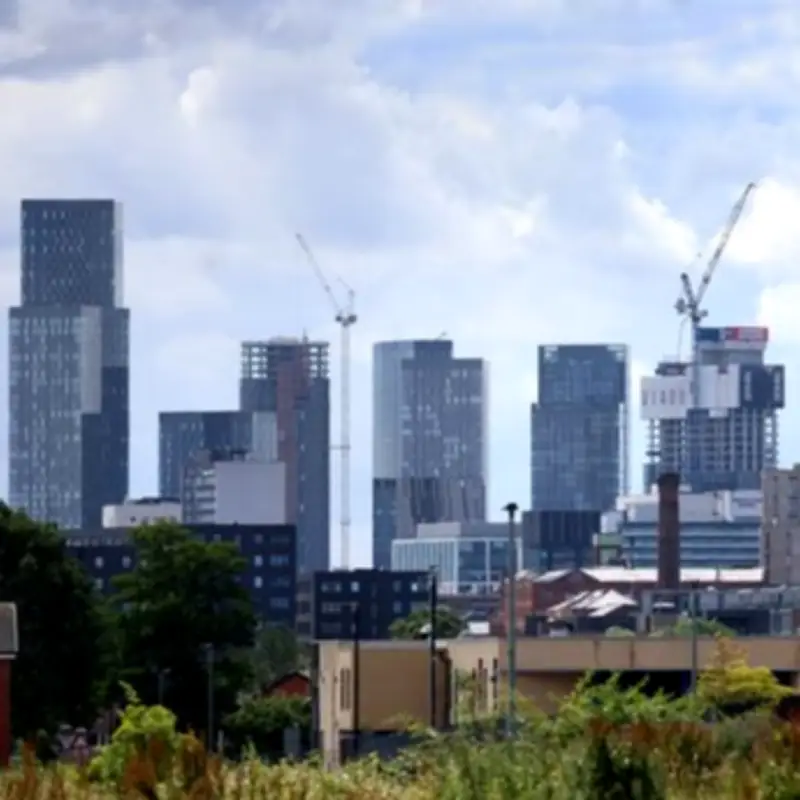
The Greater Manchester Combined Authority (GMCA) has defended its decision to loan £140 million to a skyscraper developer, claiming the process was ‘not a box-ticking exercise’. The authority was in the Court of Appeal on Tuesday and Wednesday this week over two loans it approved to Renaker, a company founded by Daren Whitaker which is behind many of central Manchester’s high-rise residential towers.
Money approved by the GMCA in March 2024 went towards two Renaker schemes in Manchester city centre, known as Trinity Islands and New Jackson. It was approved by a GMCA committee which is chaired by Andy Burnham, who is running in the Makerfield by-election on June 18. The cash came from a scheme called the Greater Manchester Housing Investment Loans Fund (GMHILF).
Legal Battle Over Loan Terms
But since then a legal battle has been fought between the GMCA and landowner Aubrey Weis. The GMCA was accused by Mr Weis in the Court of Appeal of approving the loans at ‘unduly favourable rates’. Lawyers representing Mr Weis said in their written arguments that GMCA loans to Renaker came with a base interest rate of 5.65 per cent, with an extra one per cent margin. But they argued that the extra margin should have been higher, at four percent. They also claimed that ‘no due diligence was ever conducted into Mr Whitaker’s liabilities or credit worthiness’, and that the loans were made on ‘what was obviously an unlawful basis’.
Joseph Barrett KC, representing Mr Weis, said on the first day of the hearing (June 9): 'Neither the decision maker, nor any officer involved in this process, ever inquired into or considered what pricing and terms would be available to the SPVs [special purpose vehicle] on the market for private commercial lenders.' On the second day of the hearing on June 10, Mr Barrett said a paper on the interest rate proposal for the loans was written ‘after the decisionmaker had made the decision’ to approve the funds. He told the court that the interest rate paper ‘never went to any decision maker, or any of the relevant committees’ at the GMCA.
GMCA's Defence
When questioned on the interest rate of the loan, Aidan Robertson KC, representing the GMCA, said: 'If they banged on the extra four percent, I think Mr Whitaker would run for the hills, he would have run to an alternative source of funding.' Mr Robertson said a ‘due diligence process’ took place over the approval of the loans, which he said has ‘several stages’ in total and includes going through a gateway panel and credit committee before loans are approved.
He added: 'I want to emphasise this was a decision-making process, you don’t just consider the public meeting on March 22 [2024] in isolation. This process was developed by the GMCA in consultation with external banking and consulting expertise, and was intended to allow the GMCA to perform a similar level of due diligence to a private sector lender.' Mr Robertson referenced the decision of a previous case over the loans which was heard at the Competition Appeal Tribunal (CAT) last year, which ruled in the GMCA’s favour.
He said: 'The tribunal makes the point that in this process after the public meeting that stage is followed by a due diligence process which may alter the terms of the proposed loan, with these particular loans that actually did happen. Loans may fail to proceed after the public meeting, that was evidenced before the tribunal that a certain proportion didn’t proceed. They may fall away for whatever reason, maybe because the applicant decided there were better terms from elsewhere.'
Mr Robertson went on to list other steps that are part of the process, including carrying out ‘legal due diligence’ checks over any loans being made. Asked why the interest rate paper was written after the loans were approved by the GMCA, Mr Robertson added: 'It was put together by the transaction manager, he’s been involved in this from the original proposal. He’s been involved in putting papers to the gateway panel and to the credit committee, so it’s within his knowledge that this is how the interest rates have been arrived at.'
Loan Repayment and Benefits
The loans are due to be repaid in March 2027 and so far around two thirds of the money has been drawn down for use, the court heard. Mr Robertson added that the Greater Manchester Housing Investment Loans Fund has been ‘revenue generative’ for the GMCA and government, and that it has ‘not lost any money’. 'This is simply to make the point that it’s in the authority’s interest for funding to be on property commercial terms to generate revenue,' he added. 'One of the objectives of regenerating Manchester city centre has been to encourage people to move back into the city.' The appeal was heard before Lord Justice Nugee, Lord Justice Zacaroli and Lord Justice Miles. The judgement from the Court of Appeal hearing will be made at a later date.




