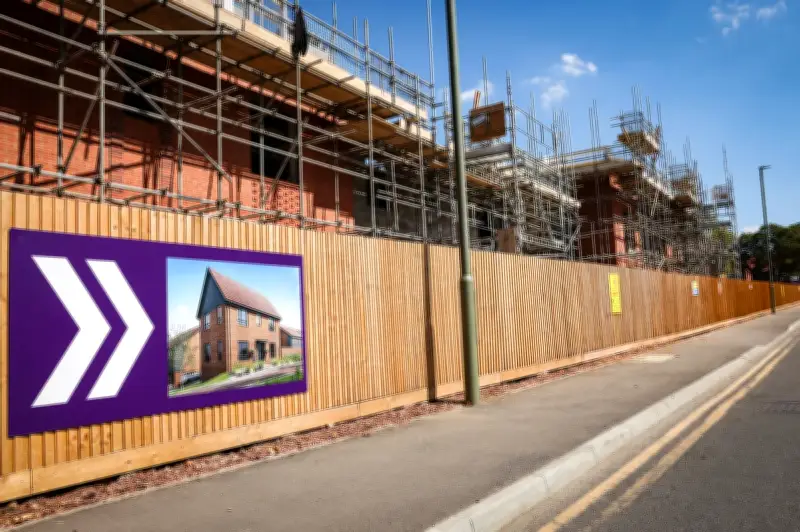
One of Britain's biggest housebuilders has said it will stop launching new housing developments in London, dealing a fresh blow to efforts to tackle the capital's housing shortage.
Taylor Wimpey chief executive Jennie Daly said the economics of building homes in London have become so challenging that the company no longer sees sufficient returns to justify the risks involved.
Her intervention comes as City Hall ramps up pressure on boroughs to approve more housing developments and seeks to boost construction across the capital amid a deepening housing crisis.
'Fundamentally broken' viability
Speaking on The Times' business podcast, Ms Daly said: "Baseline viability is, I think, fundamentally broken in London."
"The reward for undertaking what is a very high-risk form of development in London has just evaporated."
Taylor Wimpey is expected to complete a number of existing projects in the capital, but Ms Daly indicated the company does not currently intend to bring forward further schemes.
She pointed to a combination of factors that have made development increasingly difficult, including rising construction costs, additional taxes, planning requirements and weaker market conditions.
Regulations and viability reviews
Among the policies highlighted by the housebuilder giant was the requirement for new residential towers above 18 metres to have a second staircase, a measure introduced following safety concerns raised after the Grenfell Tower tragedy.
Ms Daly argued that a growing number of regulations and obligations had increased costs and made many schemes harder to deliver.
She also criticised the viability review process used by the Greater London Authority, which can require developers to increase affordable housing contributions if completed projects prove more profitable than forecast.
Under the system, councils and City Hall can review a development's finances at a later stage and secure additional affordable housing contributions where returns exceed original expectations.
"If it proves that I have made a good bet, effectively, and invested well and my scheme is profitable, I'd have to increase the level of affordable housing contribution," Ms Daly said. "I think for many, that has just proven too ambitious."
Impact on London's housing market
Her comments are likely to intensify the debate over how London can meet ambitious housebuilding targets while ensuring developments remain financially viable.
The capital remains one of the most expensive places in Britain to buy a home, with developers also facing concerns about affordability among prospective buyers.
Meanwhile, Sir Sadiq Khan has continued to push for more homes to be built and has increasingly intervened in planning decisions, calling in schemes that have been blocked or refused by local councils.
The Mayor has repeatedly warned that London needs tens of thousands of additional homes each year to meet growing demand and ease pressure on renters and first-time buyers.
The withdrawal of foreign investment in London due to higher financing and stamp duty costs is also said to be taking its toll on the housing market. "We don't have a strong domestic market on off-plan purchasing," Ms Daly said. "Although I totally understand the arguments against foreign purchasers, they did support that pre-delivery phase and allowed developers to mitigate their risk."
Planning battles and interventions
While Ms Daly admitted that Labour has made progress to improve the planning system, the consequences have not yet been reflected in planning decisions. Several London developments have faced rejection or legal defeat in recent years. In Kingston, the Motspur Park Gasworks 586-home development by Berkeley Group was frozen by Housing Secretary Angela Rayner and now faces a government review. Meanwhile, the same developer's 867-home development in Peckham has also been refused by the council.
At the time, Rob Perrins, executive chair at Berkeley, said: "How can we be allowed to build next to world heritage assets like Tower Bridge, but not here? This is why developers, including Berkeley, can no longer invest in new London sites and the housing crisis continues to deepen."
But Sir Sadiq Khan has ramped up action against councils who refuse to build homes, unblocking stalled housing schemes and reversing local planning refusals. This year alone, Sir Sadiq has intervened in eight major schemes and has vowed to use every power available to greenlight more homes for Londoners.
City Hall said that 10,058 homes will be delivered this year in the capital due to the Mayor's intervention. Examples include the Shoreditch Works scheme and the Canada Water development - both of which will bring more than 4,000 homes to the capital collectively.
The Mayor of London, Sadiq Khan, said: "Tackling London's urgent housing crisis is one of my top priorities and I am doing everything I can to deliver more homes.
"I promised to be bolder and more interventionist to get London building again, and that's what I've done. Our more muscular approach to call-ins means we are now delivering thousands of much-needed homes and other amenities for Londoners that would not otherwise have been approved."
Angela Rayner, Secretary of State for Housing, Communities & Local Government said: "Everyone deserves the security of a safe and decent home, and we know the scale of London's housing crisis demanded bold action.
"That's why we're backing the Mayor of London in getting more homes built – making sure good schemes are not left in limbo while unlocking jobs, growth and opportunity. We're also going further by expanding these powers to Mayors outside of London to make the big decisions and get this country building."