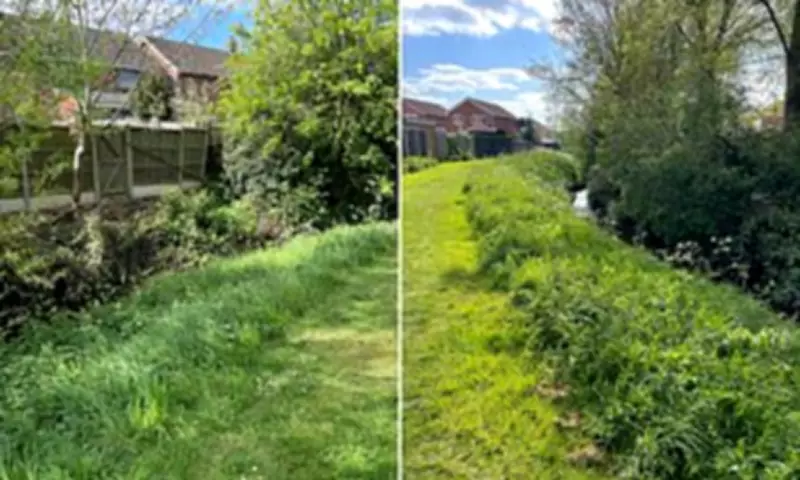
Homeowners Confronted with Massive Bills Under Centuries-Old Riparian Law
Homeowners in St Neots are facing the prospect of paying five-figure sums after their local council invoked a centuries-old legal principle to assert they are responsible for maintaining a stream adjacent to their properties. Graham Ottaway, 76, who purchased his semi-detached home with his wife approximately nine years ago, was originally informed that his property boundary ended at the garden fence.
Sudden Council Notification Sparks Financial Concerns
Just a few weeks ago, Cambridgeshire County Council notified Mr Ottaway and his neighbours that they hold riparian responsibilities for Duloe Brook, including upkeep of the waterway, surrounding foliage, and shrubbery. Riparian rights and responsibilities in the UK are legal obligations tied to land bordering water bodies like rivers, streams, or lakes, and can extend to ditches or brooks.
While riparian landowners enjoy certain entitlements, they must also maintain the waterway, address blockages, prevent flooding and pollution, and protect local wildlife. Failure to fulfil these duties, rooted in common law dating back to Ancient Rome, could lead to prosecution under modern legislation such as the Public Health Act 1936, Land Drainage Acts 1991 and 1994, Water Resources Act 1911, and Environment Agency Land Drainage Bylaws 1981.

Residents Express Shock and Financial Burden
Mr Ottaway insists he was unaware of these responsibilities, as they were not mentioned in the property deeds or by the conveyancer during the purchase. "When we did the searches on the property, if something had come back saying we're responsible for thousands of pounds worth of upkeep for the land beyond our fence, we probably wouldn't have bought the house," he told the Daily Mail.
Although responsibility for disclosure lies with the conveyancer, solicitor, and seller, the ultimate duty falls on the buyer to conduct due diligence. Sellers who fail to disclose a known watercourse could be liable for misrepresentation. Mr Ottaway noted he has been unable to find another street in the area subjected to this law, despite numerous streams running through the region.
Council Actions and Inconsistencies Highlighted
A letter from Cambridgeshire County Council, seen by the Daily Mail, informed residents of their riparian duty to maintain Duloe Brook up to their property boundaries. Council officers from the Flood and Water team inspected the area and identified vegetation and debris that could obstruct water flow, ordering removal by December 15 of last year. "The lack of maintenance of any watercourse for drainage purposes presents a risk of flooding and pollution," the letter stated.
Residents have taken no action to clear vegetation, according to Mr Ottaway, who claims inconsistencies in how the council applies riparian laws. He points out that homes on the opposite side of the bank are not responsible for maintenance, and some properties along the stream are also exempt. "It makes you think, will other councils just be able to do that if they no longer want to take responsibility for a piece of land?" he questioned.
Financial Implications and Community Impact
Mr Ottaway expressed concern over mature trees, including centuries-old oaks, on the bank, warning that if they fall, costs could escalate to thousands of pounds. "You're talking tens of thousands of pounds, you're not talking a few hundred. It's a major expenditure," he said. "It's quite intimidating because there's no ifs, no buts, about it."
He previously complained to St Neots Town Council about brambles encroaching on his fence and garden from the bank, but was told it was Huntingdon District Council's responsibility. After contacting Huntingdon, he was again redirected, leading him to pay £500 for a gate to access the bank for maintenance. Some neighbours have lived on the street for up to 15 years without hearing about riparian responsibilities, and a young couple with a baby were reportedly shocked by the revelation.

Council Response and Legal Context
A Cambridgeshire County Council spokesperson explained: "Following a report from a member of the public, we inspected Duloe Brook and found it to be in a poor state of repair. In general, the responsibility for maintaining watercourses rests with the owners of the adjacent land, however, specific responsibilities can vary, as laid out in leases and legal agreements."
The council has written to landowners to remind them of their duties and met with residents in November 2025 and March 2026 to address questions. They acknowledged that responsibility for watercourse maintenance is often not highlighted during conveyancing and have advocated for updates to the process, including a presentation to the Law Society in 2024.
Understanding Riparian Rights and Responsibilities
Riparian laws are not based on a single statute but derive from common law developed over centuries, with origins in Ancient Rome. Homeowners whose properties adjoin water have the right to reasonable use of the water, applicable when a watercourse forms a boundary or runs immediately nearby, even if beyond ownership. Alongside rights to use, flow, and purity, riparian landowners must keep the waterway free of debris, obstructions, and pollution, and ensure its maintenance.