

Cheshire Community Celebrates Victory but Faces Ongoing Uncertainty Over Land Development
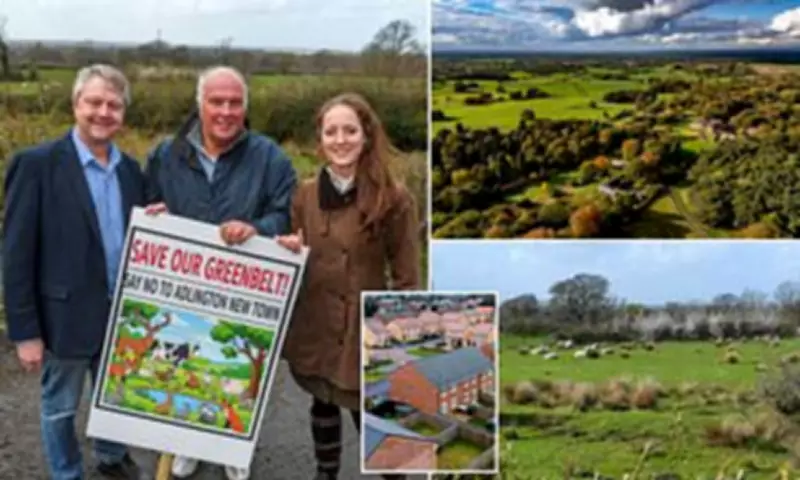
Residents and tenant farmers in the picturesque Adlington area of Cheshire are experiencing mixed emotions following the government's decision to exclude their locality from the list of seven new towns to be developed in coming years. While initial jubilation greeted the announcement, a profound sense of anxiety has now taken hold as the landowner, Belport, remains silent about its future intentions for the estate.
A Hard-Fought Campaign Against Urban Sprawl
The government's reversal came after an extensive campaign spearheaded by three distinct protest groups, supported by local councils and the area's Member of Parliament. Their collective argument centered on Adlington's unsuitability for large-scale development, citing its significant distance from essential public services, inadequate transport infrastructure, and its status as highly productive agricultural land. This pastoral landscape, characterized by gently rolling hills on the fringes of the Peak District, supports dairy and beef cattle alongside sheep farming, producing an estimated 4.5 million litres of milk annually.
Andrew Rowe, a 51-year-old business director and organiser of the Stop Adlington New Town campaign, encapsulated the community's fluctuating sentiments. "When the news landed that we had been removed from the list we jumped for joy," he said. "Now, we are back to the reality that we need to keep an eye on what Belport may pivot to next."

Tenant Farmers and Residents Await Clarity
The core of the uncertainty lies with the fifteen tenanted farms on the Adlington Estate, formerly owned by the aristocratic Legh family and now under Belport's control. With tenancies approaching expiration, farmers and residents fear the company may still pursue housing development on these plots.
Alex Kelsall, a 31-year-old cattle farmer whose 150-acre family farm was previously under threat of compulsory purchase, expressed relief for his own situation but deep concern for others. "We're now secure but it's the tenants whose future is still uncertain and it's still a very worrying time," he stated. "Belport own the estate and they are going to want a return on their investment. Some of the tenants have had their farms for generations. They have livestock and they still need some clarity."
Elderly campaigner Bridget Wenham, 80, highlighted the lack of communication, noting, "We haven't heard from them since before Christmas and there has only been one consultation event. We've never seen their full plans for how the new town would have been built."
Infrastructure and Environmental Concerns Persist
Locals argue that the area fundamentally lacks the necessary infrastructure to support substantial new housing. Adlington is served by only a single-carriageway A-road, already plagued by congestion, a railway station with a mere one train per hour in each direction, and a scarcity of school places. Recent development has been minimal, limited to small-scale projects like a former garage site in the hamlet of Whiteley Green.
Gerald Hartley, a 72-year-old business owner who moved to the area 25 years ago for its open countryside, defended the green belt's purpose. "There's a need for new housing but it's got to be in the right place with the correct facilities and the right sort of housing," he asserted. "It's designated as green belt and is highly productive farmland. The green belt exists to prevent urban sprawl. If developers were allowed to do what they want and ignore brownfield sites, we wouldn't have any countryside left."
Environmental value adds another layer to the opposition. Campaigner Aysha Hawcutt, a 48-year-old mother of two, pointed to the rich biodiversity, including deer, badgers, hedgehogs, lapwings, and over 200 species of moths. "Green fields are not empty land," she emphasised. "They're growing grass for the animals to produce food for the country to eat." She advocated for new homes to be concentrated in existing towns like Stockport and Macclesfield, which already possess the requisite facilities and infrastructure.

Political Support and Broregional Criticism
The campaigners received steadfast support from their local Labour MP, Tim Roca, whom they praised for his consistent opposition and strong representation of their concerns. Beyond the immediate locality, the proposal faced criticism across the North West region. Gerald Cooney, former Greater Manchester Labour council leader and election agent to ex-Deputy Prime Minister Angela Rayner, questioned the rationale behind selecting Adlington, suggesting profit maximisation for developers was a key driver rather than addressing housing shortages in Greater Manchester and other large towns.
Belport's Statement and the Shadow of Future Development
In a statement, Belport acknowledged the government's decision but left the door open for future development, describing Adlington as "a credible development opportunity" and "a viable proposition that can deliver homes for Cheshire and the North West alongside infrastructure and amenities."
This ambiguity, coupled with a recent planning inspector's decision to allow 540 new homes on neighbouring green belt land at Woodford Aerodrome, ensures the spectre of development continues to loom. Residents now face the prospect of battling individual planning applications rather than a single, government-led new town proposal. While this offers a chance to engage through the standard planning process, the community's hope for a definitive end to the threat remains unfulfilled, leaving them in a state of vigilant anticipation regarding Belport's next move.





