
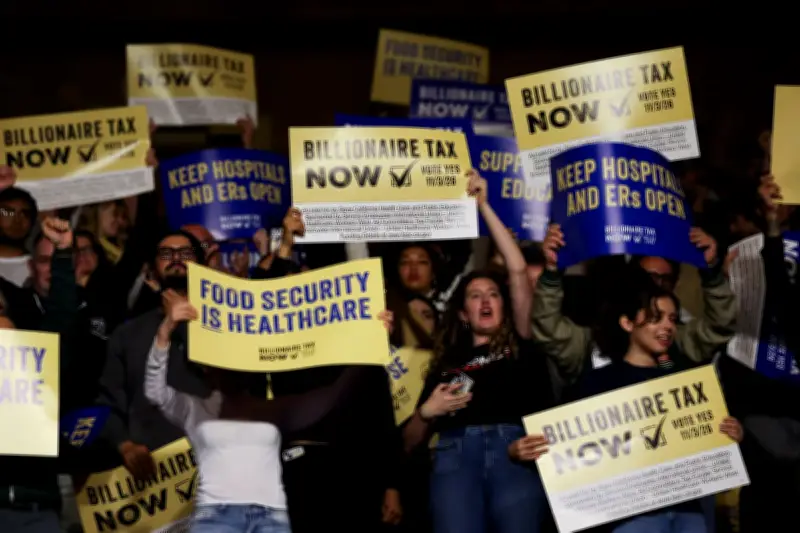
California voters will decide in November whether to impose a one-time 5% tax on billionaires, after the deadline for its backers to withdraw the measure passed on Thursday. The proposal, known as the California Billionaire Tax Act, qualified for the ballot after supporters gathered over 1.6 million signatures, one of the highest totals in state history.
Union-led effort aims to fund healthcare and education
The ballot initiative was put forward by the Service Employees International Union-United Healthcare Workers West (SEIU-UHW), which argues the tax would generate revenue for healthcare, education, and food assistance programs. Debru Carthan, vice-president of the union, said during a Thursday-evening press conference: "Enthusiasm for the billionaire tax is unlike anything we have seen before. The billionaire tax will be on the November ballot and we intend to win."
The proposal is among the highest-profile ballot efforts in the US targeting wealth disparities and is expected to be one of California's most contentious initiatives. Tech moguls have poured millions into opposing the tax.
Newsom fails to reach deal with unions
Negotiations this week between the unions and Governor Gavin Newsom failed to produce a deal before the 5pm Thursday cutoff. Newsom, widely viewed as a potential Democratic presidential candidate in 2028, has long denounced the wealth tax as a threat to the economy. The SEIU-UHW had offered a watered-down 2% tax, but Newsom rejected it. Dave Regan, president of the SEIU-UHW, said Newsom's office responded quickly to reject the union's offer, signaling the governor was "in lockstep" with California's billionaires.
Tech billionaires fund opposition
Silicon Valley elites have campaigned heavily against the measure. The Palantir co-founder Peter Thiel, crypto billionaire Chris Larsen, and former Google CEO Eric Schmidt have funded opposition groups such as the California Business Roundtable. Google co-founder Sergey Brin has spent tens of millions since January to defeat the effort, while co-founder Larry Page has moved to cut ties with the state. Brin donated $82 million to the Building a Better California Super Pac, which put forward a competing initiative to prohibit new taxes on retirement holdings and personal savings.
Labor and medical groups split on the tax
The measure has also drawn criticism from some labor unions. The California Teachers Association and the State Building and Construction Trades Council of California oppose the tax, claiming it would not provide sustainable funding. Medical organizations including the California Medical Association and Planned Parenthood Affiliates of California have also joined the opposition. A spokesperson for Planned Parenthood Affiliates of California said the group "agrees the wealthy must pay their fair share" but called the measure "shortsighted."
Proponents see strong public support
Proponents gathered over 1.55 million signatures by April alone, more than double the requirement for ballot qualification. The final tally exceeded 1.6 million signatures. Democratic Congressman Ro Khanna, who represents Silicon Valley, said he unequivocally backs the initiative: "The SEIU-UHW has shown incredible guts for standing for the healthcare of all Californians. It makes no sense to me why any Democratic elected official or traditional Democratic allies wouldn’t be supporting this."
California is home to about 200 billionaires, more than any other state, many of whom have increased their fortunes amid the AI boom. Sergey Brin's net worth has risen by nearly $100 billion in the past year to $258.9 billion, while Larry Page is worth about $280 billion, according to Forbes.




