

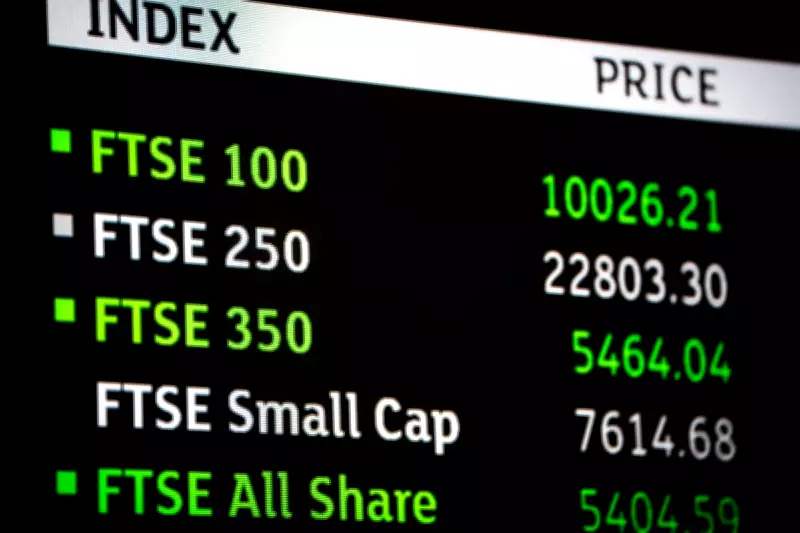
FTSE 100 Drops Amid Iran War and Inflation Concerns
Stock prices in London closed lower on Wednesday, with the FTSE 100 index falling 58.47 points, or 0.6%, to settle at 10,353.77. The decline was driven by persistent uncertainty surrounding the duration of the war in the Middle East and growing fears of higher inflation. The FTSE 250 index also ended down 110.93 points, or 0.5%, at 22,381.34, while the AIM all-share index closed down 5.19 points, or 0.7%, at 773.61.
European and Global Market Movements
In European equities, the Cac 40 in Paris closed down 0.2%, and the Dax 40 in Frankfurt ended 1.4% lower. The pound weakened to 1.3410 US dollars on Wednesday afternoon from 1.3458 at Tuesday's close, and the euro stood lower at 1.1571 dollars from 1.1648. Stocks faced pressure as Iran continued to target energy infrastructure and shipping in its conflict with the US and Israel.
The US military issued a statement warning that civilian ports in the Strait of Hormuz, allegedly used by Iran for military operations, are considered legitimate targets under international law. This escalation heightened tensions and contributed to market volatility.

Oil Market and Energy Sector Impact
Brent oil prices rose to $91.93 a barrel on Wednesday afternoon from $87.92 late Tuesday, reflecting supply concerns. In response, the International Energy Agency announced that its member countries would unlock 400 million barrels of oil from their reserves—the largest such release ever—to mitigate the impact of the Middle East war. IEA executive director Fatih Birol described the action as unprecedented in scale.
On the FTSE 100, oil majors saw gains, with Shell shares up 2.0% and BP rising 2.9%, leading the blue-chip index. However, stocks in New York were lower, with the Dow Jones Industrial Average down 0.8%, the S&P 500 index 0.2% lower, and the Nasdaq Composite falling slightly.
Inflation and Economic Indicators
Analysts noted that US inflation remains too firm for the Federal Reserve to provide additional support to the labour market. Consumer price inflation held steady in February, with the Bureau of Labour Statistics reporting a 2.4% year-on-year increase, matching expectations and January's figure. The yield on the US 10-year Treasury widened to 4.21% from 4.11%, and the 30-year Treasury yield stretched to 4.85% from 4.75%.
Corporate Performance Highlights
Legal & General shares fell the most on the FTSE 100, dropping 6.8%. The London-based insurer and asset manager reported core operating profit of £1.62 billion for 2025, up 5.9% from £1.53 billion in 2024 but below the £1.65 billion consensus. RBC Capital Markets attributed the miss to weaker Institutional Retirement and Asset Management business, along with higher group debt costs. Despite this, Legal & General announced a £1.2 billion share buyback programme, the largest in its history.
On the FTSE 250, Balfour Beatty led with an 8.9% jump in shares after reporting a 51% surge in pretax profit to £323 million for 2025 and recommending a higher dividend. Conversely, Hochschild Mining sank 7.2% despite significant revenue and profit growth, as its increased dividend fell short of market expectations.
Market Movers and Outlook
The biggest risers on the FTSE 100 included BP, Rentokil Initial, Shell, Hikma Pharmaceuticals, and InterContinental Hotels Group. The biggest fallers were Legal & General, Smiths Group, ICG, Fresnillo, and Endeavour Mining. Gold prices fell to $5,172.30 an ounce from $5,228.60.
Looking ahead, Thursday's economic calendar features US weekly jobless figures, trade balance, and building permits data. In the UK, full-year results are expected from M&G and Informa.






