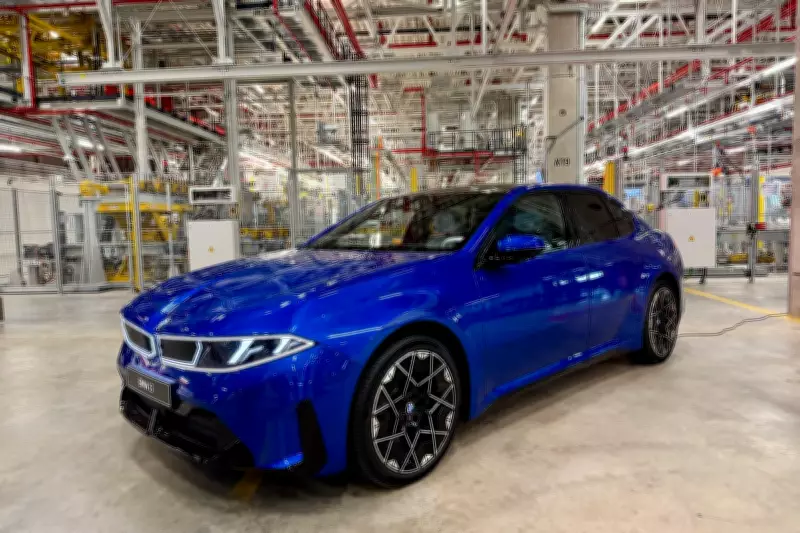
BMW Reinvents Historic Munich Plant as Electric Vehicle Production Hub
BMW has achieved a remarkable feat of industrial transformation by converting its historic Munich factory into a state-of-the-art production facility for the all-electric BMW i3. This urban manufacturing revolution represents a significant departure from traditional automotive production methods, proving that electric vehicle factories can thrive in city centers rather than requiring sprawling greenfield sites.
From Aircraft Engines to Electric Vehicles: A Century of Evolution
The Munich plant carries profound historical significance for BMW, having originally opened in 1917 to manufacture aircraft engines before transitioning to automobile production in 1950. Located near the iconic four-cylinder BMW headquarters that debuted during the 1972 Munich Olympics, this facility has long served as the production home for the brand's crucial 3 Series models. However, beginning in 2027, the factory will undergo a complete transformation to become a dedicated electric vehicle manufacturing site producing the new BMW i3, which represents the second model in BMW's innovative Neue Klasse lineup following the iX3.
The iFactory Philosophy: Urban Manufacturing Redefined
BMW has branded this transformation as the "BMW iFactory," with the Munich location serving as perhaps the most compelling example of this manufacturing philosophy. Unlike conventional automotive plants built on expansive industrial estates, this facility operates within the tight constraints of an existing urban footprint in Germany's third-largest city. Remarkably, the factory continued normal operations throughout its transformation, with approximately 1,000 vehicles produced daily even as construction progressed around ongoing manufacturing activities.

The iFactory concept revolves around four core principles: efficiency, sustainability, digitalization, and human-centered design. Space constraints have necessitated innovative vertical solutions, with the body shop positioned upstairs and the assembly hall spanning three floors across the second-largest of three new buildings. Vehicles progress from the third floor down to ground level before proceeding to testing facilities.
Substantial Investment and Digital Innovation
BMW has committed approximately €650 million (equivalent to £565 million) to convert the Munich facility into a fully electric production site. The transformation includes constructing new buildings on the former engine plant location while integrating Neue Klasse models into existing body press and paint shops. Despite the urban location's inherent spatial limitations, BMW has maintained expansion capacity for future production needs.
Digital innovation preceded physical changes, with BMW creating comprehensive digital twins of its plants in what the company terms a "factoryverse" to meticulously plan the transformation. This virtual planning environment enabled engineers to simulate production processes extensively before implementation. The resulting facility operates as a paperless factory with live digital tracking for each vehicle build, while artificial intelligence agents and humanoid robots complement automated guided vehicles that transport components throughout the plant.
Logistics and Automation at Industrial Scale
The logistics operation supporting the Munich factory is truly monumental, with over 1,000 trucks delivering approximately two million parts daily from storage facilities located just outside the city. A strict four-hour stock limit ensures components arrive precisely when needed for production. Many transport vehicles bear the names of project team members, reflecting BMW's commitment to maintaining human elements within an increasingly automated environment.
Automation plays a crucial role in both production speed and quality assurance. Approximately 800 industrial robots handle most joining work in the new body shop, achieving an automation rate nearing 98 percent. BMW reports that automated welding and screw fastening processes deliver greater accuracy, while camera systems assess paint quality to minimize defects and enhance production efficiency. The new i3 itself benefits from design simplification, containing significantly fewer components than its predecessor, with front-end assembly alone requiring one-third fewer parts.

Sustainability and Economic Impact
Beyond manufacturing efficiency, the Munich transformation serves as a test case for sustainable urban production. The facility incorporates solar panels and living roofs, with some robots partially powered by renewable energy. Waste heat generated from robotic movements helps warm buildings during winter months, while the plant achieves an impressive 99 percent scrap metal recovery rate. Even material handling equipment reflects environmental considerations, with hydrogen-powered forklifts selected for their rapid refueling capabilities compared to electric alternatives.
The economic implications extend beyond the factory gates, with a new battery gigafactory in Bavaria supporting local production and minimizing transportation requirements. BMW's high-voltage battery assembly plant at Irlbach-Straßkirchen, located approximately 90 minutes from Munich, will supply Gen6 batteries for the i3, while electric motors will arrive from BMW's Steyr facility in Austria.
Strategic Significance for European Industry
Incoming BMW chairman Milan Nedeljković has emphasized the Munich plant's broader significance for European industrial policy, stating: "Our business model is based on global free trade. Currently, this fundamental economic concept is coming under pressure. We in Europe must be careful not to fall behind." He expressed concerns that proposed industrial regulations focusing excessively on "Made in Europe" while neglecting global supply chains could potentially reduce innovation, growth, and prosperity across the continent.
Nedeljković further argued: "Europe needs to act more future-oriented by strengthening free trade and creating a positive business environment. We are convinced: Europe needs a strong industrial footprint. Since industry is the basis for applied science and innovation."
Human Element in Advanced Manufacturing
Despite extensive automation, BMW emphasizes that the iFactory philosophy prioritizes human workers alongside technological advancement. More than 7,000 employees work across various areas of the Munich plant, with enhanced training programs focusing on digital processes and new ergonomic workstations designed to improve working conditions. BMW describes the transformed facility as an innovation hub featuring cross-functional teams, with one executive explicitly stating there is "no way back to manual processes for BMW."
When production reaches full capacity, a new BMW i3 will emerge from the assembly line every 73.5 seconds, with each vehicle requiring approximately 30 hours to complete, including nine hours in the assembly hall. The facility will eventually produce multiple Neue Klasse models, including the BMW i3 Touring.
Historical Continuity and Future Vision
The Munich transformation represents a compelling narrative of industrial continuity. In 1972, the same year as the Munich Olympics, the plant produced two BMW 1600 2 electric models, providing early indication of the brand's electric future. The 2008 Project i initiative introduced the Mini E as BMW's first modern electric vehicle. Nearly two decades later, the company's electric ambitions have become physically embedded within its most historically significant manufacturing facility.
With one in four German-built automobiles bearing the BMW badge, the Munich transformation demonstrates that automotive manufacturing's future need not retreat to distant greenfield locations. Instead, production can remain embedded within urban centers, surrounded by historical context while being completely reimagined for the electric era. The calm efficiency observed during facility tours belies the revolutionary nature of this achievement, representing both a technical milestone and a statement about sustainable urban industrial development.