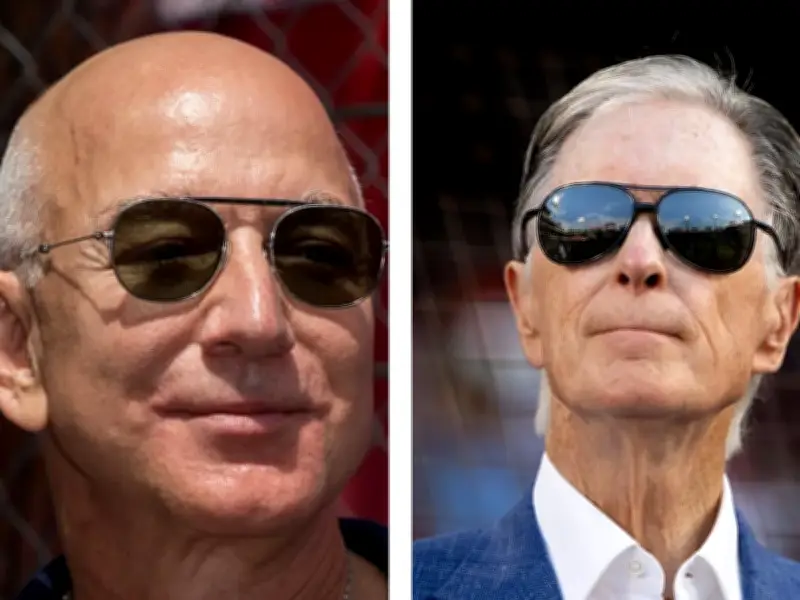
It will be 16 years in October since John W Henry stood on the steps of London law firm Slaughter and May with a promise that he, as Liverpool's new principal owner, was "here to win". It was Friday October 15 2010, when Fenway Sports Group, then known as New England Sports Ventures, loosened the vice-like grip of the detested ownership duo of Tom Hicks and George Gillett, whose ruinous reign had left Anfield on the brink of administration.
And as Henry and the rest of FSG get set to welcome on board a brand new set of investors, including some of the most powerful people on the planet, the Boston-based owners may conclude that they have in fact won. It's taken just over a decade-and-a-half for Liverpool, as a distressed asset, to go from being valued outright at £300m to seeing a £1.65billion investment for less than a third of the shares. In that regard, there is simply no other way to look at Henry's time in charge as anything other than a success.
Financial turnaround under FSG
Revenues have gone from just over £180m in 2011 to breaking the £700m barrier in the most recent results, announced back in January. While some of that is due to the Premier League's rising tide lifting all ships, it's undeniable that FSG have turned the Reds into one of the most well-run clubs in European and world football these past 15 years.
Viewing things from a financial perspective, however, does not tell the full story when it comes to Liverpool Football Club. While global popularity continues, this will always be a story of civic pride, at its heart.
Supporters' union seeks clarity
"If there's a thing that is in our raison d'etre, then this is our thing to do," says Jay McKenna, the chair of Spirit of Shankly - the supporters' union that has since written to the Independent Football Regulator for more clarity on Friday's investment news. "This is what we exist for. We campaigned against the ownership of Hicks and Gillett at the time but the Spirit of Shankly name is to hold the football club's owners to account. We always want to ensure the best of interests of supporters.
"That won't be a surprise to John Henry, Mike Gordon and Tom Werner because they have seen it across the last however many years, while they have been in charge of the club, and it is something they addressed themselves when they bought the club. So in terms of SOS, it is the reason we exist. And it's about making sure LFC exists for the next 100-odd years in the same way it has the previous 100-odd years."
Talks between the Amit Bhatia-led consortium and the Fenway group had been going on for more than a year, the ECHO has been told, long before news of their discussions became public, shortly after the club landed in Chicago for the start of their pre-season tour last month. By that point, Bhatia, the British-Indian businessman who is now the club's vice-chairman, was releasing statements confirming his departure from Queens Park Rangers after nearly two decades at Loftus Road. That alone suggested an agreement was nearing.
New investors and their appeal
Bhatia was said to have been introduced to Henry via Will McDonough, the chairman and founder of Corestone Capital and former representative of NFL legend Tom Brady. McDonough was a senior advisor to the White House Task Force for this summer's World Cup and helped facilitate a meeting during the competition at Zero Bond New York, an elite social club in the Manhattan district.
Bhatia's experience of English football after so long at QPR counted hugely in his favour for a group who have never shied away from their ongoing search for external investment. In 2022, FSG kicked the tyres on a full sale of the club and have been no doubt inundated with proposals ever since before Bhatia's consortium impressed. The idea of bringing on Jeff Bezos and Eduardo Saverin, somewhat naturally, also appealed hugely to FSG. Their enormous wealth was the obvious factor but the expertise and the resources of Amazon founder Bezos, the world's third richest man with an estimated fortune of £204billion, and Saverin - the co-founder of Facebook, worth a cool £24billion - was something those in the Fenway fold believed could, and now will, push Liverpool further into untapped markets.
"Why pick this group? The combination of deep pockets and a willingness, I think, to be relatively silent partners," former Liverpool managing director Christian Purslow told The Football Boardroom podcast this week. "It's not: 'By the way, I want a seat at the table, I want a seat on the transfer committee, I want to be chatting to Iraola about team selection'. I don't think Fenway would entertain that kind of investment. So I suspect it's that combination [that appeals].
"Let's be quite clear, John Henry was and is, at heart, is a professional investor. And this is going to be one of his greatest ever investments. I'm not party to how much money John made or didn't make in the commodities trading world but I can tell you right now buying a business for £300m and selling a stake in it for about £1.4billion 16 years later is one of the great home runs, to use a baseball term, in investing history."
Bhatia's presence, as the head of the consortium, is also seen as someone who can help the Reds explore the Indian and Asian markets, particularly given he is the son-in-law of Lakshmi Mittal, the executive chairman of the world's largest steel-making company, ArcelorMittal. Right now, though, grand plans for Asian exploration and further imprints on the other side of the Atlantic, using such powerful, impossibly wealthy backers like the Mittal family, Bezos and Saverin remain vague and opaque at ground level.
Concerns over future ownership
"Spirit of Shankly was formed on the back of bad ownership," says McKenna. "Fans had to fight to get information out there and this is a big change in our ownership. It's the biggest change in nearly two decades and there's loads of speculation, now more rampant about what it might mean in the next few years. Is it a full takeover [in the future]? Or an increased stake for these people? What does that look like? What are their plans?
"We are a fanbase and supporters from the city who aren't just going to take to people not telling us anything and we won't take it lying down. So it will be in their interest to provide more clarity on what this all means. We hope that can be done in a really honest way and we want to engage with them in the same way we do via the Supporters' Board. It would be a very good thing for them to provide more clarity about their intentions."
FSG have privately dismissed claims that the culmination of this deal marks the beginning of the end for their time as owners, although they did concede that the agreement was able to "provide flexibility" for how the relationship could evolve in the coming months and years. However, within minutes of the news being made public on Friday, a report from CNBC claimed that one of the deal's conditions gives the consortium the option, in 12 months' time, to become majority shareholders at Liverpool for just under £8billion.
That, in theory, opens the door for Bhatia, Bezos and Saverin - and their representatives on the new-look Liverpool board - to become majority owners at Anfield, without any indication to supporters right now as to how equipped they are to become custodians of the 20-time champions of England. That, understandably, is cause for concern, even accounting for Bhatia's background at QPR, who have been in the second tier since 2015.
McKenna adds: "One of the questions we will be asking is that we have been led to understand this change of ownership is guaranteed. We want to understand that and want to put it to FSG and the new owners. If we were told that the investors don't have the right to [complete a full takeover] or it's just an option and then next summer the club gets sold then we will want to know what we weren't told.
"They won't want the endless speculation, especially if people don't like the way it is going and they call for new owners. But fans will want to know that because it is about transparency and honesty and I think there is a way for the club to lead the way on this. I don't think anyone would look at this and say the level of the people involved are always content to just have a minority stake in Liverpool FC. They will want a say and if you asked most people, they would say it is to get a foot in the door and they want a bit of it long term.
"With FSG, that might not mean a 100% sale overnight but I can certainly see a world where they decrease their ownership over time. That will be a question we will want to ask in light of the media reports that it is a little bit more than an option, as opposed to a right to do it. So that is something we want to ask them."
However you view the £1.65billion investment, Liverpool have come a long way since their name was being dragged through Texan courtrooms in vain by an increasingly desperate Hicks in the Autumn of 2010. In that sense, Henry and FSG have made good on their mission statement. But after so long in possession of the keys to the Shankly Gates, the majority owners surely know there is always more to achieve at a club the size of the Reds. The eyes of the football world will now fixate on what happens next in the Anfield boardroom. But is everyone still there to win?