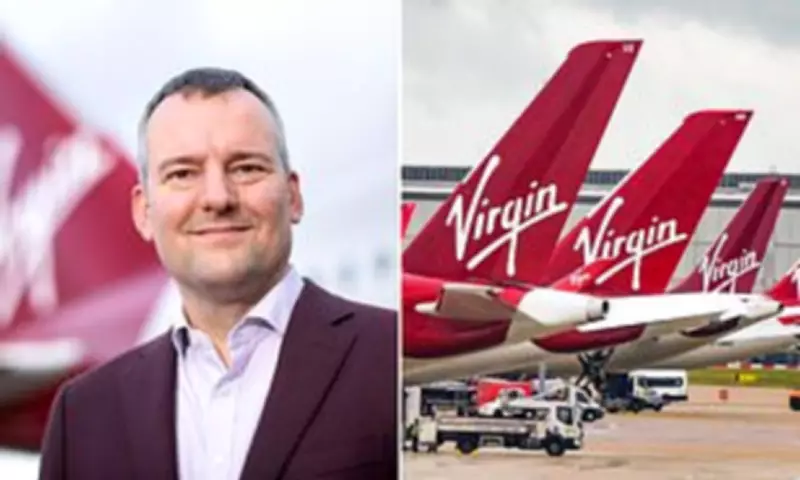
Virgin Atlantic's chief executive has cautioned that the aviation industry cannot withstand current jet fuel prices as airfares surge by as much as £360. The carrier, owned by Sir Richard Branson, has raised ticket prices amid the ongoing war in Iran, which continues to threaten jet fuel supplies. A fuel surcharge of £50 has been added to economy-class tickets, £180 to premium economy, and £360 to business class.
CEO's Concerns
Corneel Koster, the airline's CEO, expressed that his hopes for a much smoother financial year had been derailed by the fallout from the Iran war. He attributed this to jet fuel prices hitting record highs never seen before for the airline and cautioned that the industry cannot absorb increases on this scale. Speaking to The Telegraph, Koster said: 'I was looking at improving our financial results by a really significant chunk. And then this happens. We have never seen jet fuel at these levels, with prices more than doubling. The industry cannot absorb increases like this.'
Impact of the Iran Conflict
Jet fuel prices have more than doubled since the start of the US-Israel war with Iran, as the conflict has disrupted production and obstructed key transport routes across the Middle East. The Gulf region is a critical supplier of the world's oil and gas, including aviation fuel, accounting for roughly half of Europe's imports. Much of this supply passes through the Strait of Hormuz, which Iran has effectively closed in response to US and Israeli strikes.

Britain is especially reliant on jet fuel from the Middle East. Kuwait, which supplies more than four million tonnes a year (around 38% of total British imports), has seen its Mina Al-Ahmadi plant hit by a series of attacks, raising doubts about whether it can meet demand even if the Strait of Hormuz reopens.
Potential Government Measures
To offset this, airlines could be granted unusual flexibility this summer under new plans allowing them to adjust flight schedules in advance to offset potential fuel shortages. Ministers are finalising proposals to temporarily ease rules that require airlines to run part-full flights from UK airports. Currently, carriers that fail to operate these services risk forfeiting their valuable take-off and landing slots, which can be worth tens of millions of pounds.
Under the changes, airlines would be able to consolidate schedules months ahead of any disruption, reducing the risk of last-minute cancellations. While this could mean fewer flight options than usual, services that do run are more likely to go ahead as planned. Airline chiefs said the move would be crucial in avoiding widespread travel chaos and helping to prevent millions of Britons' summer holidays from being disrupted. Whitehall sources stressed that the measures, still being finalised, would be temporary.
'We are actively looking at what can be done. If it becomes necessary, we can implement the plans quickly,' a government source told The Times.
Cancellations and Route Reductions
Yet hundreds of flights have already been cancelled as the jet fuel crisis takes hold. Virgin Atlantic confirmed it has scrapped flights from London to Riyadh this month, while several other airlines — including British Airways, United Airlines, Scandinavian Airlines, Cathay Pacific, Air New Zealand, and Norse Atlantic Airways — have also announced route reductions.
Irish carrier Aer Lingus has cut more than 500 flights from its schedule in the coming weeks for 'mandatory maintenance' on aircraft. The airline is set to cancel several scheduled transatlantic services, including flights to and from Seattle, San Francisco, Minneapolis-St Paul, and Toronto, according to internal documents seen by the Irish Independent. The same internal information shows that services to London Heathrow, Manchester, Newcastle, Birmingham, and Edinburgh will also be suspended, with passengers rebooked onto alternative flights. Departures from Dublin to a range of European destinations — including Berlin, Zurich, Athens, Faro, and Amsterdam — are also being reduced.
Airlines UK, which represents major carriers such as British Airways, easyJet, and Ryanair, said: 'We are talking to the Government about crucial measures that will be needed to support aviation in the event of fuel disruption.'

Widespread European Disruption
Across the Continent, disruption has also been widespread. Earlier this month, German carrier Lufthansa said that a regional subsidiary, Lufthansa CityLine, will suspend operations due to high kerosene prices and labour disputes. Dutch airline KLM has also cancelled 160 flights across the next month as a result of rising fuel costs.