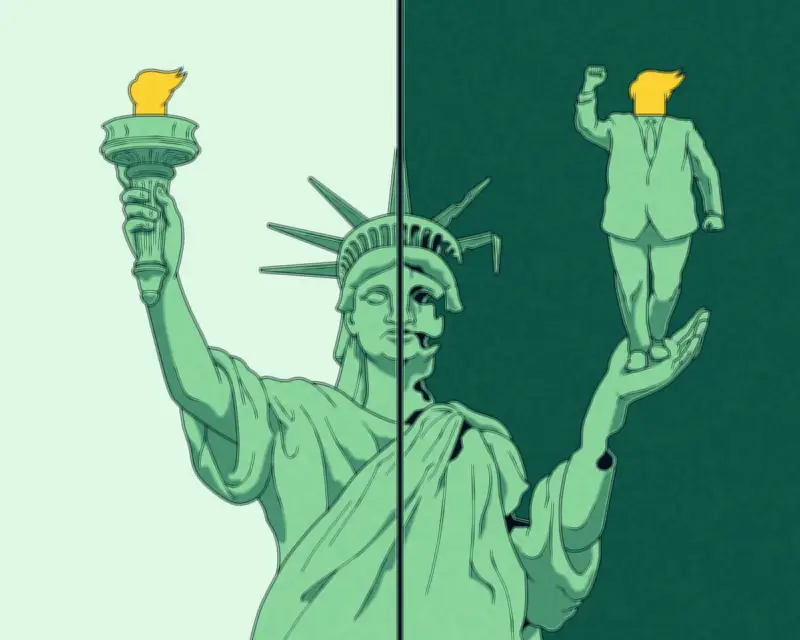
Democracy in the United States is now at its worst in 60 years, according to the Democracy Report 2026 from the V-Dem Institute at Gothenburg University. "Democracy in the USA," it says, "is now at its worst in 60 years." As the country marks the 250th anniversary of its founding, the anti-federalist fear voiced by Patrick Henry of an overmighty president abusing executive power to become a new king has come closer than ever.
V-Dem analysts note that in 2025 President Trump issued 225 executive orders, while the Republican-controlled Congress passed just 49 laws, most of them minor, such as a measure "to amend the Internal Revenue Code of 1986 to modify the rules for postponing certain deadlines by reason of disasters." The Heritage Foundation's Project 2025, built on the "unitary executive theory," is now more than halfway to completion, according to its own tracker, aided by supreme court rulings.
Trump's efforts to fix the election
The autocrat's playbook includes fixing the next election. Beyond extreme partisan gerrymandering—matched by Democrats in some places—there are multiple attempts to deny the vote to groups likely to vote Democratic, by restricting mail-in ballots, demanding on-the-spot documentary proof of citizenship, and other legal and procedural devices. If the 3 November result were close in districts that could swing control of the House of Representatives, Trump and the Republicans would pull out every stop to disqualify or exclude Democratic victors.
Why a landslide is required
That is why Garton Ash calls for a landslide. Hungary showed this spring that widespread popular revulsion, channeled into turnout, can sweep away all obstacles a would-be autocrat puts in place—even when those obstacles are larger than America's. The election may not be fair; it may not even be entirely free; but the result would be irrefutably plain.
Trump himself is doing the most to bring about an anti-Trump landslide. His tariffs and his "war of choice" in the Middle East have raised the cost of living, most visibly in petrol prices. The war against Iran has cost $37.5bn, according to official figures, with another $67.1bn already requested. Opposition to the war and the president's disapproval rating are both approaching 60%. His regime's blatant corruption adds to his unpopularity: one estimate puts his personal and family enrichment at roughly $2bn. The latest revelation is the plan by Fifa president Gianni Infantino, a Trump crony, to sell stakes in running the World Cup to an investment fund led by Joshua Kushner, Ivanka Trump's brother-in-law. Satire wilts at the pairing of Fifa and Trump.
An open goal for the Democrats
All this amounts to an open goal for the Democrats, but where is the Lionel Messi or Harry Kane to put the ball in the net? As a European in the US, one keeps asking: "Where's the leader of the opposition?" There is no disciplined campaigner like Hungary's Péter Magyar answering the mood for change with "and this is the change you need." Friends who study these things at Stanford University say such leadership rarely exists at this stage. The 1994 midterm, when Newt Gingrich's "Contract with America" shaped a nationwide campaign and delivered a big Republican victory, is the exception that proves the rule.
Usually, midterms are a referendum on the incumbent, with the president's party losing seats, especially in the House. But the scale varies widely: from 54 seats lost in 1994 and 63 in 2010 to just five in 1986 and nine in 2022. This time, a single-digit result would be vehemently and perhaps even violently contested afterwards.
The Democrats are making a poor job of scoring. Senate minority leader Chuck Schumer, 75, hardly resembles a prize striker, and in opinion polls the party vies with Trump for unpopularity. Much of the energy is with democratic socialists like New York mayor Zohran Mamdani, but can they win in Michigan or Wisconsin? Ezra Klein has suggested the diversity might be a strength—different candidates for different places. But getting the wrong candidate in just a couple of the 35 Senate seats up for grabs could cost the Democrats their slim chance of flipping the Senate.
What is at stake
The future of democracy itself is at stake, not just the Democrats' fortunes. A normal midterm change in control of the House is the absolute minimum needed to start checking, if not reversing, the unprecedented erosion of liberal democracy. That check would come through Congress's constitutional powers to control government funding, to investigate, and to impeach. A landslide would also bring a psychological shift, making Trump look like a "loser"—his own worst nightmare. He will try first to prevent, then to circumvent and delegitimate a Democrat-controlled House with all the means at his disposal. Nonetheless, it would be the end of the beginning.
Last summer, Garton Ash wrote that Americans had 400 days to save their democracy. It is now little more than 90.