

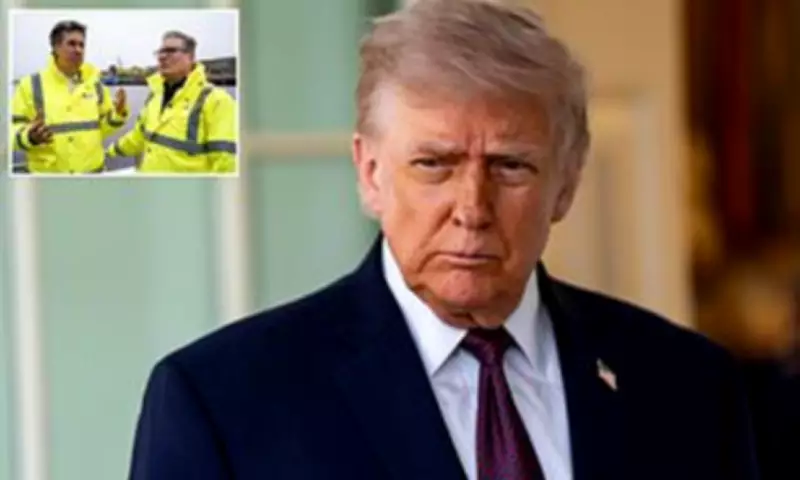
Former US President Donald Trump has launched a fresh verbal assault on Britain's Labour government, specifically targeting its Net Zero energy strategy. In his latest social media outburst, Trump questioned why the United Kingdom continues to restrict new oil and gas extraction in the North Sea while European nations grapple with severe energy shortages.
Trump's 'Drill, Baby, Drill' Mantra for Britain
Using his Truth Social platform, Trump implored Prime Minister Keir Starmer and Energy Secretary Ed Miliband to adopt his famous "drill, baby, drill" approach to energy production. The former president called it "absolutely crazy" that the UK refuses to exploit what he described as "one of the greatest fields in the World" for oil and gas.
"Europe is desperate for Energy, and yet the United Kingdom refuses to open North Sea Oil," Trump wrote in his characteristically emphatic style. "Aberdeen should be booming. Norway sells its North Sea Oil to the U.K. at double the price. They are making a fortune."

Renewable Energy Under Fire
Trump's criticism extended to Britain's renewable energy initiatives, which he dismissed with his trademark derision. The former president specifically called for an end to wind turbine construction, referring to them as "windmills" in his scathing assessment of what he termed Britain's "tragic" transition efforts.
This intervention comes against a backdrop of global energy market volatility, with Trump's own foreign policy decisions contributing to price instability. The former president's increasingly controversial approach to Iran has been identified as a significant factor in the recent surge of oil and gas prices worldwide.
Labour's Defiant Response
Senior Labour figures have begun pushing back against Trump's persistent criticism of Britain's energy policies. Prime Minister Starmer recently expressed frustration with how international conflicts, including those involving Trump's actions, are impacting British households through fluctuating energy costs.
"I'm fed up with the fact that families across the country see their bills go up and down on energy, businesses' bills go up and down on energy because of the actions of Putin or Trump across the world," Starmer stated last week, drawing a pointed comparison between the former US president and Russian leader Vladimir Putin.
Chancellor Reeves Weighs In
Chancellor Rachel Reeves has similarly criticised what she described as the "folly" of American foreign policy decisions and their consequences for UK families. While acknowledging that "no sensible person is a supporter of the Iranian regime," Reeves questioned the strategic wisdom of initiating conflicts without clear objectives or exit strategies.
"To start a conflict without being clear what the objectives are and not being clear about how you are going to get out of it, I do think that is a folly," Reeves remarked. "And it is one that is affecting families here in the UK but also families in the US and around the world."
Economic Implications and Policy Pressure
The International Monetary Fund recently highlighted how Middle Eastern conflicts have created what it termed a "major energy crisis" with particular consequences for the UK economy. According to the influential financial body, Britain has experienced the sharpest reduction in growth forecasts among major global economies following the latest regional tensions.
Energy Secretary Ed Miliband faces mounting pressure from within his own party to reconsider his stance on North Sea drilling. Several Labour MPs and trade union leaders are urging a relaxation of the ban on new oil and gas licenses as households confront the prospect of higher energy bills.
Net Zero Commitment Remains Firm
Despite this pressure, Miliband has maintained that recent international crises actually reinforce the necessity of accelerating Britain's transition away from fossil fuels. The Energy Secretary argues that global volatility demonstrates why the country must move "further and faster" toward achieving Net Zero targets.

"If there's one lesson we must learn from this crisis, we cannot keep being on this fossil fuel rollercoaster," Miliband told BBC audiences recently. "This is the mission this Government came in with. Some people said it was wrong, some people said it was not the right thing for the country. Unfortunately, very sadly, what this crisis demonstrates yet again - as Russia-Ukraine did - it is absolutely the right thing for the country."
Expert Analysis and Industry Response
Energy policy experts have questioned the substance behind Trump's intervention. Tessa Khan, executive director of campaign group Uplift, suggested the former president was "ill-informed" about both North Sea resources and UK energy policy fundamentals.
"The Iran crisis does not change the fact that the UK has burned most of its gas and most of what is left in the North Sea is oil, the majority of which is exported," Khan explained. "The price we pay for both oil and gas are determined internationally, so producing it here doesn't shield us from sky-high prices. New drilling will do nothing to lower bills and have only a marginal impact on our energy security."
The Department for Energy Security and Net Zero has been approached for official comment regarding Trump's latest criticisms and the ongoing debate about North Sea resource exploitation. As global energy markets remain unstable, the political and policy debate about Britain's energy future continues to intensify both domestically and internationally.





