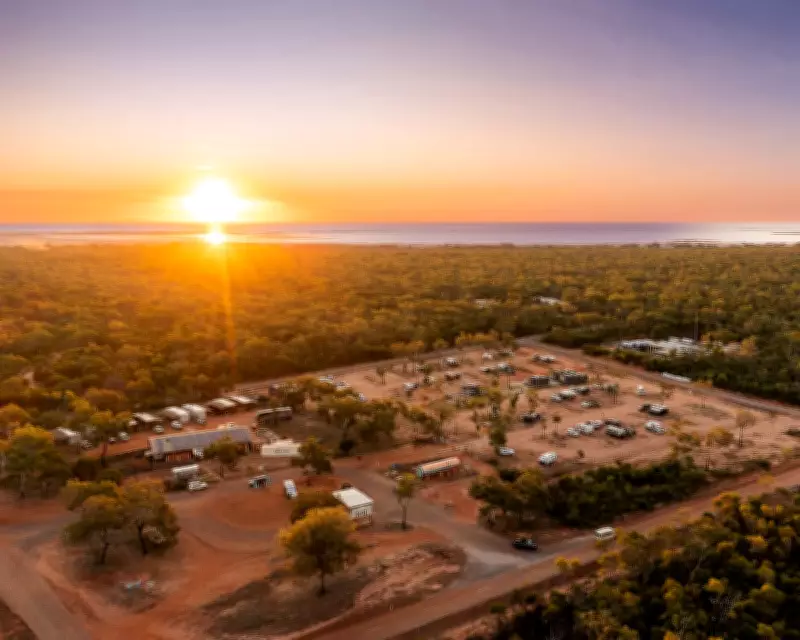
After community members began installing solar panels on street lights around Djarindjin in remote north-west Australia last year, local leader Nathan McIvor says they started to see the possibilities of taking ownership of their own electricity generation.
Community-Led Renewable Energy Project
Now, this community 200km north of Broome, home to nearly 400 Bardi and Jawi people, is planning to install a multimillion-dollar solar and battery farm. This facility would generate enough renewable energy to meet 80% of their power needs, significantly reducing reliance on government-owned diesel generators.
The project, named Aalga Goorlil (meaning "sun turtle" in the local language), comes as Australia grapples with rising fuel costs and limited supply due to geopolitical tensions.

Energy Self-Determination
Nathan McIvor, chief executive of the Djarindjin Aboriginal Corporation (DAC), stated that the community suffers from frequent power outages, prompting a push for energy self-determination. "We're investing in an idea," he says. "Ownership of everything. The time has passed where communities rely on a broken system, and we out at Djarindjin don't believe the system works for us."
Under their proposal, Djarindjin would significantly reduce its reliance on fossil fuels and externally owned power sources. "We believe that if there is an issue, it doesn't matter whether it was created by white, black, brown or brindle, we need to take ownership of those issues, we take ownership of the risks, and we take ownership of the rewards," McIvor explains.
Current Energy Situation
Currently, Djarindjin is powered by diesel generators provided by Horizon Power, an energy retailer owned by the Western Australian government. Horizon supplies power to 117 Aboriginal communities in WA. McIvor noted that DAC has already invested $2 million in feasibility studies and submitted a business case to the WA government. A government spokesperson acknowledged the work done and stated that the proposal is under assessment.
Federal Funding for Similar Projects
On Thursday, two renewable energy projects in the Northern Territory received full federal funding. The Ngardara Solar Microgrid (NSM) project in Borroloola, 1,000km south-east of Darwin, was awarded $8.3 million. This will fund a 2.1MW solar array and 1.8MW/6.6MWh battery, meeting 80% of the community's energy needs and saving an estimated 1.2 million litres of diesel annually over 25 years.
The project, funded by the First Nations stream of the Australian Renewable Energy Agency's regional microgrid program, is expected to reduce household electricity bills by up to 50%. It also includes a workforce development program offering 10 people a certificate II in construction and renewable energy, plus two electrical apprenticeships.
Critical for Remote Communities
Karrina Nolan, executive director of Original Power (an Indigenous-owned organisation that helped design the project), says renewable energy projects are "absolutely critical" in remote communities. "We've been saying for a long time, before there was a conflict in the Middle East and the diesel crisis – communities should and can be self-reliant and also climate resilient," Nolan says. "That also means if people are cut off due to cyclones, floods – all which have happened up here in the last eight weeks – that people can have their own power generation."
She adds that offsetting electricity bills with renewables allows households to invest savings back into the local economy. The remote community of Ltyentye Apurte (Santa Teresa), 80km south-east of Alice Springs, also received Arena funding for a microgrid to improve power reliability in an area prone to outages. CEO Ellie Kamara says construction is planned to start in March 2027, with the project allowing the community to sell excess electricity back to the grid, creating income for economic security.

Government Support
The minister for Indigenous Australians, Malarndirri McCarthy, stated that the projects in Borroloola and Ltyentye Apurte demonstrate the potential of community-led energy developments. "Reducing the reliance on diesel for power and electricity in places like Borroloola and Santa Teresa is critical to improving energy security and affordability in remote communities," McCarthy said. "Community-led microgrid projects mean more reliable, clean energy while at the same time supporting local training and job opportunities."