Oil Markets React to Potential De-escalation in Iran Conflict
Oil prices experienced a notable reversal during Asian trading sessions on Tuesday, shedding earlier gains following a significant report regarding the United States' stance on the ongoing military conflict with Iran. According to sources, President Donald Trump has communicated to his aides a willingness to terminate the American-Israeli war against Iran, even under conditions where the strategically vital Strait of Hormuz remains predominantly closed to maritime traffic.
Price Movements and Market Analysis
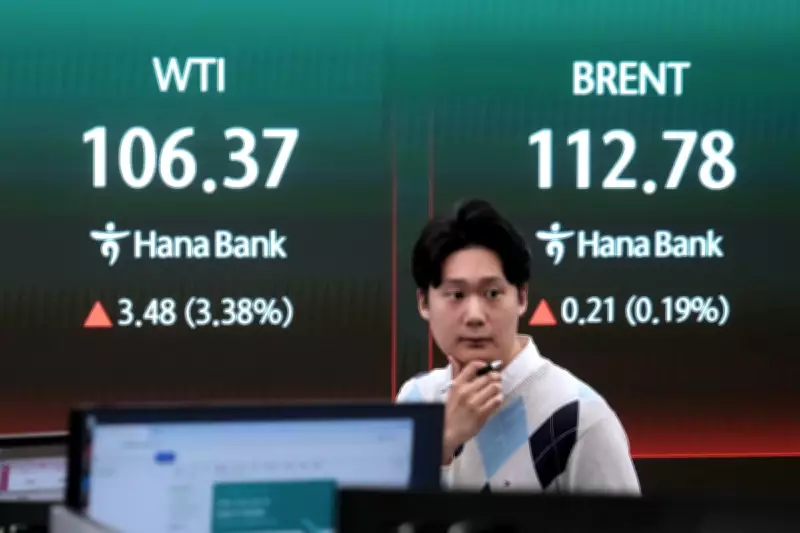
Brent crude futures for the May delivery contract declined by $1.22, representing a 1.08 percent decrease, settling at $111.56 per barrel by 0210 GMT. This downturn occurred after an initial surge of approximately 2 percent earlier in the trading session. The more actively traded June contract was recorded at $105.76 per barrel. Concurrently, US West Texas Intermediate futures for May fell by 98 cents, or 0.95 percent, to $101.90 a barrel, retreating from their highest levels since early March.
Market analysts have interpreted this price drop as a temporary reaction to the prospect of war cessation. However, they caution that any substantial and lasting adjustment in oil prices will only materialize once full navigation through the Strait of Hormuz is reliably restored. The waterway is a critical conduit, typically facilitating about one-fifth of global oil supplies and a quarter of liquefied natural gas shipments.

Geopolitical Developments and Supply Concerns
The Wall Street Journal reported on Monday, citing administration officials, that President Trump is prepared to conclude the military campaign against Iran without insisting on the immediate reopening of the Strait of Hormuz, potentially deferring that issue to a later date. This report follows a stark warning issued by Trump on Monday, threatening to "obliterate" Iran's energy infrastructure, including oil wells and plants, if Tehran did not reopen the strategic passage.
Iran's closure of the strait has already exerted immense upward pressure on oil markets throughout March. Brent crude futures surged by 59 percent during the month, marking the highest monthly gain on record, while West Texas Intermediate experienced a 58 percent increase, the most significant rise since May 2020.
Sugandha Sachdeva, founder of the New Delhi-based research firm SS WealthStreet, commented on the situation, stating, "While diplomatic signals remain mixed, the ground reality suggests that uncertainty will persist. Even in the event of de-escalation, restoring damaged infrastructure will take time, keeping supply tight."
Regional Tensions and Supply Chain Disruptions
Further complicating the energy landscape, Kuwait Petroleum Corporation disclosed on Tuesday that its fully loaded crude oil tanker, the Al Salmi, capable of carrying up to 2 million barrels, was struck by an alleged Iranian projectile at a port in Dubai. Officials have raised alarms about potential oil spills in the vicinity, highlighting the ongoing threats to seaborne energy supplies.
In a separate development, Yemeni forces targeted Israel with missiles over the weekend, escalating concerns about possible disruptions to the Bab el-Mandeb strait. This chokepoint links the Red Sea and the Gulf of Aden and serves as a key route for vessels traveling between Asia and Europe via the Suez Canal.
Data from Kpler indicates a significant rerouting of Saudi crude exports through this passage. Volumes redirected from the Gulf to the Red Sea port of Yanbu reached 4.658 million barrels per day last week, a sharp increase from the January and February average of 770,000 barrels per day.
Inventory Data and Market Sentiment
A preliminary Reuters poll released on Monday suggested that US crude oil stockpiles, along with distillate and gasoline inventories, are expected to have declined last week. This data adds another layer to the complex supply-demand dynamics influencing global oil markets.
Vandana Hari, founder of oil market analysis provider Vanda Insights, summarized the prevailing market confusion, stating, "Contradictory statements and signals on the state of the war are flying thick and fast, and truth and facts are the biggest casualty. Crude is likely to continue being whiplashed and directionless."

The oil market remains highly sensitive to geopolitical developments, with traders closely monitoring diplomatic signals, military actions, and supply chain disruptions. The potential for de-escalation in the Iran conflict offers a glimmer of hope for stabilized prices, but the path forward is fraught with uncertainty, infrastructure challenges, and regional volatility that will likely keep markets on edge in the coming weeks.