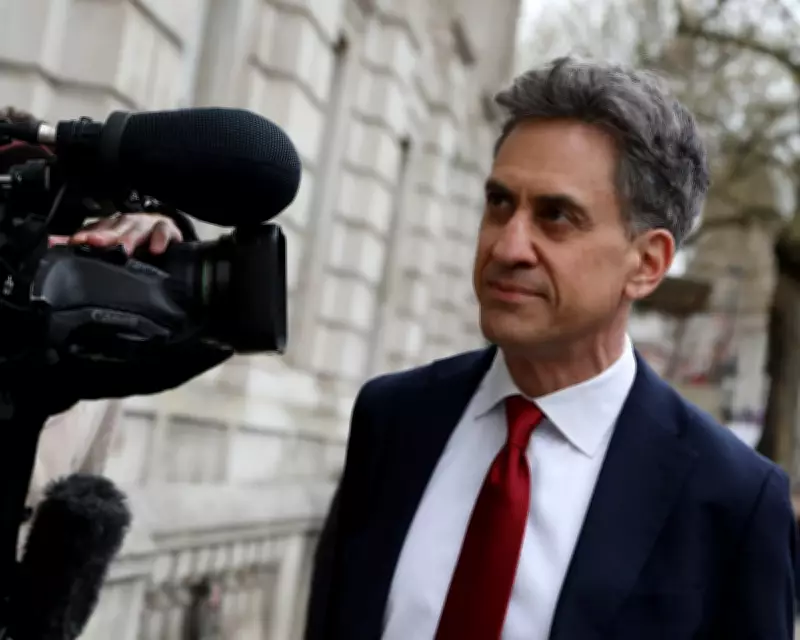
Energy Secretary Ed Miliband arrived at the Cabinet Office in London for a Cobra meeting on the Middle East crisis on 31 March 2026, as captured in a photograph by Alishia Abodunde/Getty Images. This high-level gathering underscores the escalating geopolitical tensions that are now directly influencing domestic energy policy debates in the United Kingdom.
Labour's Green Pledge Under Siege from Reform UK's Fossil Fuel Fantasies
It is deeply concerning to witness the Labour Party even considering entertaining Reform UK's unrealistic fantasies about expanding fossil fuel extraction. As columnist Zoe Williams argues, only a steadfast commitment to renewable energy sources can genuinely deliver lower household bills and enhanced national energy security in the long term.
The Political Bind: Principles Versus Populist Pressure
Ed Miliband currently finds himself in a significant political dilemma. Reform UK, led by Nigel Farage, is aggressively advocating for the issuance of new oil and gas exploration licences in the North Sea. They misleadingly frame this as a straightforward solution to reduce fuel costs for ordinary citizens. This narrative is steadily gaining traction, attracting cheerleaders not only within certain media circles but also among some trade union factions.

This places the Labour government in a precarious position. Having secured power with a manifesto strongly supportive of green policies—much of which has already been diluted or abandoned—the core principle of prioritising renewable energy over fossil fuels remains. Authorising fresh exploration in the North Sea would blatantly contradict every foundational principle of the party, and particularly those of Miliband himself. His political legacy is intrinsically tied to a career-long, determined, and often gruelling legislative battle against climate breakdown.
Yet, the pressure from Nigel Farage and Reform UK is intensifying. Farage has masterfully framed the debate as an elemental clash between the everyday common person and out-of-touch metropolitan elites. He propagates the notion that the so-called 'wokerati' are indifferent to the cost-of-living crisis, while the political right genuinely cares. The ongoing war in the Middle East fortifies this narrative, fostering a pervasive sense of scarcity, fear, and a desire for energy independence from volatile global markets.
The Illusion of a Quick Fix: Why North Sea Drilling Fails
The Forties Bravo oil platform, situated 110 miles east of Aberdeen in the North Sea, symbolises an industry in decline. The Conservative government initiated the 33rd licensing round back in October 2022, which was met with fierce opposition. Even then, before any acute oil crisis or substantial threat from Reform UK, this move was largely political posturing rather than a practical energy strategy.
The North Sea is no longer an attractive prospect for major investors. It can be likened to the last few individuals remaining at a nightclub at closing time—only about a quarter of the available blocks received any bids. While free-market advocates blamed the windfall tax introduced in 2022, the reality is that energy companies were posting record profits due to the Russia-Ukraine conflict. Their hesitation to invest was not driven by financial hardship.
Should Labour succumb to pressure and announce a new licensing round now, the impact on consumer energy bills would be negligible. Even if development commenced immediately—which is unlikely—it would take five to seven years for new wells to become productive. Furthermore, UK-produced oil and gas cannot be ring-fenced for the domestic market; it is sold on the global market where prices are set internationally. Scraping together marginal reserves from a depleted basin years later is a futile exercise that does nothing to insulate the UK from global price shocks.
The Renewable Alternative: A Path to Security and Lower Bills
The constructive and effective strategy to shield households from price volatility and bolster national resilience is to decisively break from fossil fuel dependency. Investing aggressively in renewables like wind, solar, and currently underutilised hydrogen offers an immediate and long-term solution. This approach would directly reduce bills, combat climate change, and craft a powerful, positive political narrative.

Remarkably, since the Middle East crisis escalated, the UK's wind and solar power generation has been breaking records, according to analyses by Carbon Brief. This demonstrates the viability and strength of the renewable sector. The story of the North Sea is one of inevitable decline and obsolescence, whereas the story of British wind power is one of abundance, innovation, and discovery.
Navigating the Political Storm
The real enigma is why this is portrayed as a complex dilemma at all. There is no scenario where Labour can appease Reform UK or alleviate voter anxiety by indulging in a nostalgic fantasy that cannot keep the lights on. There is no political advantage in muting commitments to renewables or resorting to temporary measures like price caps.
The only viable path for Labour to emerge intact from the impending cost-of-living pressures and far-right political pressure is to master the art of storytelling. They must confidently articulate a narrative that is both truthful and radical in its practicality. Nigel Farage is merely beating an empty oil drum; the Labour government does not need to drop its principles and dance to his tune. The future of UK energy security, economic stability, and environmental responsibility depends on a clear, unwavering commitment to a renewable energy transition.