Labour's Solar Panel Push Faces Criticism as 'Tone Deaf' Amid Regional Disparities
Labour's ambitious drive to blanket British rooftops with solar panels has been branded as "tone deaf" by critics, with new analysis exposing significant regional inequalities in adoption. More than 1.6 million homes across the nation have already installed panels, typically costing homeowners up to £8,000 for Chinese-made equipment.
Solar Dead Zones and Hotspots Mapped Across the Country
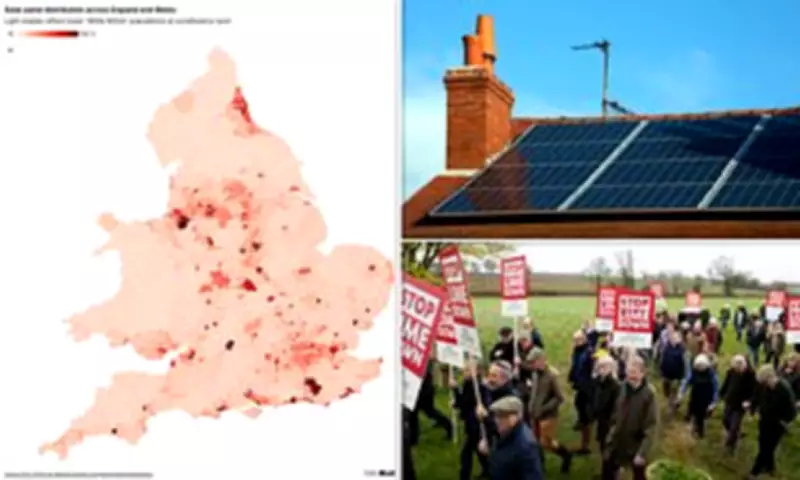
Interactive mapping reveals that parts of the United Kingdom remain solar dead-zones, with installations as sparse as just one per square kilometre in areas like Hexham, Northumberland. In stark contrast, Plymouth Moor View has emerged as the nation's solar panel capital, boasting 144 installations per square kilometre.
The top five constituencies for solar panel density include:

- Plymouth Moor View (144 per sq/km)
- Leicester East (122 per sq/km)
- Bristol Central (117 per sq/km)
- Manchester and Withington (116.9 per sq/km)
- Nottingham East (106.9 per sq/km)
Political Opposition and Policy Criticism
Richard Tice, Reform UK's shadow business, trade and energy secretary, has launched a scathing attack on Labour's approach. "While we support targeted rooftop solar where it actually works, we do not support Mad Miliband's Net Zero push that risks wrecking our countryside and valuable agricultural land," Tice told the Daily Mail.
He emphasized the timing concerns, stating: "At a time when household bills are already skyrocketing, it is completely tone deaf for Labour to push the public into buying expensive plug-in solar panels." Tice confirmed Reform UK's position would involve scrapping what he termed "Net Stupid Zero policies" to reduce energy bills.
Labour's Expansion Plans and New Initiatives
Under Labour's ambitious expansion strategy, Britons may soon access plug-in solar panels from major retailers including Lidl and Amazon. Energy Secretary Ed Miliband has indicated he wants homeowners to have this option "within months," citing the economic impacts of Middle East conflicts as justification for his controversial Net Zero agenda.
These plug-in versions, priced around £400 and suitable for patios or balconies, aim to reduce pressure on the national grid. Another significant initiative announced by Miliband will require most new homes to incorporate onsite renewable electricity generation, likely through solar technology.
Controversial Solar Farms and Community Resistance
The proliferation of solar technology, driven by Labour's Great British Energy goal, has extended beyond rooftops to massive solar farms covering hectares of countryside. One particularly contentious proposal is the Lime Down project in Wiltshire—a planned 500-megawatt, 3,000-acre solar farm north of the M4 near Malmesbury.
After two years of local community resistance, energy firm Island Green Power submitted official plans in January, though Wiltshire Council has already pledged to fight the development.
Financial Support and Installation Statistics
The Warm Homes plan, backed by £15 billion in taxpayer funding, enables homeowners to apply for low and zero-interest loans for solar panel installations—what the government has termed a "rooftop revolution." Since Labour assumed power in June 2024, Energy Secretary Ed Miliband has aggressively pursued Great British Energy objectives with taxpayer-backed subsidies.
This drive has resulted in over 177,000 domestic installations completed in 2025 alone—equivalent to 485 installations per day. Solar energy contributed 6 percent of the UK's annual electricity last year, boosted by the sunniest summer on record, though wind and gas remain the dominant power sources.
Expert Warnings and Strategic Concerns
Labour ultimately aims for 95 percent of Great Britain's electricity to come from clean energy sources including nuclear, solar, and wind power. Currently, the UK possesses approximately 22 gigawatts of solar capacity, compared to China's world-leading 887 gigawatts—representing over half the global total.

Experts have raised significant concerns about solar investment in the UK context. Professor Peter Dobson of Queens' College Cambridge's Physics department told the Daily Mail: "Domestic investment should be spent on nuclear energy as soon as possible—the UK is one of the worst countries in the world to invest in a solar energy scenario."
He criticized political approaches, stating: "None of the political parties have addressed the issue properly and strategically. The timescales have been made too short for proper planning and too few engineers have been involved in the decision making. It is time to stop policy decisions being made without a detailed techno-economic assessment."
Geopolitical Risks and Infrastructure Limitations
Ed Miliband faces substantial pressure to avoid excessive reliance on China for solar power—a nation identified by MI5 as a threat to UK economic and national security. Defence and intelligence officials express concerns about Chinese influence over UK energy infrastructure, heightened by ongoing Middle East conflicts.
Chancellor Rachel Reeves has attempted to reassure the public by promising support for "those who need it most" as oil and gas prices experience increasing volatility. The UK Solar Alliance, campaigning against rapid solar expansion, argues the technology remains inefficient and overly dependent on China.
A spokesman emphasized: "Net Zero cannot mean blind speed. Where a critical infrastructure programme relies heavily on manufacturing concentrated in one geopolitical sphere, that is a strategic dependency and it deserves open and sober assessment, not dismissal. Decarbonisation should reinforce resilience, not quietly introduce new structural exposure."
Additional challenges include the UK's inclement weather limiting consistent year-round solar power generation and the current lack of infrastructure to store excess summer energy for winter use.