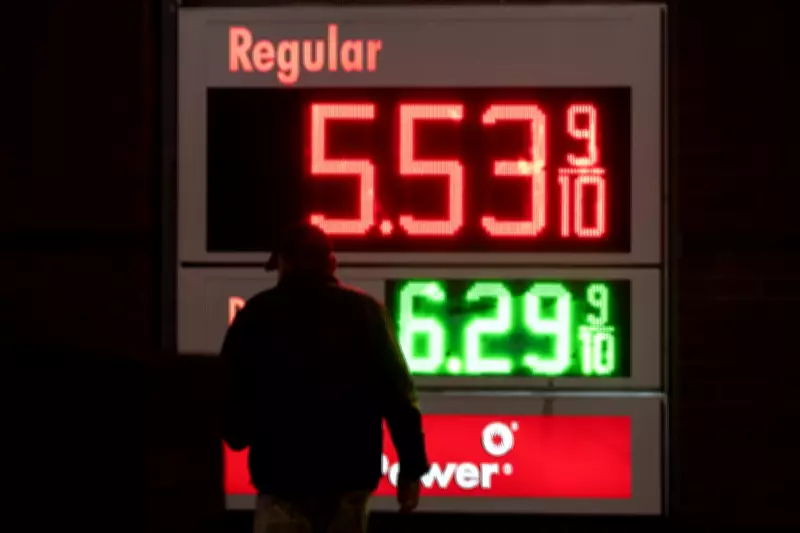
Americans could soon see gas prices hit $5 a gallon, according to analysts at JPMorgan Chase & Co. The ongoing war with Iran is no longer just driving up crude oil prices – it is now squeezing global fuel supplies in ways that could increase the cost of gasoline, diesel and jet fuel, the analysts warned in a note Friday, as reported by Bloomberg.
Refining and Fuel Crunch
“If refinery runs continue to be constrained by limited supplies of crude, fuel prices, rather than crude prices, may become the ‘primary transmission channel for demand destruction,’” Natasha Kaneva and a team of analysts said in the note. “In that scenario, crude could plausibly stabilize around $100 [a barrel] even as product cracks widen sharply. The next phase of the shock then may look less like a classic crude spike and more like a refining and end-user fuel crunch.”
“This likely helps explain why US gasoline prices are at [$4.55 a gallon] and why the risk of $5 gasoline can no longer be dismissed,” the analysts added.

Price Surge and Driving Season
U.S. gasoline prices quickly surged above $4 a gallon in March for the first time in four years. A temporary peace agreement between the U.S. and Iran in mid-April briefly eased prices before fuel costs climbed again, nearing $4.50 a gallon in early May. “The timing could hardly be worse,” the analysts wrote. “The US driving season unofficially begins with Memorial Day at the end of May.”
Americans have spent $23.9 billion more on gas, year-on-year, since March 1 because of the Iran war’s impact on U.S. fuel prices, according to Patrick DeHaan, head of petroleum analysis at tracking site GasBuddy, who posted on X. The astronomical added cost breaks down to $6,462 a second and $23.3 million every hour, DeHaan noted. It’s the equivalent of paying for 1.2 billion hours of daycare; the combined budget for the National Science Foundation, Small Business Administration, and the Department of State; and just $1 billion shy of U.S. costs for the war so far.
Impact on Drivers
Oil prices soared in early March as shipping in the Strait of Hormuz, which sees the transit of 20 percent of the world’s oil supply, ground to a halt over fears of Iranian attacks on tankers. Drivers of large vehicles are feeling the impact. Filling up a Ford F-150’s 36-gallon tank now costs $160.56, based on AAA’s U.S. average price of $4.46 for a gallon of gas on Monday, May 4. That is up from $114.12 a year ago, an increase of $46.44 per fill-up. Even for drivers who have bought a less gas-guzzling vehicle, such as the Toyota Camry, costs are still elevated with drivers paying significantly more than they did last year.
Administration Response
The Trump administration has argued that prices will fall once the conflict ends, though there is no clear timeline for when that might happen. When gas prices were above $4 a gallon in mid-April, Trump brushed off the sharp increase by telling reporters gas prices were “not very high.” Earlier this month, Trump said that once the war is over, gas prices will “drop like a rock.”