

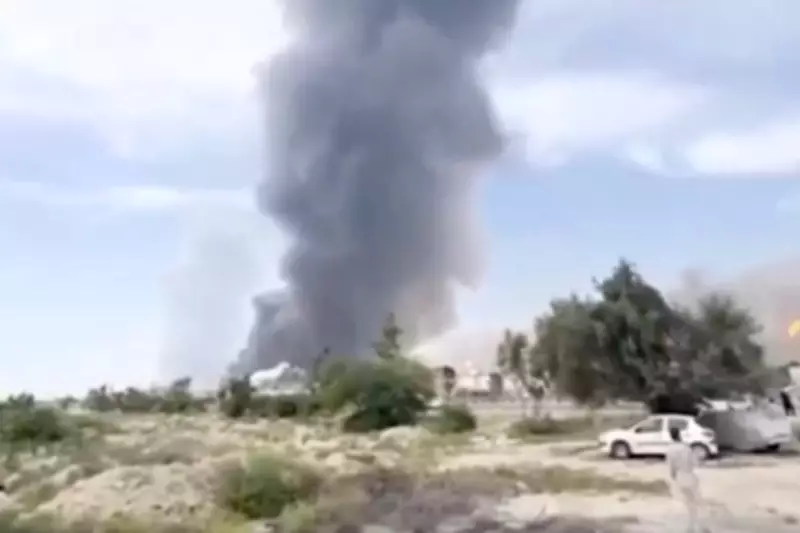
Israel's Attack on Iran's South Pars Gas Field Represents Major Escalation
President Donald Trump has issued a stark warning, threatening to "massively blow up the entirety" of Iran's South Pars gas field if Tehran launches further attacks on energy facilities across the Gulf region. This comes after Israel conducted a significant strike on the vital gas field on Wednesday morning, drawing immediate condemnation from both Iran and Qatar, a close US ally that shares the facility.
Retaliation and Presidential Response
In retaliation for the Israeli strike, Tehran targeted multiple energy facilities across the Gulf, including Qatar's Ras Laffan Industrial City, which employs approximately 115,000 workers. President Trump responded forcefully on Truth Social, claiming that Israel's strike had only impacted a "relatively small section of the whole" facility and asserting that Washington had no prior knowledge of the attack.
"Unfortunately, Iran did not know this, or any of the pertinent facts pertaining to the South Pars attack, and unjustifiably and unfairly attacked a portion of Qatar's LNG Gas facility," Trump stated. He added that "NO MORE ATTACKS WILL BE MADE BY ISRAEL pertaining to this extremely important and valuable South Pars Field unless Iran unwisely decides to attack" Qatar.

The US president then delivered a severe warning: if Iran attacks Qatar again, the United States would "massively blow up the entirety of the South Pars Gas Field at an amount of strength and power that Iran has never seen or witnessed before."
Strategic Shift in Israel's War Approach
The strikes on South Pars represent a significant escalation in the three-week-old conflict, with potentially devastating long-term consequences. Israel's war strategy had previously focused on targeting top Iranian officials, resulting in the deaths of security chief Ali Larijani and Basij paramilitary force commander Gholamreza Soleimani, alongside bombing military installations across Iran.
However, experts indicate that attacking energy infrastructure marks a transformative shift in Israel's approach that could profoundly affect Iranian civilians and the global economy. Dr Umud Shokri, an energy strategist and senior foreign policy advisor, described a full strike on South Pars as a "worst case scenario" since it is crucial to Iran's energy supply, supporting power generation, heating, industry, and petrochemicals.
"Disruption doesn't just hit exports, it hits daily life. Expect outages, shortage, and inflation almost immediately, meaning ordinary Iranians absorb the shock first," Shokri wrote on X. He noted that such a move might not destabilize the regime but could instead provide justification for tightening control and blaming external forces.
Iran's Retaliatory Threats and Actions
Following the Israeli strike, Iran distributed evacuation notices to several key energy facilities:
- Saudi Arabia's Samref Refinery and Jubail Petrochemical Complex
- United Arab Emirates' Al Hosn Gas Field
- Qatar's Mesaieed Petrochemical Complex, Mesaieed Holding Company, and Ras Laffan Refinery
The Ras Laffan Industrial City was struck by a ballistic missile on Wednesday, igniting a massive fire, according to QatarEnergy, the state-owned company. Qatar's military intercepted four out of five missiles. QatarEnergy reported that emergency response teams were immediately deployed to contain the fires, with extensive damage sustained but no casualties among personnel.
Global Significance of South Pars
South Pars is the world's largest fossil gas field, jointly owned by Iran and Qatar. The Israeli strikes mark the first time fossil fuel production facilities have been targeted in this conflict, as opposed to transportation sites like ports. Experts warn that the damage to production could have impacts lasting years beyond the war's conclusion.
Saul Kavonic, an analyst at MST Financial, told the Financial Times: "Something that takes out a few million barrels of production would have a bigger impact because it means there is no way to refill stocks even after the war ends." He added that hitting a liquefied natural gas facility would be particularly severe, potentially requiring several years for repairs.

This escalation transforms the conflict from a regional military confrontation into a potential global energy crisis, with implications for markets, civilian populations, and international relations that could extend far beyond the immediate battlefield.





