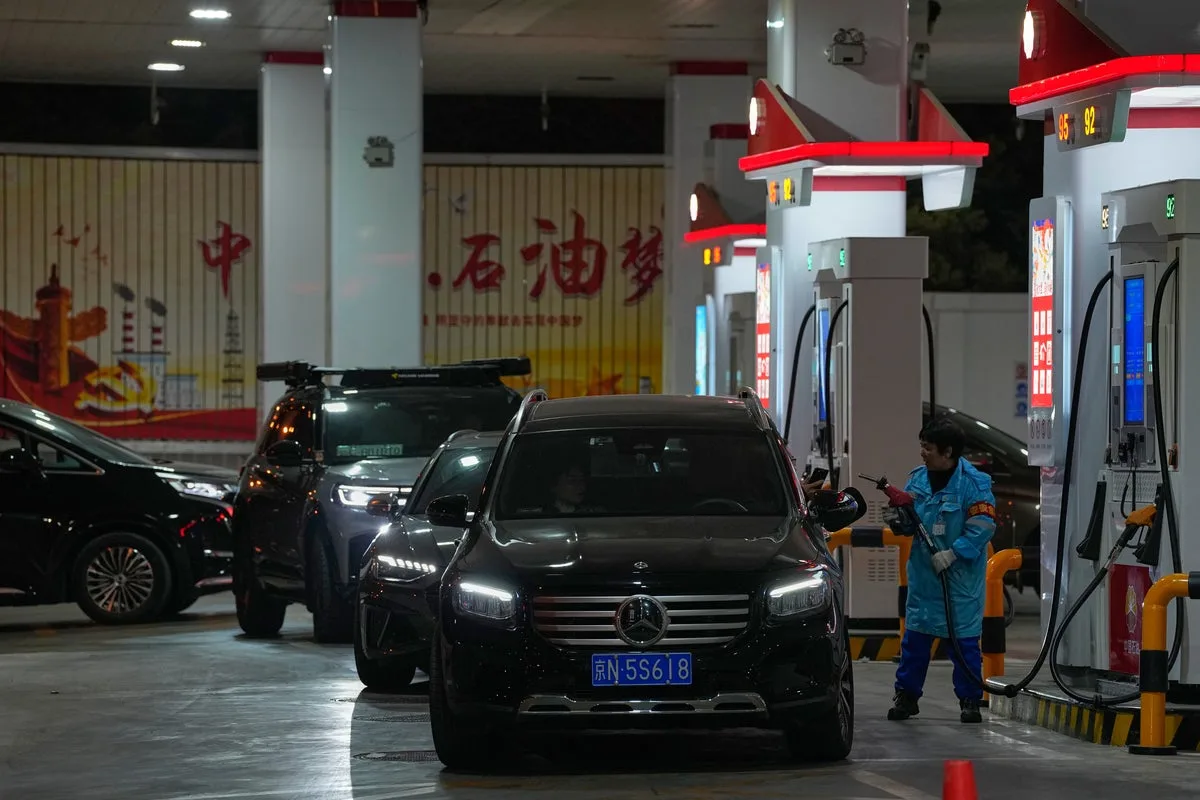
Chinese Motorists Queue at Pumps as Government Caps Record Fuel Price Hike
Chinese Drivers Rush to Fill Up Before Capped Fuel Price Increase

Motorists across China rushed to refuel their vehicles over the weekend, forming lengthy queues at petrol stations, after receiving text message notifications about an impending significant increase in retail fuel prices. The state-led intervention, however, capped the hike at roughly half of what the standard pricing mechanism would have dictated, in an effort to cushion the economic impact.

Government Imposes Temporary Controls on Record Adjustment

The National Development and Reform Commission (NDRC), China's state planner, announced on Monday that maximum retail prices for gasoline would rise by 1,160 yuan, equivalent to approximately $168, per metric ton. Diesel prices were set to increase by 1,115 yuan per metric ton. These adjustments, effective from midnight on Monday, represent the largest fuel price increases on record in China, pushing price limits close to levels last witnessed in 2022 following Russia's invasion of Ukraine.

Under its standard framework, the NDRC reviews fuel prices every ten working days based on international crude oil costs and other factors. Without the government's intervention, prices would have surged by 2,205 yuan per metric ton for gasoline and 2,120 yuan for diesel. "To cushion the impact, ease the burden on downstream users, and support economic and social stability, authorities introduced temporary controls within the existing pricing framework," the NDRC stated in its official announcement.

Wide Pickt banner — collaborative shopping lists app for Telegram, phone mockup with grocery list

Drivers Respond to Pre-Hike Notifications

State-owned energy giant Sinopec proactively notified its customers via text message on Sunday evening, warning of a "relatively large increase" in fuel prices scheduled for midnight on Monday. The message advised motorists to refuel outside of peak hours to avoid congestion. This alert triggered a nationwide response, with drivers flocking to petrol stations on Sunday night to fill their tanks before the price adjustment took effect.

Social media platforms like Rednote and Weibo were flooded with posts depicting long queues at stations. One Rednote user in Shanghai shared a photograph of a substantial line at a PetroChina station, commenting, "Drivers should switch to EVs as charging after 10 pm costs less than 50 cents per kWh." The scene was replicated in cities such as Suzhou in Jiangsu province and Beijing, where motorists waited patiently to mitigate the additional cost.

For a typical private car owner, the fully implemented adjustment would add about $6.5 to the cost of filling a 50-litre tank with 92-octane gasoline. The government's cap, therefore, provides a measure of relief, though the increase remains substantial.

Economic Ripple Effects and Analyst Perspectives

The price hike is directly linked to rising global oil prices, which have been exacerbated by the ongoing US-Israeli conflict with Iran. Analysts estimate that a 10 percent increase in oil prices could elevate China's producer price inflation, currently running at minus 0.9 percent, by approximately 0.4 percentage points. However, economists caution that such cost-push inflation may not be beneficial for the broader economy.

Shuang Ding, chief China economist at Standard Chartered Bank, noted that pure cost-push inflation can squeeze corporate profits, potentially stifling business growth. The government's intervention aims to limit the extent to which refiners can pass on increased costs to consumers, but high oil prices could still dampen consumer demand, preventing full cost transmission and possibly deepening losses within the refining sector.

Refining Sector Under Pressure

Chinese consultancy GL Consulting highlighted that rising crude costs and persistently weak demand have placed significant strain on refiners. In Shandong province, the country's primary hub for small-scale independent refiners, profits have plummeted to near a three-year low. According to data from Oilchem, losses reached 122 yuan per ton by March 20, underscoring the sector's financial challenges.

GL Consulting further explained that earlier high operating rates among refiners, coupled with lacklustre demand and an export ban on fuel products, had led to temporary highs in gasoline and diesel inventories. This inventory buildup, combined with the current price pressures, creates a complex landscape for China's energy market, balancing between consumer protection and industrial viability.

Pickt after-article banner — collaborative shopping lists app with family illustration

While the government's temporary price controls offer a short-term buffer, the underlying volatility in global oil markets, driven by geopolitical tensions, suggests that fuel costs may remain a pressing issue for Chinese consumers and businesses alike in the coming months.