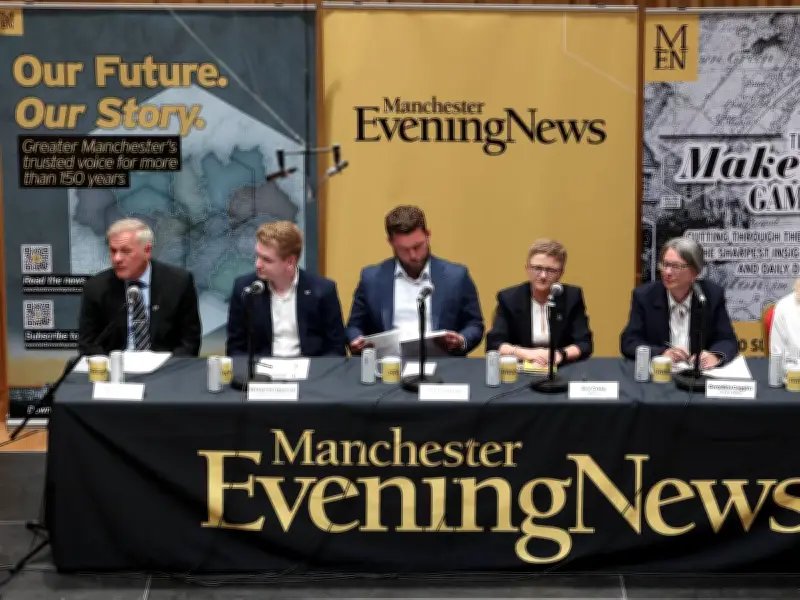
Next week, the new mayor of Greater Manchester will be elected. The vote to replace Andy Burnham will be held on Thursday (July 30), with the result due on Friday (July 31). Candidates faced off at the Manchester Evening News hustings event earlier this month, speaking on issues such as housing, public transport, crime, the cost of living crisis and the UK economy.
The Manchester Evening News approached those who attended the hustings – Reform's Sian Astley; the Greens' Geraldine Coggins; Labour's Bev Craig; the Conservatives' Phil Eckersley; the Lib Dems' Richard Kilpatrick; and Restore Britain's Marlon West – with the rest of the questions asked by readers. Ms Astley and Mr West did not respond. The rest provided answers.
Accessibility and Democracy
Nathaniel Yates (MUDSA): Will the next mayor commit to fully supporting the campaign to make all 96 train stations step-free?
Geraldine Coggins: Yes. This won't happen overnight, but public transport should work for everyone, and that means working to make every station accessible. Too many disabled people are effectively locked out of parts of our transport network. As Mayor, I will work closely with Transport for Greater Manchester, Network Rail and the Government to agree on a publicly available programme for improving station accessibility, prioritising the stations where better access would benefit the greatest number of disabled passengers.
Bev Craig: Everyone should be able to use public transport independently and with dignity. I'll continue working with Government, Network Rail and train operators to improve accessibility across the network as we build a fully integrated Bee Network.
Phil Eckersley: Yes. It is unacceptable that disabled passengers, older residents and parents with prams are effectively excluded from parts of our rail network. The Mayor cannot deliver every station upgrade alone because Network Rail, train operators and government funding are involved. However, I will publish a clear accessibility audit of every station, identify the priority projects and establish a properly costed delivery programme. I will then use the Mayor’s influence to secure the necessary funding.
Richard Kilpatrick: It is absolutely vital that we make all 96 train stations in Greater Manchester step-free. I joined Liberal Democrat Councillor Alice Delemare in Davenport last week to talk just about this because of the impact it is having on her residents. I would fully commit to advocating for the funding needed to deliver step-free access across Greater Manchester.
Hanna Rana: What does a healthy democracy look like to you personally?
Geraldine Coggins: A healthy democracy is one where people feel they genuinely have a voice and where decisions are made with communities, not imposed on them. Too often politics is something done to communities rather than with communities. For too long, Greater Manchester has seen decisions driven by large developers and powerful interests while many residents feel ignored. I want a Greater Manchester where local people have a real say over planning, transport, green spaces and public spending.
Bev Craig: A healthy democracy is one where people help shape decisions, not just vote every few years. That's why I'll expand opportunities for residents to have their say through Mayor's Question Time, youth panels and stronger community engagement.
Phil Eckersley: A healthy democracy means residents knowing how decisions are taken, where their money is being spent and who is responsible when things go wrong. It requires respectful disagreement, a strong local media, proper scrutiny and leaders who answer difficult questions rather than hiding behind slogans. That is why one of my central pledges is to open the books at the GMCA. I will publish the receipts, make contracts and performance information easier to understand and give residents across all ten boroughs a clearer voice in mayoral decisions.
Richard Kilpatrick: A healthy democracy is one where the contract between people and the people who seek their vote at election time is a strong one. Where all the institutions that should serve people actually do and where people feel advocated for. I also think a healthy democracy is judged on how it treats minorities and a healthy democracy is one that ensures strong representation of minorities. I also think we need a proportional voting system, something the Liberal Democrats have campaigned on for decades. I think there is clear evidence that our voting system no longer serves us as a democracy.
Air Quality and Social Housing
Liz Godfrey (Mums for Lungs): Given tight budgets, what specific, immediate actions will you take to clean up our toxic air and protect children's health?
Geraldine Coggins: Clean air is a public health issue, especially for children, the elderly and vulnerable residents. Within my first year as Mayor, I will invest in safer walking and cycling routes to schools and work with communities to create quieter, safer residential streets where there is local support. I will also improve bus reliability to reduce car dependency and prioritise air quality monitoring around schools and major roads. Finally, I'll call on Westminster to adopt Green MP Sian Berry's bill to give us all a legal right to breathe clean air.
Bev Craig: Cleaner air is vital for healthier communities. I'll continue expanding the Bee Network, make walking and cycling easier, support cleaner public transport and increase green spaces to improve air quality while helping people get around more sustainably.
Phil Eckersley: I support an investment-led approach that improves air quality without imposing a punitive charging zone on working people and small businesses. My immediate priorities would be cleaner buses, action at pollution hotspots near schools, better traffic flow and stronger enforcement against unnecessary vehicle idling. I would publish local air-quality performance in a clear dashboard so parents can see whether pollution is actually falling.
Richard Kilpatrick: Firstly I would invest £2m in establishing Particulate Matter monitors outside every school in Greater Manchester to reduce our reliance on modeling. I would support Councils with a TfGM grant to install anti-idling Traffic Regulation Orders outside schools. In the longer-term we need to look at restricting car journeys in the City Centre and in our town Centres, but this needs to be a open discussion not a top down mandated process.
Jennifer Belli (Shaw Housing Tenants Campaign): Will you commit to holding housing associations accountable and protecting existing social housing tenants?
Geraldine Coggins: Yes. I have a plan to deliver 20,000 publicly owned, genuinely affordable rent-capped homes over the next ten years, helping to ease pressure on social waiting lists and giving more people a secure place to call home.
Bev Craig: Existing social housing is just as important as building new homes. I'll work with housing providers and local councils to protect affordable housing and make sure tenants' voices are heard.
Phil Eckersley: Yes. Social homes should not quietly disappear into the open market while families remain on waiting lists. Housing associations are independent bodies and the Mayor cannot simply overrule every decision. However, I would use GMCA funding, partnerships and public scrutiny to demand transparency over disposals, conversions, rents and tenant consultation.
Richard Kilpatrick: Yes. I don’t know the details of the situation in Shaw, but housing associations are there to work for us not against us. Where they are failing residents they need to be held to account. The Local Authority should have the powers to do this but where that is not happening I would be happy to commission an investigation into these practices.
Support and Safety
Michelle McHale (Manchester Central Food Bank): What specific commitments will you make to fund early, local advice services to stop people from hitting rock bottom?
Geraldine Coggins: I will work closely with councils, the NHS and the voluntary sector to make early advice services a core part of Greater Manchester's approach to prevention, so people can get help with debt, benefits and housing before they reach crisis point. I will also explore how Greater Manchester Combined Authority can use shared data infrastructure and outreach teams to more effectively coordinate across Greater Manchester to reach residents who are currently missing out on financial support, and proactively help them claim it. I want to make sure people get the help they're entitled to before a temporary setback becomes a long-term crisis.
Bev Craig: I want to prevent problems from becoming crises. I'll expand the Live Well approach by bringing services together in neighbourhoods and working closely with councils and the voluntary sector so people can get help earlier.
Phil Eckersley: Early advice can prevent a manageable problem becoming an eviction, a homelessness case or a serious health crisis. It can also save the public purse money. Councils retain responsibility for many advice and welfare services, but the Mayor can coordinate funding and bring organisations together. I would review the fragmented system across Greater Manchester and work with councils, foodbanks and advice providers to establish clear local access points and referral routes.
Richard Kilpatrick: This is a great question but the answer is also quite complex. Some localities are better than others at this. I think we can look at commissioning a GM level of service for those struggling to navigate the system. I think we can look to work with tenants unions, Citizen’s Advice and other third sector providers and make sure those services work smoother.
Xaverian College students: How will you balance tough police enforcement with preventative measures like youth clubs and education to tackle anti-social behaviour?
Geraldine Coggins: Communities deserve to feel safe, and anti-social behaviour should be taken seriously. But enforcement alone is not enough. We need visible neighbourhood policing alongside investment in youth services, sports facilities, youth clubs and mentoring programmes.
Bev Craig: We need both prevention and enforcement. I'll expand neighbourhood policing while investing in youth services and opportunities that help keep young people away from crime.
Phil Eckersley: It is not a choice between enforcement and prevention. We need both. Persistent antisocial behaviour must have consequences, with visible neighbourhood policing and quicker action against repeat offenders. At the same time, prevention means youth activities, mentoring, education and early intervention before young people become trapped in criminal behaviour. I would require police performance on antisocial behaviour to be published borough by borough. I would also bring councils, schools, police, charities and businesses together to target preventative support at the neighbourhoods experiencing the greatest problems.
Richard Kilpatrick: Where a crime is committed it is important that the police investigate and ensure that people are brought to justice. I know that anti-social behaviour is amplified on social media now too but it is important that people report crime when they see it. Then we do need to ensure that Mayoral Development Corporations build facilities and community assets for young people to use. But we also need neighbourhood policing to have a strong relationship in our communities that will help with prevention.
Local Spending and Suburbs
Kirsty Humphries (The Wellsprings, Bolton): How will you guarantee that Greater Manchester's public spending actually goes to local family firms and SMEs, rather than big business?
Geraldine Coggins: I will use GMCA’s procurement powers to give greater weight to local employment, apprenticeships and local supply chains, and I will publish an annual Local Wealth Report showing how much public spending stays in Greater Manchester. Local businesses create local jobs and stronger communities. Public money should help build local wealth, not leak out to distant shareholders. Our housing plans are a prime example of this approach. Our new publicly owned housing provider, Homes for Greater Manchester, will show how public investment can build homes and stronger local economies at the same time: creating jobs, supporting local businesses and ensuring more of every public pound stays in Greater Manchester.
Bev Craig: I want public investment to create local jobs and support local businesses wherever possible. I'll work with councils and partners to help more SMEs access procurement opportunities and strengthen local supply chains.
Phil Eckersley: As somebody who built and runs a Greater Manchester business, I know smaller firms are often locked out by complicated tendering, oversized contracts and slow payment. I will introduce a clear “Greater Manchester first” procurement approach within the law. Contracts should be broken into sensible lots where possible, tender documents simplified and local suppliers given earlier notice of opportunities. I will publish how much GMCA spending reaches Greater Manchester SMEs, along with payment performance and the names and values of major contractors.
Richard Kilpatrick: There are restrictions on procurement at GM and Local Government level. Current legislation has very stringent restrictions on ensuring value for money. That is an important thing and we should obviously ensure value for money in everything we do, but I would advocate for changes in legislation that provides some elasticity to allow for local companies to benefit from contracts. I would ensure a consistent use of Social Value reporting including publication of local apprentice and employment data for bigger contracts at GM and across the ten boroughs.
Maria Romanenko (Ukrainian Refugee Support Organisation): What does success look like for our forgotten suburbs, and how will you bring investment out of the big town centres and into these communities?
Geraldine Coggins: As Mayor, I will improve orbital bus connections and ensure communities outside town centres are properly connected. I will push investment out into neighbourhoods and suburbs so that prosperity is shared more fairly across Greater Manchester.
Bev Craig: Success means every part of Greater Manchester shares in our growth. I'll back our neighbourhoods and local high streets as well as town centres, making sure investment reaches communities right across the city-region.
Phil Eckersley: Success means residents seeing improvements where they live, not merely reading about another flagship city-centre announcement. I will introduce a fairer deal for the boroughs, with transparent information showing where GMCA transport, regeneration and skills funding is being spent. Communities such as Reddish should have credible plans for local transport, high streets, employment sites and public spaces.
Richard Kilpatrick: I would increase the number of the Mayoral Development Corporations to ensure investment gets to towns outside the City Centre. As a part of that I would continue to support funding for grants to district centres too. We know that Stockport and Altrincham are good examples of regeneration but we need to ensure that we are providing the jobs, opportunities and services for all our district centres to thrive.
Knife Crime, Cycling, and Heritage
Chorlton High School students: What practical, everyday steps will you take to stop knife crime and protect students?
Geraldine Coggins: We need prevention as well as enforcement. That means investing in youth workers, school-based mental health support, mentoring programmes and safe places for young people outside school hours. We also need neighbourhood policing focused on building trust with communities. I will also build on the good work already happening in parts of Greater Manchester by rolling out more knife surrender bins, safer knife replacement schemes, bleed control kits and 'Stop the Bleed' training, so communities are better equipped both to prevent violence and respond when incidents occur.
Bev Craig: I'll expand neighbourhood policing and work with schools, youth services and health partners to prevent young people being drawn into violence. Prevention, early intervention and stronger local policing all have a role to play.
Phil Eckersley: I would bring police, schools, youth services and health partners together around the schools and neighbourhoods facing the greatest risk. That means visible policing around transport interchanges and identified hotspots, faster intelligence-sharing, targeted work with young people at risk of carrying knives, and support for trusted youth and mentoring organisations. I would publish knife-crime trends and outcomes across each borough, rather than hiding poor performance in a Greater Manchester-wide total.
Richard Kilpatrick: Getting involved in knife crime doesn’t happen because people are inherently bad, it's because the support network that should be working for young people isn’t. That can mean home is not a great place to be, or that poverty is forcing them into a spiral, or there are no positive services for them so they find belonging in a group that isn’t good for them. We need to focus on that prevention. If we can make place and ensure young people feel listened to we might be able to reduce knife crime. On mental health issues - we know this is linked to this too. We need to improve access to mental health services across Greater Manchester.
Sarah Rowe (Walk Ride GM): When our bike contract comes up for renewal, how will you fix underperformance and get Manchester moving?
Geraldine Coggins: The scheme needs to be located where people want to travel. As Mayor, I will work with Transport for Greater Manchester to produce a Bike Hire expansion plan to extend coverage into more neighbourhoods. I will also integrate cycle hire properly with Bee Network ticketing and make sure bikes are available at stations, colleges and town centres. That’s how you turn hire bikes into a practical everyday transport option rather than an occasional leisure activity.
Bev Craig: I want many more people choosing active travel. I'll improve cycling infrastructure, better integrate bike hire into the Bee Network and make cycling a more convenient option for everyday journeys.
Phil Eckersley: Before renewing the contract, I would require an open review of its cost, usage, availability, geographical coverage and value for money. The answer is not simply to spend more. Bikes need to be located where people can conveniently use them, integrated with transport hubs and supported by safe routes. The system must also serve communities beyond central Manchester.
Richard Kilpatrick: I don’t think it is inherently the contract that is at fault. I think it is that Greater Manchester is a patchwork when it comes to good cycling infrastructure. My view is that we need to prioritise coverage of cycle lanes and infrastructure over complexity or quality. Delivering hundreds of miles of cycle lane is the first step then upgrading that later when we need to. That will improve use and we need to see the full ecosystem to determine how we can properly deliver transport modal change.
Bridie Meehan (Cheadle Civic Society): As Mayor, how will you make sure local villages get the same funding and heritage protection as flagship town centre projects?
Geraldine Coggins: I would support stronger design standards, better community involvement in planning decisions and investment that respects local character. Regeneration should enhance places, not erase their identity. Communities should have a genuine voice in shaping developments that affect them.
Bev Craig: Regeneration should strengthen the character of our towns and villages, not undermine it. I'll support thriving local high streets while working with councils to ensure growth respects local heritage.
Phil Eckersley: Planning decisions largely sit with local councils, but the Mayor influences spatial strategy, regeneration and funding. I would prioritise brownfield regeneration, reuse empty buildings and ensure heritage and local character are properly considered when mayoral funding is awarded. I will also press for a fairer deal for district centres and local villages, rather than concentrating regeneration funding on a small number of flagship projects. Local residents must be involved before decisions are effectively settled.
Richard Kilpatrick: To directly answer your question Local Authorities have planning powers not Greater Manchester, so some of the details that you raise are not in the power of the Mayor. That doesn’t mean I would not champion heritage and ensure that where we have development it is not sympathetic with local heritage and conservation. I would want a GM Heritage organisation that would be duty bound to make representations to every local authority on planning applications that would impact local heritage or conservation.
Division, Foodbanks, and Greenbelt
Ben Gilchrist (Groundwork Greater Manchester): Can you tell us one specific thing you have already done to fight division, and one specific thing you pledge to do if elected?
Geraldine Coggins: As Mayor, I will establish a Greater Manchester Tensions Monitoring Network, bringing together councils, community organisations, local services and the police to identify rising tensions early and respond before they become entrenched.
Bev Craig: I've always worked to bring communities together through partnership and inclusive leadership in Manchester. As Mayor, I'll continue standing against hate and strengthen community cohesion through a Greater Manchester Social Partnership.
Phil Eckersley: As Mayor, I would establish regular engagement with faith and community representatives, backed by transparent reporting on hate crime and police outcomes. Leadership also matters. I will challenge hatred firmly, but I will not use community tensions for political advantage. Greater Manchester needs a Mayor who lowers the temperature and brings people together.
Richard Kilpatrick: I have done several things to fight this. I stood in solidarity at my local mosque when it was threatened by the far right. I have called on Manchester Council to adopt a definition of anti-muslim hate and islamaphobia. I have also organised events with my Jewish community supported by the local mosque to bring faith groups together. I don’t just want to say warm words, I want to show what hope looks like in leadership. I do that now and I will continue to do that to fight the politics that sees kindness as a weakness.
Joe Troop (Trafford North Foodbank): Will you work with our foodbanks to create a consistent, single approach across Greater Manchester so nobody falls through the gaps?
Geraldine Coggins: Yes. I want someone facing a crisis to receive the same standard of support wherever they live in Greater Manchester. As Mayor, I will work closely with councils, foodbanks and advice organisations to develop a common referral system and shared minimum standards across Greater Manchester, so residents don't face a completely different system simply because they cross a borough boundary. People in crisis shouldn't have to navigate ten different systems just to get the help they need.
Bev Craig: Nobody should miss out on support because of where they live. I'll work with councils, foodbanks and the voluntary sector to spread best practice and improve access to support across Greater Manchester.
Phil Eckersley: Yes. Residents should not face an entirely different maze of support simply because they cross a borough boundary. Councils will continue to administer many services, but the Mayor can coordinate a common framework. I would work with councils, foodbanks and advice organisations to establish shared minimum standards, simpler referral arrangements and a clear Greater Manchester directory of emergency support.
Richard Kilpatrick: Yes. When I talk about failures within services and how people struggle to navigate them, it is things like this. There is no reason why we have different processes. I would use the Mayor’s power of convening to bring the boroughs together and with organisations like yours, I would co-design a consistent approach.
Brenda Williams (Friends of Carrington Moss) & Claire Elliot (Save Tameside Greenbelt): What is your definition of 'good growth,' and how will you give residents a real voice in protecting their greenbelt?
Geraldine Coggins: As the Friends of Carrington Moss know, I have spent most of the last decade fighting Labour's plans to build on that greenspace and others. Their focus on growth at all costs is something I have called out repeatedly over the years. Good growth improves people's lives while protecting the environment. Communities must have a meaningful voice in planning decisions, and greenbelt and nature should only be sacrificed in genuinely exceptional circumstances.
Bev Craig: Good growth means delivering the homes and jobs we need while protecting nature and making the best use of brownfield land first. Communities should have a genuine voice in shaping the places where they live.
Phil Eckersley: Good growth provides the homes people need, regenerates neglected communities and brings the infrastructure required to support development. It should not mean taking the easiest option and repeatedly building on valued green spaces. I will prioritise brownfield sites, empty buildings and town-centre regeneration. Development must come with transport, schools, GP access and other essential infrastructure. Residents deserve a genuine voice before plans are decided, not a consultation after the real decisions have been made.
Richard Kilpatrick: The greenbelt is important and we need to develop brownfield first. But we know that if we are going to meet future housing targets in the next couple of decades we will have to build on places that might be currently greenbelt. In that situation we need to ensure that we protect green space as much as we can and see green space as community assets. I would make green space a legal requirement in special planning which would put legal safeguards on green spaces across GM. On “good growth”, growth needs to work for everyone or as many people as possible. I am less focussed on growth for growth sake and more interested in delivering for the needs of people.
Business, Tower Blocks, and Voluntary Sector
Joe White (Start-up Partner): How will you improve communication so that young entrepreneurs actually know what help is available?
Geraldine Coggins: I will ask the Business Growth Hub to work with colleges, universities and local authorities to ensure every graduate, apprentice and new business registration receives clear information about the support available at the point they're starting a business, rather than expecting them to discover it themselves. Every good business idea deserves the best possible chance to succeed, regardless of who you know or where you come from.
Bev Craig: Greater Manchester already has excellent business support, but more people need to know about it. I'll strengthen outreach through the Business Growth Hub so entrepreneurs can access advice, finance and mentoring more easily.
Phil Eckersley: I would require the Business Growth Hub to publish clear measures covering awareness, participation, outcomes, cost and borough-by-borough reach. Support should be promoted through colleges, banks, accountants, business groups, councils and established local employers, rather than relying on people finding a website. As a business owner, I would also simplify the language. Entrepreneurs need practical help with finance, recruitment, exporting, premises and growth, not a confusing landscape of programmes and acronyms.
Richard Kilpatrick: I think we need to create physical hubs. We can’t just create a service and expect people to come to it. We need distinct places in each borough where businesses can be set up, individuals have access to advice and resources. I would put these at the heart of our Mayoral Development Corporations and I would ask our University sector to support it. Where we have major new contracts or developments I would urge for a Business Growth Hub to be included to provide opportunity and access for SMEs to each other.
Mark Slater & Ben Claire (Save the Seven Sisters group and Greater Manchester Tenants Union): Will you support the task force working to refurbish and save the 750 Seven Sisters social housing tower blocks in Rochdale?
Geraldine Coggins: I will absolutely engage with the task force, residents and housing experts to explore the best way of protecting social housing on this site. My number one priority is to avoid the unnecessary loss of social housing and ensure local communities have a genuine voice in deciding its future. Too often, redevelopment and regeneration lead to a net loss of genuinely affordable homes and disrupt established communities. Residents deserve to be partners in shaping their neighbourhood, not simply told what's going to happen to it.
Bev Craig: I'm committed to protecting and improving affordable housing wherever possible. I'll work with local partners to explore every opportunity to preserve good-quality social homes alongside building new ones.
Phil Eckersley: I support urgently examining every credible option to retain and refurbish these homes, provided that the buildings can be made safe, decent and financially sustainable. The final decisions involve the council, housing providers, tenants, regulators and funding bodies, so it would be dishonest for the Mayor to promise an outcome unilaterally. I would ensure the task force has meaningful engagement with tenants and transparent evidence comparing refurbishment and demolition. Residents must be shown the full costs, risks, timescales and consequences before irreversible decisions are made.
Richard Kilpatrick: I don’t know the details of the tower blocks but where there is strong governance and a willingness to work with the local authority I would always support resident led projects. But we need to make sure that fire safety, housing standards and repair services remain as good as they can be.
Toni Toner (Barlow Moor Community Association): Will you commit to increasing and ring-fencing funding for the voluntary sector?
Geraldine Coggins: Absolutely. Community organisations often prevent problems long before public services become involved, yet many face constant funding uncertainty. I would champion longer-term funding arrangements and ensure the voluntary sector is recognised as a key partner in delivering better outcomes.
Bev Craig: Our voluntary and community organisations are central to making Greater Manchester stronger. I'll deepen partnership with the sector and ensure it plays a bigger role in delivering services and supporting local communities.
Phil Eckersley: I would review GMCA grants and contracts to identify how much reaches frontline voluntary and community organisations in each borough. I would also introduce longer-term funding where outcomes justify it, because one-year funding cycles undermine stability. I would not promise a blanket spending increase before opening the books. First, we must identify what works, remove waste and redirect money towards effective frontline delivery.
Richard Kilpatrick: Yes I am - but I also know we need Live Well funding to be more available to more areas. We can be better in leveraging Social Value money from large contractors in GM. Currently that is done through the GM Mayor’s Charity and we need to support that work and make it easier to get to organisations like yours.
Renewables, Culture, and HMOs
Frances Healey (Say No To Scout Moor 2): What will you do to stop the Scout Moor 2 development from going ahead on your patch?
Geraldine Coggins: As a Green councillor, I support expanding renewable energy, including onshore wind, because we urgently need to tackle the climate emergency. But Green politics is also about protecting nature and listening to communities. Deep peatlands are some of our most valuable carbon stores and wildlife habitats, so any proposal must demonstrate that it avoids or minimises damage to irreplaceable peatland and biodiversity. I will judge Scout Moor 2 on that evidence, not simply on whether it is a wind farm.
Bev Craig: Any development must balance our climate ambitions with protecting nature and listening to local communities. I'll expect major proposals to demonstrate genuine environmental benefits while ensuring local people are properly heard through the planning process.
Phil Eckersley: I oppose sacrificing deep peatland and valued landscapes without compelling evidence that the environmental, economic and community impacts have been properly addressed. The Mayor is not able simply to veto every planning proposal, and the decision must follow the lawful planning process. However, I would insist that the full effects on peat, wildlife, flooding, local infrastructure and nearby communities are independently and transparently assessed.
Richard Kilpatrick: I have always believed that projects like this must work for local communities that host them. I would always support a model that provided reduced bills for people living locally. It is important that renewables contribute to a diversification of our energy market, whether the profits stay local or not. Because only by diversifying our energy market will we be able to reduce prices in the long term. I am happy to learn more about the environmental impact of the project.
Phil Jones (Manchester Food and Drink Festival): How exactly do you plan to invest in our cultural infrastructure to grow the economy and protect local arts venues like the Oldham Coliseum?
Geraldine Coggins: Culture is a vital part of Greater Manchester's economy, but too many venues are struggling while town centre buildings sit empty. My Empty Shops Team and £10 million Community Development Fund will help community organisations, cultural groups and creative enterprises bring vacant buildings back into use, helping more local arts and cultural organisations put down permanent roots.
Bev Craig: Culture is one of Greater Manchester's greatest strengths and a major driver of economic growth. I'll continue supporting our creative industries and cultural venues so every borough benefits from our success.
Phil Eckersley: Culture is not an optional extra. It supports jobs, tourism, town-centre activity and Greater Manchester’s international reputation. I would establish a transparent cultural investment plan covering all ten boroughs, with clear outcomes and a fairer distribution of funding. The Mayor cannot run every venue, but can convene councils, cultural bodies, businesses and investors to help viable venues develop sustainable plans. For places such as Oldham Coliseum, residents deserve clarity about the business case, capital costs and long-term operating model. Investment must protect culture without writing blank cheques.
Richard Kilpatrick: We need to continue to leverage contributions from larger venues in GM to invest in local arts and music venues and provide a grant available to grassroot venues. But we also need to safeguard local arts and music venues as assets of community value. We need more from the national government on this too. We have been promised meaningful help on business rates, rents, COVID loans but nothing has materialised. I would be advocating for change from the government.
Keely Dalfen & Samantha Terrell (The Brick): How will you challenge the stigma around HMOs while making sure they are safe, clean and properly run?
Geraldine Coggins: The issue isn't whether housing is shared; it's whether it's well managed. Well-managed shared housing helps people rebuild their lives and should be judged by the quality of its management, not by stereotypes about the people who live there. Through our Healthy Homes programme, I'll work with councils to improve housing standards, crack down on rogue landlords and make sure every resident has a safe, decent home.
Bev Craig: Well-managed shared housing can play an important role in helping people rebuild their lives. I'll work with councils and providers to raise standards while ensuring people have access to safe, decent accommodation.
Phil Eckersley: Councils have key licensing and enforcement powers. As Mayor, I would encourage consistent standards across Greater Manchester, better sharing of intelligence about rogue landlords and stronger cooperation with reputable homelessness charities. Good providers should not be stigmatised because of the actions of bad ones. The distinction should be based on safety, management, resident support and neighbourhood impact.
Richard Kilpatrick: Any elected politician in GM will know the benefit that a mixed housing offer has. I would openly challenge any suggestion that HMOs are inherently bad. We know that these facilities help people, especially young people. I would openly work with organisations like yours to fight this narrative.
Youth, Transport, and Homelessness
Bury Grammar School Students: What will you do as Mayor to improve job prospects and future opportunities?
Geraldine Coggins: Young people need genuinely affordable homes, reliable transport, good education and access to decent jobs. I will expand the Greater Manchester Youth Jobs Guarantee, giving young people who have been out of work or education for longer than a year access to paid work placements, mentoring and careers support. I'll also back local businesses, green industries and apprenticeships while improving public transport and making buses free for under-22s so that opportunities are within reach wherever you live. Every young person should feel they have a future in Greater Manchester.
Bev Craig: Every young person deserves the chance to succeed. I'll expand skills, apprenticeships and employment support while making it easier and cheaper to access education and work through the Bee Network.
Phil Eckersley: Young people need a clear route from education into a real job, apprenticeship or business opportunity. I would bring employers, schools, colleges and training providers together to align skills funding with genuine vacancies. I would also require major GMCA contractors to report on apprenticeships and opportunities created for local young people. Careers support must reflect the whole economy, including engineering, digital, construction, health, social care and entrepreneurship.
Richard Kilpatrick: It is vital that we build an economy that works for the future opportunities for young people. I would be looking to create the AI digital infrastructure our country needs right here in Greater Manchester. In doing so, provide the next generations with the jobs and opportunities they need. We can work with our outstanding further education institutions to create learning hubs and utilise technology to make sure that the infrastructure can be used to reduce fuel bills and provide place making.
Winstanley College Students (Noah Miller): What changes do you plan to make to public transport in Greater Manchester, and specifically, what are your plans for the future of bus passes?
Geraldine Coggins: Public transport should be affordable, reliable and accessible. I would make all bus travel free for under-22s. I support expanding and improving the integrated Bee Network, making buses more reliable and improving connections between communities that are currently underserved.
Bev Craig: I'll continue building a fully integrated Bee Network, freeze fares and improve services across buses, trams and local rail. I'll also introduce free Bee Network bus travel for all 11 to 18-year-olds while protecting free travel for older and disabled residents.
Phil Eckersley: My priority is a reliable, affordable and accountable network that serves all ten boroughs. I will review Bee Network performance, including punctuality, cancellations, value for money and the fairness of routes and investment. I also want simpler ticketing and better integration between buses, trams, trains and active travel. I would protect concessionary travel commitments while reviewing the wider bus-pass system against affordability and actual usage.
Richard Kilpatrick: A first phase would be to extend bus passes to under 22 year olds and make it free for teachers and schools to take pupils on the Bee Network for school trips. The second phase would be to provide passes to NHS and care workers. Finally, I would have the ambition to provide free travel on the Bee network within 15 years paid for by the localisation of stamp duty receipts.
Winstanley College Students (Stavan Chavan): What is your direct plan to tackle homelessness and rough sleeping across all ten boroughs?
Geraldine Coggins: Homelessness is not inevitable. We need more publicly owned, rent-capped homes that vulnerable people can afford to live in. We need stronger prevention services, better support for people leaving institutions, continuing the Bed for the Night project, and a Housing First approach that provides stable accommodation alongside support.
Bev Craig: I'll make ending homelessness a central mission by expanding A Bed Every Night, strengthening homelessness prevention and delivering more genuinely affordable homes across Greater Manchester.
Phil Eckersley: Councils hold the statutory responsibility for homelessness services, but the Mayor should provide leadership and coordination. I would establish a consistent Greater Manchester prevention framework, improve cooperation when people move between boroughs and focus intervention on the causes of homelessness, including eviction, domestic abuse, addiction and discharge from institutions. I would also support properly managed emergency and supported accommodation, with clear routes into settled housing.
Richard Kilpatrick: I am not sure that a statement of ending rough sleeping is realistic to the needs and issues faced by people on our streets. Mental health issues can mean people who are not homeless will feel more comfortable on the streets than in provision. So it is a complex picture. I would aim to improve the wrap around service across GM. Making it consistent and building a network of agencies that can help. I would ensure provision is there for road side assessments in each local council. I would argue for the government to make it legal for Asylum Seekers to work because a large section of our rough sleepers are people who have been granted asylum but do not have the means to rent or access emergency accommodation.
Tamzon Ward (Lush): What specific powers and funding would you use as Mayor to rebuild neighbourhood-based services?
Geraldine Coggins: The loss of youth clubs, community centres and local services has damaged so many communities. My Empty Shops Team and £10 million Community Development Fund will help bring empty high street buildings back into community use. That will create opportunities for youth organisations, community groups and local charities to secure affordable premises and rebuild neighbourhood services. I'll also use our Green Spaces Fund to improve parks and green spaces in the communities that need them most, giving more young people safe places to play, exercise and spend time outdoors.
Bev Craig: I'll expand neighbourhood-based youth services through our Youth Promise and the Live Well approach, bringing together education, health and community support so every young person has somewhere safe to go and the opportunity to thrive.
Phil Eckersley: Councils are primarily responsible for local youth provision, but the Mayor can coordinate partners, use devolved skills and community funding, and attach social-value requirements to GMCA contracts. I would map existing provision across all ten boroughs to expose the areas with the greatest gaps. I would then bring together councils, police, schools, sports organisations, businesses and charities to direct support where it can have the greatest preventative impact.
Richard Kilpatrick: I would utilise funding available within the Mayoral Development Corporation where assets can be created and handed over to the community as a community asset. There is also the opportunity to provide more through the Live Well programme. I have also said that we need to levy more through Social Value to make sure that the organisations making a lot of money from the City Region are contributing to community assets.