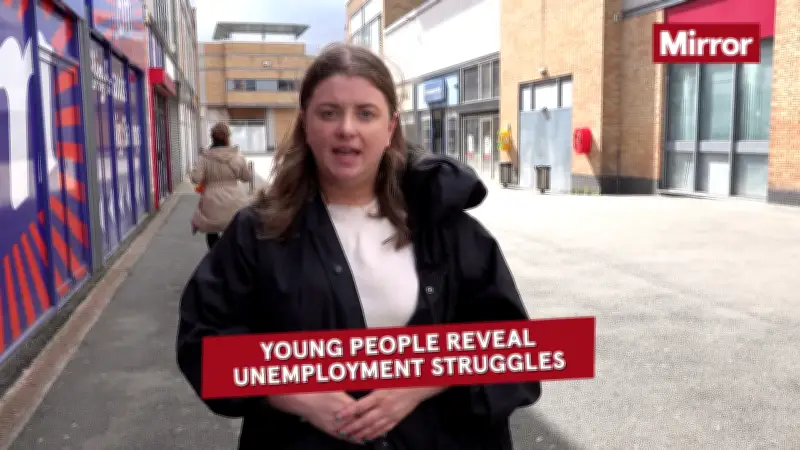
The early summer drizzle provides a miserable backdrop to scenes of unemployed young people collecting their universal credit from a Job Centre surrounded by pound shops in Huyton, Knowsley. Where once school leavers could look forward to moving into a job that would, with time, enable them to buy a house and start a family, young people in the UK are facing their bleakest ever future. Almost one million people aged 16 to 24 are not in education, employment or training (NEET), according to an alarming new report commissioned by the Secretary of State for Work and Pensions.
The report reveals that one in eight people fall into the NEET category, with 60 percent of those not actively looking for work. Six out of 10 NEETs have never had a job, up from four in 10 in 2005. It is not that young people are not qualified; almost 30 percent of NEETs leave school with good GCSEs or equivalent, more than 21 percent have a Level 3 qualification, and 15 percent have a degree. But still they are not finding jobs.
A generation left behind
This generation has borne the brunt of years of austerity and lost crucial years of social development to the Covid pandemic. Now they are taking their first steps into adulthood against a backdrop of economic turmoil and a dwindling high street where the traditional Saturday job is hard to come by. The review warns that Britain is facing a 'lost generation', branding the declining situation a 'moral crisis'. Nowhere is this crisis more apparent than in Huyton, Knowsley, where young people are 40 percent more likely to be NEET, earning the borough the dubious title of the 'NEET capital of the UK'.
Local Government figures from the Department for Education (DfE) showed that in 2025, 5.7 percent of school leavers in Knowsley were NEET, compared with just one percent in the leafy London suburb of Ealing. The people of Knowsley, which covers Huyton, Kirkby and Prescot, have long faced employment difficulties, with a 2023 University of Liverpool report citing the legacy of deindustrialisation, low economic activity and deprivation as longstanding contributing factors. A ten-year plan is in place to revitalise the lacklustre centre, with a focus on restaurants and leisure, but for the NEETs of today, options are limited.
Stories from the frontline
Arriving in the town, The Mirror hears stories of young people who have spent up to four years trying and failing to find work. Knocked back for entry-level McDonald's jobs and facing fierce competition for work on supermarket tills, they say the only options lie further afield, but without the money or means to travel, many are stuck. Terry, who did not wish his surname to be published, told how despite having earned an NVQ in retail and customer service, he has held just two paid positions in his life, both temporary Christmas roles. Now 28, he said he has tried everywhere from B&M to the Card Factory, but to no avail, adding that he would work 'nearly anywhere as long as it was a paid job'.
A polite and articulate young man, Terry has rewritten his CV countless times. Nine times out of 10, he will get a rejection email and has managed to land an interview 'once or twice'. He says he feels unsupported by the Job Centre, which he claims failed to help him understand the importance of a cover letter. He has even completed two work experience courses, which guaranteed a job interview at the end, but this was unfortunately no guarantee of a job placement, and Terry was left empty-handed on both occasions. Instead, for the past four years, Terry has volunteered at the Alder Hey Charity Shop in the town centre. He says that if he were not here, all he would be doing is sitting in front of the computer, firing off endless applications into what feels like an abyss.
Terry pondered: 'I have done the application. I know the application is fine, I can do that. I have even got to job interviews, and I can do a job interview. What is this missing mystical ingredient that will get me hired? I don't know. The companies won't tell you because most of them don't give actual feedback.'
Mental health and disability challenges
Volunteering alongside Terry is his sister Amy, who says she has recently had to stop job hunting as the thankless process now makes her want to 'vomit'. The 31-year-old, who is currently studying for a course in mental health, says her own anxiety and depression, on top of her needs as a person with ADHD, mean she faces additional challenges. Amy, who attended college before entering the job market more than 10 years ago, shared: 'I did have a job back in 2016, but it was constant panic attacks. Then they look at you like, 'Well, if we're going to have that, we don't want you'. And then it becomes a problem, then because no one wants to have me if I'm going to have a panic attack.'
According to the recent NEET report, the proportion of disabled young people classified as NEET, who cite mental health as their primary condition, has soared from 24.3 percent in 2011 to 42.6 percent in 2025. In line with this, there has also been 'a significant increase in the number of young people with neurodevelopmental conditions who are NEET'. Volunteering has helped Amy's confidence, but it is still not enough. While Amy says she has 'tried and tried' to find a paid role, she has found herself competing against applicants with decades of experience. Interviews can be as far away as Manchester, a costly commute, while jobs in the local area are fiercely competitive.
Local perspectives and employer views
At a local pub, the Mirror caught up with friends Nathan and Joe, both 22, who faced the gruelling task of finding work as 18-year-olds. Joe told us that during his time on Universal Credit, most job offers were too far away. Nathan, who now works on the doors in Liverpool, told us: 'I had to branch out elsewhere, there's not really anything in this area involved in this sort of work. You have got like ASDA and stuff like that, or shops, but you don't really hear much of them.' One of the jobs offered to Joe was a 16-hour contract at Liverpool Airport. The wage was not enough to cover the commute which would have involved taking a taxi back. Nowadays, Joe drives, which makes things much easier, and he was fortunately able to secure a position at the warehouse where his dad works. Not everybody is so lucky.
Locals say jobs in the area tend to be part-time, with little advancement potential. As a jobseeker, Joe was put forward for 16-hour Easter contracts but found skilled, full-time work rare. He noted: 'It's not really any progression, not like something you could do for the rest of your life or you could build on.' The Mirror also spoke with Liam Hanlon, managing director of Knowsley-based building restoration services firm, the Forshaw Group. Around seven years ago, the company jointly formed the Knowsley Employer Apprenticeship Partnership through the Knowsley Chamber of Commerce. The aim was to bring businesses together to 'do something proactive to bridge the skills gap, provide employment for youngsters', with a focus on boosting social mobility.
Although he has noticed improvements, Liam says 'it's still not great'. He would like to see the Government reconsider the way funding is distributed. According to Liam, it costs a business £70,000 to bring an apprentice through their training programme, and much of that cost is borne by the company itself. This year, Liam says, marks the first time in his memory that companies are not taking on any apprentices. This, he says, 'speaks volumes of the challenge that we have got.' Liam argued: 'We don't need all these funding agencies, we don't need all of these colleges and training facilities. What we need is a link to meaningful jobs and support to provide those places. Employers don't get any money or nowhere near enough money for what it costs to provide that training.'
Government response
Meanwhile, dreary queues continue inside the large Job Centre overlooking the retail park where so many applications have been rejected. It is here where enthusiastic young people like Terry and Amy determinedly hold out hope that their efforts will pay off, allowing them to achieve the same ordinary dreams their parents once held. The Department for Work & Pensions (DWP) told the Mirror: 'We are bringing forward the biggest employment reforms in a generation, including to the Jobs and Careers Service, to create opportunity for people across the country. Central to this is tackling youth unemployment, which is why we are creating one million opportunities through our £2.5 billion youth employment support, ensuring every young person can earn or learn. Alongside this, Alan Milburn is investigating the barriers keeping young people out of work, and our skills reforms will reverse the decline in apprenticeships, giving businesses the trained workforce they need now and in the future.'