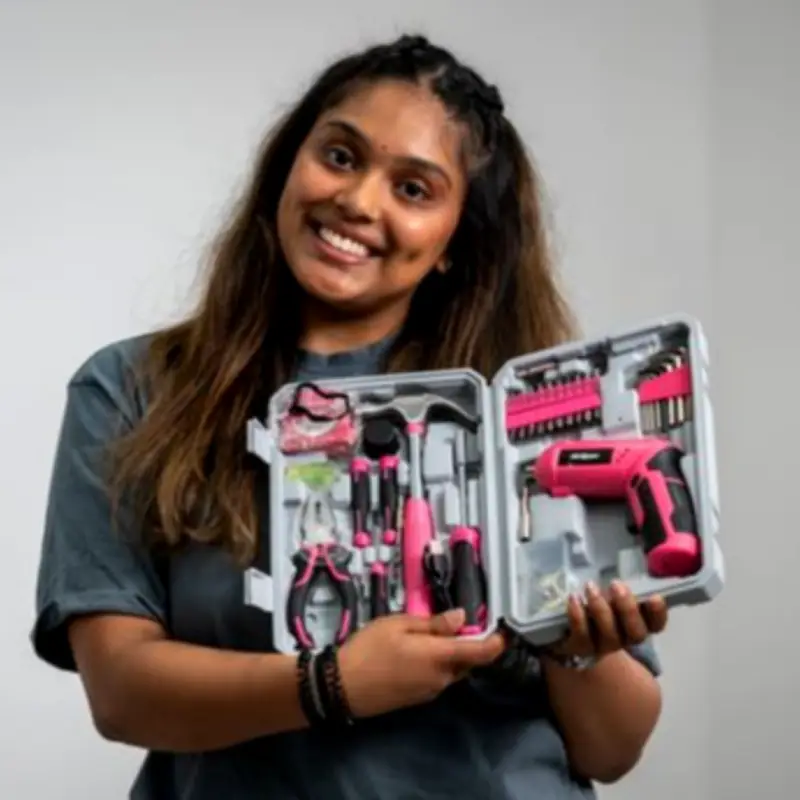
A psychology graduate burdened with £30,000 in student debt is retraining as a plumber, driven by the belief that hands-on trades are immune to the rise of artificial intelligence. Heena Kerai, 21, from Bolton, decided against a traditional graduate career after becoming convinced that practical skills offer greater job security in an era of rapid technological change.
From psychology to plumbing
After completing her degree at Edge Hill University, Heena chose not to pursue a psychology-related role. Instead, she is training to become a plumber while working part-time as a SEN teaching assistant. With support from her parents, she is privately funding a £5,500 plumbing qualification, which she hopes will lead to a future in a profession where skilled workers remain in constant demand.
Heena said: 'I enjoyed university and I’m glad I went, but midway through my degree I started thinking AI is taking over so many industries. I wanted something practical that will always be needed.' Her interest in plumbing began while helping her father, Vilash Kerai, 50, who works in the trade. 'When I was younger I used to go with him and be his little labourer, handing him tools and watching him work. Eventually I realised I didn’t just want to hand over the tools, I wanted to do the work myself.'
Challenging stereotypes
Heena is now two years into a three-and-a-half-year qualification. Entering a male-dominated industry was initially daunting. She said: 'Walking into a room and being the only woman is scary. People look shocked to see you there. It was definitely something that I found hard at first. I started telling myself, “I’m not intimidated by them, they’re intimidated by me.” That mindset certainly helped me.'
As an Indian woman in the trades, Heena feels added pressure, as many people still expect women to follow more traditional career paths. 'In a lot of Asian households there’s this expectation that women go into careers like healthcare or finance. That’s why I’m proud to be doing this. I was worried about what my family think but they are really westernised which means they are way more accepting. My family have been supportive and that means everything.'
Breaking the mould
Heena regularly encounters stereotypes about what plumbers are supposed to look like. 'I always say to my dad that I’m not a typical-looking plumber. People expect an older bald white man, not someone like me. One person who does our lectures even joked there were no bald people in the room, but that’s exactly the point, I want to break that down. People always are shocked when I am on work experience with my dad, and he is sat back watching me work, they can't believe I am not the one sat watching.'
Industry estimates suggest there are between 120,000 and 150,000 qualified plumbers in the UK, but only around 12,000 to 15,000 are women, meaning females account for roughly one per cent of the trade. However, progress is evident: the proportion of female plumbing apprentices has risen from around one in 40 in 2020 to approximately one in 20 today.
Online criticism and determination
Alongside challenges on-site, Heena has faced criticism online after documenting her training journey on Instagram. 'There are so many supportive people, but there are also condescending comments from men questioning whether I know what I’m talking about. Most of the time it’s people with no profile picture trying to tell me I can’t do the job.' Despite this, she remains determined. She believes female tradespeople can also make some customers feel more comfortable. 'A lot of women living alone or elderly people feel safer opening the door to a female plumber. I want girls to look at me and think, “I can do that too”, because they can.'
Future plans
Heena began her plumbing course in October 2024 and is funding it privately while managing university debt. Having recently completed her psychology degree, she is now considering studying for a diploma in London while continuing her plumbing training. She hopes to balance being a part-time plumber and a part-time psychological wellbeing practitioner, but will take plumbing full time if her love for the career continues to grow. Her story aims to encourage more women to challenge expectations around male-dominated careers. 'There is no typical image of what a tradesperson should look like. Women in male-dominated industries are not a trend - it’s just women finally being brave enough to walk into rooms where they weren’t expected before.'