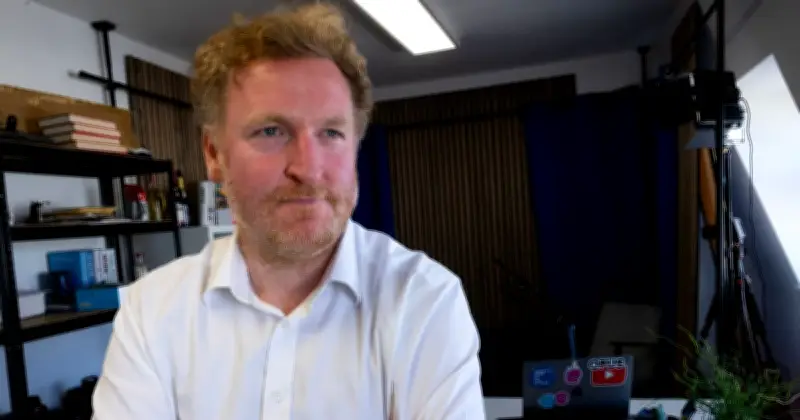
As unemployment mounts, vacancies dwindle, and panic soars that AI will steal jobs, it might feel like a scary time for a youngster starting out in life. Yet while he fears the catastrophe of a “lost generation” of young people unable to find work, Jimmy McLoughlin also says: “There’s never been a more exciting time to be starting your career.”
The former Downing Street special adviser, who now hosts the viral Jimmy’s Jobs of the Future podcast, offers a surprising paradox in an era of economic turmoil. BP, Jaguar Land Rover, and GSK are among several major companies that have slashed hundreds of jobs in 2026. Growth in Britain remains largely stagnant. The number of people aged 16 to 24 not in education, employment or training (NEETs) hovers just below the one million figure – 981,000 – according to new ONS data.
A paradox at the heart of the jobs market
McLoughlin, who has spent hours interviewing top-flight business executives and politicians – including Sir Tony Blair and Andy Burnham – about the world of work, says his optimism comes with an important caveat. “There’s a paradox that sits at the heart of the economy and particularly the jobs market for young people at the moment,” he explains.

“There have never been more different types of jobs available. But because the traditional ladders have broken down in some places, and there aren’t as many accountants and lawyers and so on, it is much harder for people to navigate it. So there’s more opportunity, but it’s harder to work through. That’s a real challenge for young people.”
Helping youngsters navigate an unpredictable world has been McLoughlin’s mission since he started the podcast in his spare room with a £40 Amazon microphone during Covid. He quit No 10 as business director under Boris Johnson in 2019, having also worked for Theresa May, because he and his wife were having their first child. As Covid struck and his wife worked as a doctor, he faced the dilemma of “trying to work out what I was going to do next”. He thought interviewing people on a podcast would help him find a job. It ended up becoming his raison d’être.
A 'stain on our nation'
McLoughlin has called the UK’s shocking number of NEETs a “stain on our nation”. He continues: “At the outset, it’s worth reminding ourselves that these were some of the people that were hit hardest by the pandemic. So I think there are a lot of skills that they haven’t perhaps picked up there, and that is leaving a sort of economic stain and legacy.”
He is critical of a Labour triple whammy – the minimum wage increase, the National Insurance rise, and greater worker protections under the Employment Rights Act – for making it costlier to hire entry-level staff. “They are three policy interventions that would be a challenge for business at any time. To do all three at once has been a problem,” he says.
“We need to find ways of taking the risk on young people to employ them. I think there will need to be quite a radical policy shift at some stage on this. There’s a danger that we have a lost generation with this. If we can’t get people jobs before the age of 24, there is a huge increased likelihood that they don’t ever end up having a job throughout their whole lives.”
Yet he also praises many parts of the new Prime Minister’s agenda, including the renewed focus on vocational training and the creation of No 10 North, which he says is an important symbol. “There needs to be a culture shift in how we view some of those vocational jobs and the hard hat being as important as the graduate cap,” he says, borrowing Burnham’s soundbite. “I actually think it’s a great phrase. We do have an enormous shortage of construction workers, electricians, plumbers, and so on. They are great jobs, and sometimes in our national debate, we don’t necessarily view them as highly skilled. Well, I think being an electrician or a plumber is quite a highly skilled job.”

Spotlighting hidden opportunities
Jimmy’s Jobs of the Future, which has 128,000 YouTube subscribers, highlights many inspirational examples of opportunities that don’t make the news. For example, Sports Interactive, the firm behind video games such as Football Manager, doesn’t just need computer programmers. “Miles Jacobson, the studio director, said to me that they’re short of people who can write English narrative and write the storylines,” McLoughlin explains. “English graduates don’t necessarily think ‘I’ll go and work for a video games company’. So that was a big part of Jimmy’s Jobs of the Future, to try to spotlight all these amazing companies across the UK and the jobs that they were creating.”
Having switched careers himself twice, first by going into Downing Street from business and then into podcasting from No 10, McLoughlin perhaps knows better than most how to get your foot in the door. “The secret is trying to find ways to experience a new job,” he reveals. “When you’re young, that’s easier because there are set-up work experience schemes, internships. It’s harder in later life, actually. But seeing if you can spend time at companies doing the job, even for a half day or so on, is really valuable. It is something we’re going to see a lot of in the next five years. We focus rightly on the one million unemployed under the age of 24, but actually we’ve got more over-50s out of work than we’ve ever had before as well.”
He supports Burnham’s plea for businesses to offer work shadowing, even if it is not exclusive to the modern age. His father Patrick was inspired to become an MP after visiting the House of Commons aged 16 while part of a Derbyshire mining community. He later became transport secretary and chief whip in the coalition government. “What’s been amazing about our interview with Andy Burnham is the amount of people that have responded saying yes, I did this work shadowing with Andy Burnham, and it made a big difference,” says McLoughlin. “A lot of what we’re trying to do is give people that initial catalyst ignition moment of where they think ‘yeah, I can go and do this’.”
AI as a tool, not a threat
He says AI is the “fundamental issue that is going to define our working generation” and that “a lot of jobs could be at risk”. But while he is in no doubt that “every job will change”, he says: “I don’t think all the jobs will go. Too often we think of jobs as a singular task, and that's what AI is very good at – getting rid of singular tasks. Actually, most people's jobs are a bundle of tasks. It’s going to be thinking about the kind of value people can bring. What are the things that only humans are going to be able to do? Human-to-human interaction is going to be critically important.”
He says his own job is “changing on a monthly basis” due to new AI tools available, for example, using it to prepare a briefing document ahead of his recent Burnham interview. He also finds it useful as a creative spark. “I find it sometimes quite useful to help me get going – what are three things we need to do today or should do,” he says. “It can be a bit like a morning coffee.” But he doesn’t fully trust AI. “I pretty much have to check everything, because one of the things I use it a lot for is checking jobs data and which jobs are growing, etc, and so on,” he says. “It’s very good at going through the last 15 years, but when you’re asking it to do more complicated things, you do need to check it.”
Today, McLoughlin often talks about the traditional career ladder being broken. “When you left school 30 years ago, there were 15-20 professions that made up the bulk of what people went and did. Now it’s just so much more fragmented,” he says. He now advises young people to do a few different jobs in their 20s – a world away from past generations showing loyalty to one company for decades. But maybe his biggest tip for success to beat the unemployment crisis in the AI age is the simplest of all. “One of the questions I get is: what makes successful people successful entrepreneurs, politicians, business leaders?” he says. “The simple fact is it’s the ones that get started. It’s the ones that want to do something and get on with an idea and run with it. That’s basically the big golden thread out of all of them – people that wanted to get on and just do something, and don’t necessarily worry too much about what other people think.” As hockey star Wayne Gretzky once famously said: “You miss 100% of the shots you don’t take.”