Why Silicon Valley's Obsession with Fashion and Taste is Growing
Why Silicon Valley is Obsessed with Being Tasteful

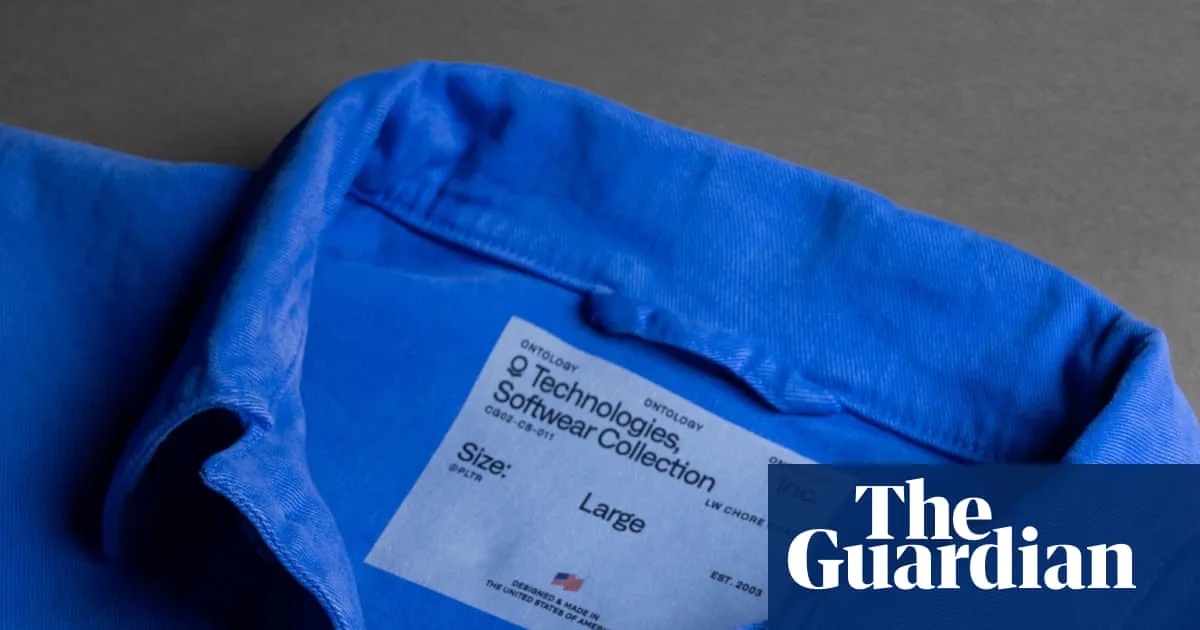
Last week, US spy tech and data firm Palantir launched its latest merchandise drop, including a denim chore coat. Priced at $239 (£175), the jacket is described on the website as offering "rugged utility, enduring style" and features the company's logo on the chest pocket, available in blue or black.

Eliano Younes, head of strategic engagement at Palantir, told the New York Times that the coat is part of the company's commitment to "re-industrializing America," as it is made in Montana and evokes workwear from a bygone era. "It's not political," he added. "It's about people who love Palantir and are aligned with our mission."

This mission includes aiding the Trump administration's deportation drive and Israel's devastating assault in Gaza, alongside publishing a militaristic manifesto. Nonetheless, all 420 jackets sold out within hours. There is no accounting for taste, it seems.

Wide Pickt banner — collaborative shopping lists app for Telegram, phone mockup with grocery list

The Rise of the Chore Coat

Once a niche garment, the durable French worker's jacket—and its variations, collectively known as chore coats—has become ubiquitous over the past two decades. Made from cotton twill or moleskin, it originated in France after World War I, when rapid industrialisation created a need for practical, durable workwear.

Chore coats have been embraced by fashion brands across the price spectrum and worn by celebrities like Monty Don and Harry Styles, moving far beyond their utilitarian roots. They have become a defining signifier of casually alternative taste, making them an appealing proxy for tech firms seeking to appear cool, fun, and tasteful. As one style commentator noted of Palantir's jackets, "they need cultural capital to be perceived as acceptable in the zeitgeist."

Other Tech Players in Fashion

Palantir is not alone. AI company Anthropic collaborated with Air Mail, a high-end digital newsletter, to host pop-ups at its newsstands in New York and London, offering "thinking" caps, coffee, and surprises. OpenAI sells gen-Z-adjacent long-sleeved T-shirts on a 90s-style online shop, capitalising on a tongue-in-cheek design trend that recalls a less corporate, more democratic internet.

Technocapitalists have been absorbing various industries for decades: bookstores, music, hotels, taxis, food delivery, even water. On Tuesday, five major US book publishers sued Meta, alleging it pirated millions of their works to train large language models. OpenAI, Anthropic, and Microsoft face similar copyright suits.

The Met Gala and Tech's Taste-Washing

At the Met Gala on Monday, Amazon co-founder Jeff Bezos and his wife Lauren Sánchez bought their way to the top table with a $10m donation. The fundraiser for the Metropolitan Museum of Art's Costume Institute raised a record $42m this year. Also attending were Meta's Mark Zuckerberg, Alphabet's Sergey Brin, and executives from TikTok, Instagram, Snap, and Slack. OpenAI, Meta, and Snap purchased tables for at least $350,000 each.

The fashion industry has always had a complex relationship with the super-rich; taste and refinement can be tempered by cash. But this year's Met Gala proved that taste has become a buzzword in Silicon Valley. Zuckerberg has made a public effort to cultivate personal style, wearing Bode shirts instead of hoodies. Months before the Met Gala, he sat in the front row at Prada's show during Milan Fashion Week.

According to Kyle Chayka in the New Yorker, tech bros are trying to give themselves a veneer of the artisanal, as if personal taste can give their companies an edge. "We might call what's going on now 'taste-washing,' an attempt to give anti-humanist technologies a veneer of liberal humanism," Chayka writes. This is often self-serving: tech and finance prognosticators tout their finely honed human instincts while happily automating everything around them.

A greater interest in fashion is not necessarily bad. Why should only celebrities or high-end customers be entitled to wear a chore coat? In a world of overwhelming automation, prioritising human discernment could be positive. However, when it comes to tech behemoths, there is a hunch that this leads to hoarding and optimising for financial benefit.

Pickt after-article banner — collaborative shopping lists app with family illustration

The Fleeting Nature of Tech's Taste Drive

Tech's drive for taste could be fleeting, much like the industry's quick abandonment of social justice when it no longer suited it. When the next fad arrives, matters of style and cool will continue in ways that cannot be optimised or defined solely by wealth. And, as a reminder, we do not have to buy what they are selling.

Bill Cunningham, the fashion and street style photographer who died in 2016, was a lifelong wearer of the classic blue chore coat. In the 2010 documentary Bill Cunningham: New York, he downplayed his own style but clearly had an eye for what looked interesting. He explained why he gravitated towards the jackets, which he discovered in Paris on street-sweepers: they were cheap, washable, functional, with three big pockets. "And I thought the colour was nice," he said.