

Starmer Must Harness UK's Scientific Stars to Drive Economic Growth
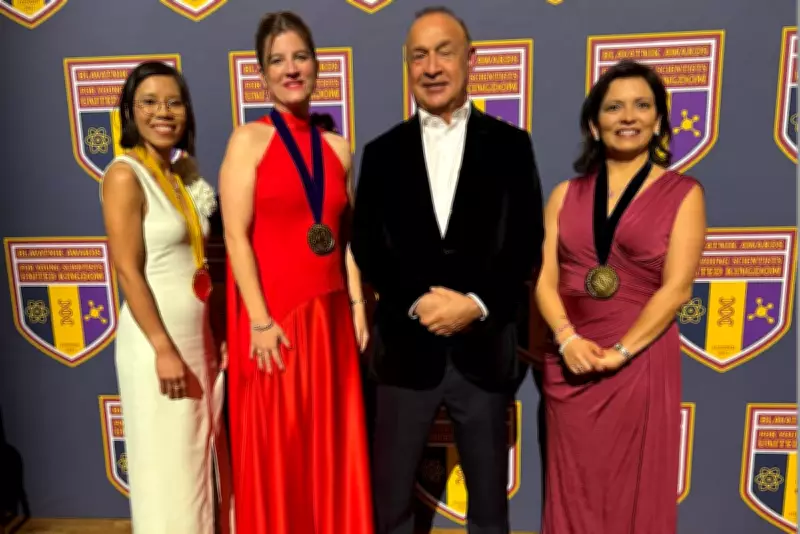
The brightest young British scientists were honoured with prestigious awards this week, prompting calls for Prime Minister Sir Keir Starmer and Chancellor Rachel Reeves to pay closer attention. The 2026 Blavatnik Awards for Young Scientists, held at the Banqueting House in Whitehall, offered a restorative and uplifting contrast to the political turmoil dominating headlines.
A Celebration of Scientific Excellence
While Donald Trump prepared his State of the Union address in Washington DC, and the Epstein scandal continued to unravel with implications for the monarchy, three brilliant female researchers stepped into the spotlight. Dr Maxie Roessler, Dr Thi Hoang Duong (Kelly) Nguyen, and Dr Paola Pinilla were named laureates of the awards, each receiving £100,000 – the UK's largest unrestricted science prize.
Now in their ninth year, the Blavatnik Awards recognise early-career breakthroughs with potential to transform scientific understanding and address global challenges. The awards are given to UK researchers under 42 years old across three categories: life sciences, chemical sciences, and physical sciences and engineering.

Groundbreaking Research with Real-World Impact
Dr Pinilla of University College London received her award for research that helps resolve how planets begin. By combining telescope observations with sophisticated modelling, she has pinpointed pressure points showing how planets emerge in young solar systems and how water and life-forming molecules take shape.
Dr Nguyen from the MRC Laboratory of Molecular Biology was recognised for groundbreaking work on telomerase, the enzyme protecting chromosome ends during cell division. Her team's modelling provides vital insights into ageing and cancer, making successful therapy more likely.
Professor Roessler of Imperial College London was honoured for pioneering research into electrons and how cells use them to power essential processes. To illustrate the scale: an electron is 100 billion times smaller than a grain of salt.
The Economic Imperative
Presenting the awards, Cambridge University Vice Chancellor Deborah Prentice said the winners provide "grounds for optimism about the future of this country," adding that "current plans for growth in the UK economy rest heavily on science and technology."
The awards' impact extends far beyond laboratories and classrooms. Professor Nicholas Dirks, president of the New York Academy of Sciences which administers the awards, revealed that past Blavatnik winners have founded 52 companies worldwide, collectively raising $2.8 billion in capital. In the UK alone, Blavatnik laureates have been behind two company formations.
Globally, the awards have led to six publicly listed companies with a combined market capitalisation of $24.7 billion. This demonstrates how science is vital for a healthy, expanding economy – sparking businesses that create jobs and wealth while making real differences.
Untapped Potential
As the government struggles with its growth agenda, experts argue it should look closely at these figures. Britain is not lagging in science – we have some of the world's leading institutions. The nation should play to these strengths and better support scientists in turning advancements into world-beating businesses.
It's a crying shame that more isn't being done to exploit this potential. Worse still, scientific research faces funding cuts despite its proven commercial possibilities. Beyond commerce, Blavatnik winners' discoveries deliver significant real-world impact. UK award recipients have secured more than 50 patents, while globally that number exceeds 900.
The Philanthropic Vision
The awards' namesake, 68-year-old Ukraine-born Sir Leonard Blavatnik, ranks as the 75th richest individual globally with an estimated $26.5 billion fortune. Unlike other oligarchs frequently criticised for materialism, Blavatnik has distinguished himself through philanthropy, donating heavily to Oxford University and giving more than £50 million to Tate Modern.
His generosity and determination to use his fortune well sets him apart. If more wealthy individuals followed suit, imagine how much better their cash could be spent – enhancing lives, improving health and safety, and benefiting the planet.

A Call to Action
The Blavatnik Awards event was refreshingly apolitical in the heart of Westminster's political firmament. Yet observers wished more politicians had attended – Starmer, Reeves, Science Minister Lord Vallance, Business Secretary Peter Kyle and their colleagues – to listen, pay heed, and be similarly inspired.
As a nation, we risk looking a proverbial gift horse in the mouth. The government must recognise that supporting scientific excellence isn't just about funding research – it's about creating an ecosystem where breakthroughs can flourish commercially, driving economic growth and solving global challenges simultaneously.





