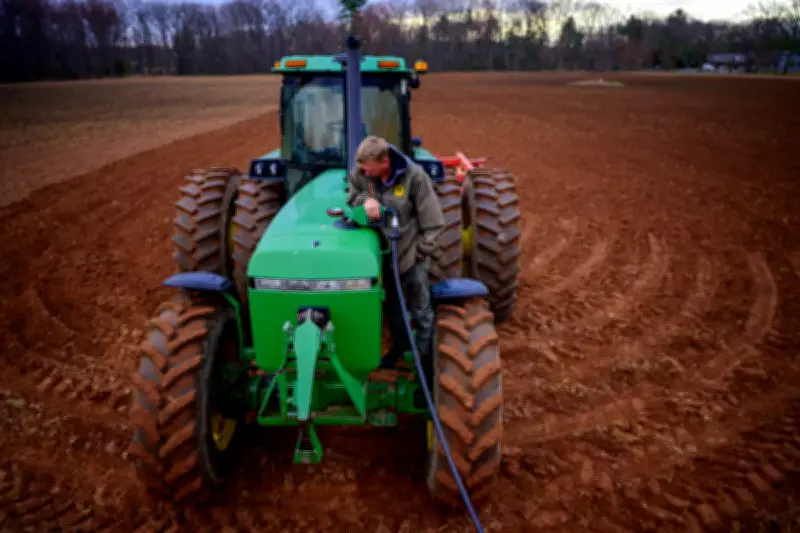
It has been a challenging few years for American farmers. Squeezed last year by tariffs, they lost an estimated $34.6 billion when former trade partners ceased purchases. Now, the war with Iran has depleted crucial fertilizer stores and driven diesel fuel prices to record highs. Like the trucking industry, agriculture relies heavily on diesel to run machinery, as diesel-powered engines are more fuel-efficient than gasoline ones.
The price increase is hitting during the spring planting season, compounding difficulties. Blake Gendebien, who owns a 1,200-acre dairy farm with 500 cows in Lisbon, New York, said: “These rising costs are hitting us at the wrong time here in the north country. I use 20,000 gallons of fuel to get my crops in the ground and harvested.” Last April, he paid about $2.65 a gallon for off-road diesel; this year, it is pushing $5 a gallon.
According to recent statistics, 86% of American farmers run small family farms, defined as having a gross income of $350,000 per year or less. The majority of these farms have high-risk profit margins of 10% or less. Rising diesel costs pose a serious threat to their ability to stay in business. “It is a massive cost for farmers that are already barely getting by,” Gendebien said.

No Choice but to Buy
Sam Frost, a fourth-generation farmer and CEO of Frost Livestock Company in Colorado, recently purchased diesel for the family farm without looking hard at the price. “I am still going to go buy fuel regardless,” he said. His hay production grosses about $200,000 annually, while his brother’s organic meat and vegetable operation adds another $100,000. They operate two diesel trucks and eight tractors across 425 acres.
On March 2, Frost paid $3.13 a gallon for on-road diesel and $3.08 for off-road diesel. Last month, off-road diesel jumped to $4.43 a gallon in his area. He would normally order twice as much diesel, but drought has delayed field preparation. To weather increased fuel costs, Frost is limiting other spending and may pass along some costs to consumers.
In northeastern North Carolina, cotton farmer Julius Tillery is changing his planting process to minimize diesel use. “I am very careful on my planting dates,” he said of his 125-acre farm, started by his great-great-grandfather in the early 20th century. “I can not afford to plant crops in bad climates, so the production window becomes smaller.” Before the price increase, he might have planted earlier; now, he lacks that margin. To save money, he is also fueling himself with lower-quality sustenance: “more ramen noodles.”
Harder for Farmers of Color
Small and Black-owned farms like Tillery’s are less able to rebound from price shocks. According to the 2022 Census of Agriculture, 55% of Black-operated farms earned less than $5,000 a year, compared to 41% of all farms. Only 12% made $100,000 or more. From 2017 to 2022, the number of all farmers fell by 4%, while Black-operated farms declined by 8%. Of 1.9 million farms, only 32,600 were Black-operated.
“The issue that most Black farmers have is our credit issues,” Tillery said, noting that relying on credit to buy fuel is not an option. Under the Biden administration, the USDA provided direct loans to only 36% of Black farmers who applied, compared to 72% of white farmers. The Trump administration has gone further, canceling a $300 million program designed to help Black farmers increase capital and prevent land loss, citing “discriminatory preferences based on diversity, equity and inclusion.”
John Boyd, founder and president of the National Black Farmers Association, raises Angus beef cattle and grows soybeans, corn, wheat, and hemp on 2,000 acres in Virginia. He watches his fuel gauges carefully to maximize efficiency, with diesel costing close to $6 a gallon. “A 100-horsepower tractor holds about 100 gallons of diesel fuel, and that is $600,” he said, enough for a day or day-and-a-half of planting. Rising fuel prices could be an economic last straw for farms already on the edge. “We have almost 200 pending Black farmer farm foreclosure notices,” Boyd said, adding that he has reached out to the Congressional Black Caucus without response.

What Could Help Now
Gendebien believes there is a large disconnect between rural America and Washington. “We do not have enough farmers in Congress,” he said. “We do not even have a Farm Bill.” (The House passed its version on April 30, and the Senate is expected to introduce its own.) That is why he is running for Congress against Elise Stefanik. “It would be so nice to have a congressman from the north country that understands the beginning of food production at the farm gate all the way to the dinner plate.”
In the absence of an end to the war, farmers have limited options. “One thing that we could do really quickly is end the tariff war,” Gendebien said. “We would rather make money on our own through fair trade, rather than have our friends and neighbors and their tax dollars have to help us.” Frost would like to see federal agencies that suffered mass layoffs rehire staff to help farms access resources like grants. The Natural Resource Conservation Service in Colorado Springs has been de-staffed for a year and a half, preventing site visits and reviews for a project to transition from irrigation ditches to gated pipe.
Despite these challenges, farmers remain determined. “I fell in love with the smell of the land,” Boyd said. “Farming is a sense of freedom. I ain not giving out, and I ain not giving up.”