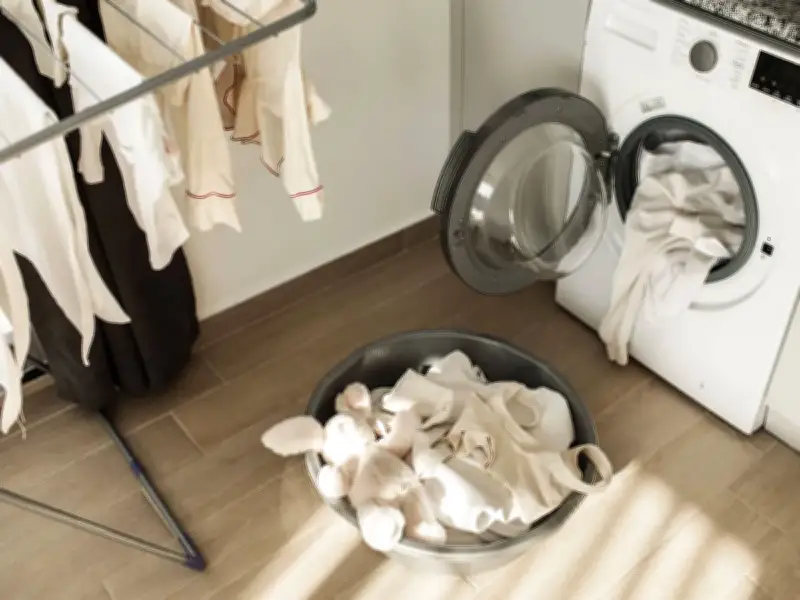
Drying laundry indoors this autumn and winter without a tumble dryer can fill a home with excess moisture, raising the risk of condensation, damp and mould. Experts have shared their top tips with Express.co.uk for households without access to a tumble dryer, and one method stands out as unbeatable: pairing a standard clothes airer with a dehumidifier.
While none of these methods may be as speedy as a tumble dryer, several techniques and appliances can dry clothes efficiently while keeping damp problems at bay.
Dehumidifiers are a game-changer
Dehumidifiers are not only highly effective at removing excess moisture from a home, particularly during winter, but they can also double as a makeshift dryer. This helps reduce the condensation produced by drying clothes indoors.
Max Wilson, co-founder of self-storage company Pocket Storage, said: "For households regularly drying washing indoors, I'd recommend an ordinary clothes airer paired with a dehumidifier, particularly if condensation is already a problem. It's a useful option in a flat where you don't have a garden or balcony and the washing can otherwise end up hanging around for days."
"When clothes dry, the water hasn't disappeared; it's gone into the air. A heated airer helps warm the washing, but that moisture still needs somewhere to go. A dehumidifier removes moisture from the surrounding air, helping the clothes dry without relying on the radiators."
Wilson advised following the manufacturer's guidance on positioning and operating temperature, leaving the air intake and outlet clear, and keeping wet washing from dripping onto the device. He also noted that homes still need ventilation, because a dehumidifier does not bring in fresh air.
Stephen Hankinson, energy expert at Electric Radiators Direct, agreed: "Drying your clothes indoors can increase humidity, which can lead to mould and dampness on walls. This is especially present in poorly ventilated spaces, like bedrooms, which can quickly become a breeding ground for mould if damp air isn't dealt with properly."
"To prevent moisture build-up, open a window, switch on an extractor fan, or use a dehumidifier when drying laundry indoors. A dehumidifier is a game changer, so I recommend investing in one this autumn and winter. It works by removing excess moisture from the air, helping your clothes dry faster and reducing the risk of damp or mould."
Scott Godfrey, a construction trade consultant at Black Hammer, argued that dehumidifiers are more effective than purpose-built heated airers because they combat condensation, which the latter do not. He said: "If you're regularly struggling to dry clothes during autumn and winter, I'd recommend using an ordinary clothes airer alongside a dehumidifier. I actually think this is a better option than a heated airer especially if condensation is already a problem."
"Drying clothes indoors can just make the air too damp, which then means that the water evaporates from your clothes much more slowly, but a dehumidifier tackles that problem by removing moisture from the surrounding air and allowing your clothes to dry more efficiently."
Godfrey recommended putting the airer in a relatively small room, spacing the clothes out properly, and positioning the dehumidifier nearby. He advised keeping the door and windows closed while it is running, and ensuring there is enough space around the dehumidifier for air to circulate.
Swap the radiator for a heated airer
For those looking for a more economical option, heated airers can help save considerably more on energy bills, explained Scott Byrom, home energy expert at The Energy Shop. He said: "If you're trying to avoid the cost of a tumble dryer and the damp risk of draping clothes over a radiator, the best solution is a heated airer paired with good ventilation."
"A heated airer is purpose-built for the job. It warms the clothes directly through heated bars, meaning it dries laundry far faster than a standard, unheated drying rack. It's also much safer and more efficient than using a radiator, because it doesn't block your central heating from warming the room."
On energy consumption, Byrom explained: "Compared to a tumble dryer, the savings are significant - a typical heated airer uses around 200 to 300 watts, meaning a four-hour drying cycle costs roughly 20p to 30p."
By contrast, a tumble dryer uses around 2,500 watts, so a single cycle can easily cost 70p to £1, depending on the tariff. Swapping the tumble dryer for a heated airer can save over £50 across the autumn and winter months if several loads are done a week.
Consider a drying pod
For those on the lookout for another budget-friendly alternative, a drying pod offers a lower-power option to the traditional tumble dryer. Ian Palmer-Smith, appliance repair expert at Domestic & General, said: "The main appeal of using tumble dryer alternatives like heated airers and dryer pods is the lower running costs. Heated airers usually use between two and 26 pence per hour, whereas a tumble dryer can cost you closer to 75p per hour."
"Although you'd probably have to use a heater airer or drying pod for longer at a time, it would likely still cost you much less overall than a tumble dryer load. Drying pods are also gentler on your clothes, with less risk of shrinkage and damage to delicate fabrics and sportswear."
Additionally, airers are compact and portable, meaning they can be used more flexibly, placed in rooms with more radiators and airflow, making them adaptable to the colder months. Palmer-Smith also warned: "However, it's important to make sure that a heated airer or drying pod is safe and not at risk of overheating. Don't use them in small, enclosed rooms with little ventilation as excess heat and humidity can increase this risk. Remember to follow the manufacturer's guidance and regularly inspect that the product is working."