
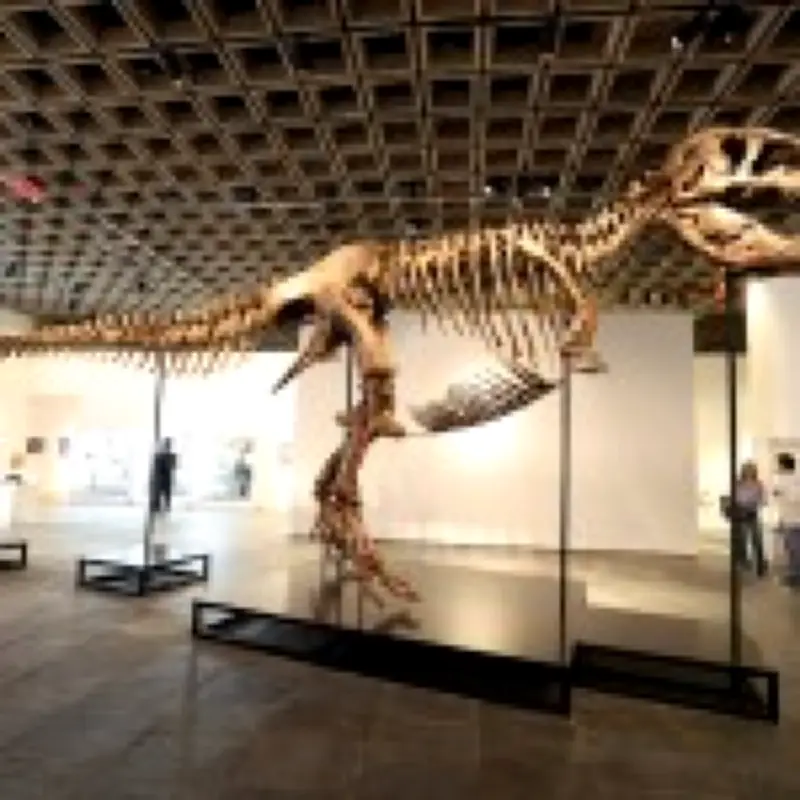
A near-complete Tyrannosaurus Rex fossil named Gus will go under the hammer at Sotheby's in New York, with a minimum starting bid of $19 million and an expected sale price of up to $30 million (approximately £22.5 million). The auction house describes Gus as one of the largest and most complete T Rex specimens ever found, comprising 183 bone parts.
Discovery and Assembly
The dinosaur roamed what is now Harding County in northwest South Dakota some 67 million years ago. The skeleton, measuring 38 feet long and 12.5 feet tall, was discovered in 2021 when a metatarsal from its foot was spotted protruding from the ground by ranch-owner Gary "Gus" Licking and his wife, Dana. Texas-based company Theropoda Expeditions named the fossil after Gary, who died at age 67 in 2022 during the excavation process.
Cassandra Hatton, worldwide head of Sotheby's Science & Natural History division, stated in a company video: "Gary had for years roamed around his 6,500 acre property and seeing T Rex teeth and little bits of fossils and such and he realised that there was probably something really important under the ground." She added that it took two years to assemble the ancient creature, mounting it in a predatory pose held up by rods above a steel platform.
Scientific Significance
The listing notes: "Judging from the overall size and degree of bone development, it can be determined that Gus' skeleton belonged to a very large, robust, adult individual." Some bones show signs of fractures and healing, suggesting another T Rex bit into Gus. The fossil was found in the Hell Creek Formation, which stretches across South Dakota, Montana, North Dakota, and Wyoming, an area rich in dinosaur bones.
Dana Licking expressed gratitude that the team assembled Gus, noting the giant reptile could have been "lost" forever. "To make it come to life takes a lot of love and care and dedication, and they stopped at nothing to make that happen," she added. Thomas Heitkamp, president of Theropoda Expeditions, said his team camped on Gary and Dana's property for five months each year, describing the challenge: "You're dealing with material that has been a part of the earth for a very, very long time and it has no interest in cooperating – it wants to stay there."
Criticism from Paleontologists
This auction follows a trend of high-profile dinosaur fossil sales. Sotheby's sold Sue the T Rex in 1997 for $8.4 million. Apex the stegosaurus became the most expensive dinosaur fossil ever sold at auction, fetching $44.6 million in 2024 when it was expected to sell for just $4 million. The winning bidder was hedge fund billionaire Kenneth Griffin. Another T Rex nicknamed Stan sold for a record $31.8 million in 2020.
However, paleontologists and museum curators have criticised the commercialization of fossils, arguing that science is being priced out. Professor Susannah Maidment, a researcher at the Natural History Museum in London, told Metro: "Dinosaur specimens are extremely rare and all are scientifically important because we have so few of them. Yet they are increasingly being sold like pieces of art to private individuals who often consider them as assets rather than natural heritage." She warned that fossils sold privately may be lost to science, as they could be resold or destroyed. "Amateur and commercial palaeontologists deserve to be recompensed for their work in finding, excavating and preparing fossils, but a valuation of $50 million is profiteering off natural heritage that should be available for everybody to see, not locked away in a rich person's house," Maidment added.
Ongoing Discoveries
Scientists continue to learn about T Rex. Recent research suggests the dinosaur's dagger-toothed mouth was covered by plump lips, and it may have had fluffy feathers rather than scales. Additionally, the T Rex likely walked on its tiptoes, contrary to earlier depictions of heavy-footed steps. The auction of Gus highlights the tension between commercial fossil sales and scientific preservation.




