
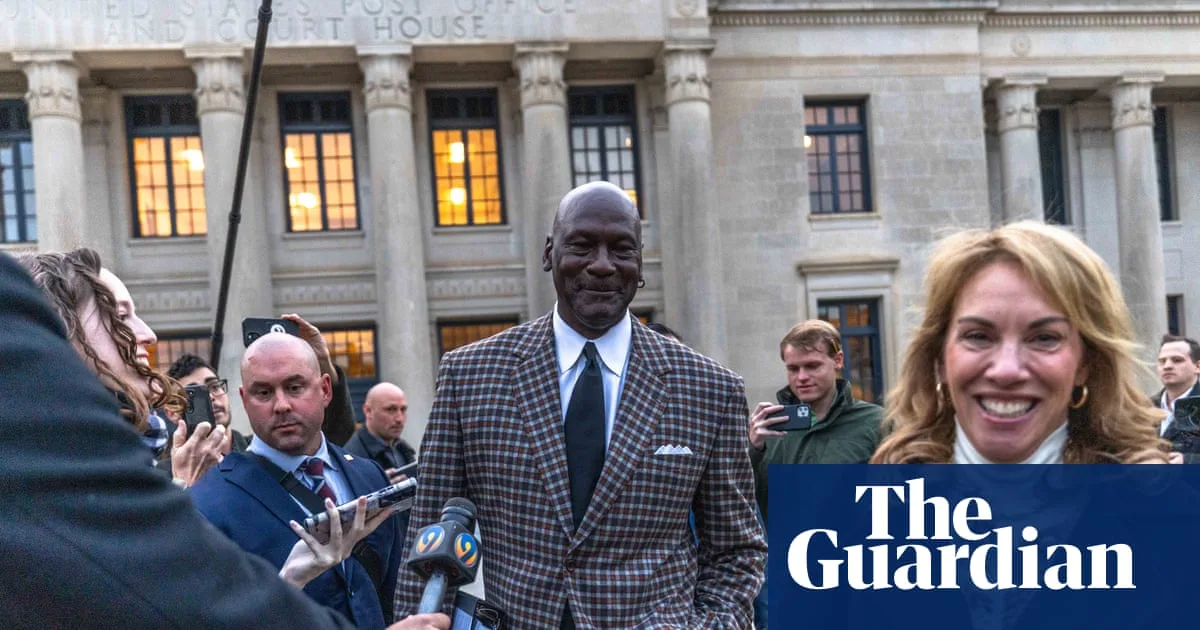
Michael Jordan testified in a federal courtroom in Charlotte on Friday that his competitive drive and status as a newcomer to Nascar prompted him to challenge the stock-car racing organisation over alleged antitrust violations. Introducing himself as Michael Jeffrey Jordan, the NBA legend said he invested $40m of his own money into 23XI Racing, the Cup series team he co-owns with business partner Curtis Polk and former driver Denny Hamlin.
“Someone had to step forward,” Jordan said. “I was a new person, I wasn’t afraid. I felt I could challenge Nascar as a whole. I felt as far as the sport, it needed to be looked at from a different view.”
The trial centres on the expiration of a 2016 agreement that granted Nascar teams “charters”, a system similar to franchises in other professional sports. Nascar demanded charter membership renewals when the agreement expired in 2024. Jordan’s 23XI Racing and Front Row Motorsports refused to sign the 112-page document, while the other 13 organisations agreed to the terms.
Jordan said he and Hamlin sought to discuss possible changes or extensions with Nascar, but the organisation was not open to negotiation. He also revealed he purchased a third charter in late 2024 for $28m. “Denny convinced me getting a third driver improved our chances to win,” he said. “So I dove in.”
Heather Gibbs, daughter-in-law of Joe Gibbs, testified earlier about a frantic six-hour period in September 2024 when teams were told to sign the charter extension. She said Joe Gibbs tried to call Nascar to appeal against the demand, but chief executive Jim France refused. Quoting Gibbs's plea, she said France replied: “If I wake up and I have 20 charters, I have 20. If I have 30, I have 30.”




